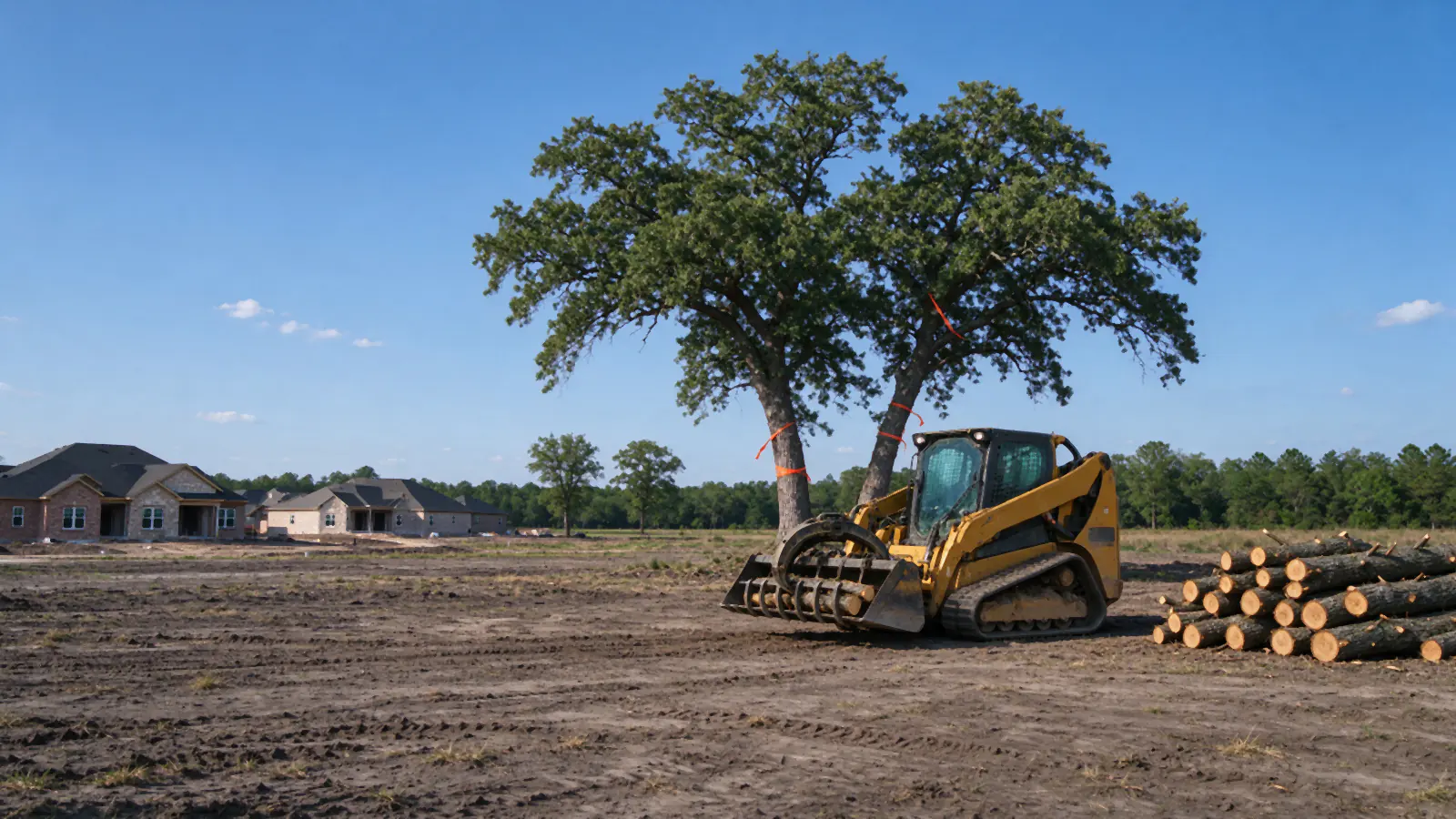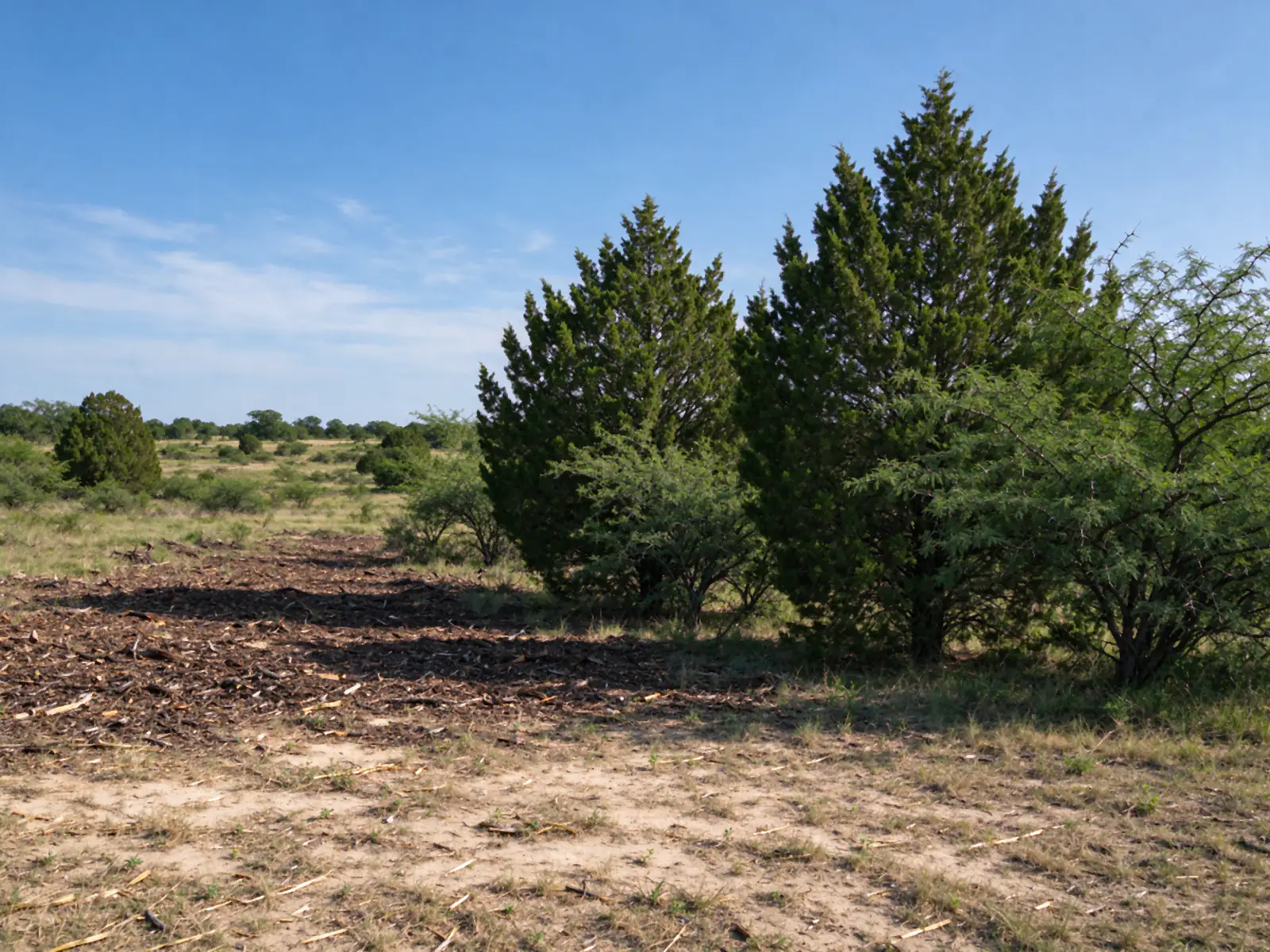
Land clearing around Denton typically runs about $1,500 to $3,500 an acre for light brush, $2,500 to $4,500 for moderate brush with small trees and $3,500 to $6,500 or more for heavy woods, before city permits, tree mitigation and haul-off, which are priced separately. Post Oak Land Clearing Denton publishes these ranges so you can size a job before anyone walks it.
The rest of this page breaks those numbers apart: what moves an acre up or down, which parts of a Denton price come from a public fee schedule, and which parts nobody can price until the ground has been seen. For a quick number on your own acreage, the land clearing cost calculator applies the same ranges.
Typical per-acre ranges around Denton
These are typical ranges for Denton-area and wider North Texas projects. They are budgeting ranges, not quotes, and they assume a machine can reach the work.
| Work | What the ground looks like | Typical range |
|---|---|---|
| Land clearing, light | Brush, briars and saplings, few trees over a few inches | $1,500 to $3,500 an acre |
| Land clearing, moderate | Mixed brush with trees up to about 8 inches across | $2,500 to $4,500 an acre |
| Land clearing, heavy | Dense cedar or hardwoods, larger trees | $3,500 to $6,500 or more an acre |
| Forestry mulching | Light to moderate growth, mulch left in place | $1,400 to $3,500 an acre |
| Brush hogging | Pasture grass and light brush shredded | about $40 an acre (Texas A&M AgriLife custom rate survey, East region) |
The brush hogging figure is an average from the Texas A&M AgriLife Extension custom rate survey for the East region, which includes Denton County. It describes shredding open pasture, not cutting through saplings on an overgrown lot; once there are woody stems thicker than a mower deck can take, the job is brush clearing and prices like it.
Stump grinding has no published range here. Its price turns on stump diameter, how many there are and whether the grindings are hauled, so it is priced per job on the stump grinding and removal page.
Public benchmarks you can check yourself
Two public sources show where machine work sits when the ground is open and easy to reach.
- TxDOT roadside brush removal. A Texas Department of Transportation contract for 33 acres of brush removal along roadways in Denton County drew bids of $1,360 to $2,000 an acre, with a low bid of $1,590. Highway right-of-way is large, open and reachable from the pavement, so it is a floor for big open brush, not a homeowner rate. Dense brush on a private lot usually costs more per acre.
- AgriLife dozer rates. The same AgriLife survey puts bulldozer land clearing at an average of about $159 an hour for machines under 160 horsepower and $207 an hour for larger ones. Those are hourly machine rates; how many hours an acre takes depends on the ground, which is why no honest per-acre number falls straight out of them.
What moves the price of an acre
Two acres can sit next to each other and price very differently. Each driver below changes either how fast a machine works or how much work follows it.
| Driver | Why it moves the price | Where it shows up around Denton |
|---|---|---|
| Acreage | Mobilization and setup spread over more acres, so the per-acre price falls as size rises | A half-acre backyard carries a full machine move |
| Vegetation density | More stems per acre means slower passes and more material | Cedar clearing in redcedar thickets; privet along creeks |
| Tree diameter | Larger trunks take longer to mulch or fell and leave bigger stumps | Post oaks and cedar elms on Cross Timbers lots |
| Stump and root volume | Pulling and grubbing roots is extra machine work and extra debris | Building pads, driveways and pond sites cleared by clearing and grubbing |
| Terrain and slope | Slopes slow machines and raise erosion work afterward | Creek banks and draws |
| Wet ground | Saturated clay ruts, so crews wait or switch to lighter machines | Sanger and Slidell clays west and north of Denton |
| Rock | Rock wears mulcher teeth and slows grinding | Gravelly loams on some upland tracts |
| Hidden debris | Wire, old fence, concrete and dumped trash stop machines | Old farmsteads and fence rows |
| Machine access | Narrow gates and backyards limit machine size | In-town lots behind fences |
| Distance to disposal and hauling | Every load adds truck time and a tipping fee | Haul-off to the City of Denton Landfill |
| Whether mulch stays | Leaving mulch on site avoids loading and tipping entirely | Pasture and wooded acreage |
| Burning rules | Where burning is not allowed, debris has to be mulched or hauled | No open burning inside Denton city limits |
| Erosion control | Silt fence and cover add material and labor | Any job that bares an acre or more of soil; see erosion control |
| Selective-tree protection | Fencing and working around keepers slows the job | Heritage post oaks inside the city, kept by selective clearing |
| Utility conflicts | Lines overhead and underground force handwork or utility coordination | Easement clearing and road frontage |
| Follow-on grubbing or earthwork | Grading and pad prep are separate scopes after clearing | Land clearing and grading jobs |
| Mobilization of large equipment | Trailering a large machine costs the same for one acre or twenty | Every job, felt most on small ones |
The method you choose sits under most of these. Mulching in place skips hauling and keeps soil covered; clearing and grubbing removes stumps and roots for a building pad but creates debris and bare ground that both cost money to deal with.
What’s inside a Denton land clearing price
A quote is a bundle. Some pieces have a public number from an agency; others depend on the ground and have to be checked on a walk. This table splits them.
| Part of the price | What sets it | Local figure |
|---|---|---|
| Machine time | Machine type and size, hours on site, density | Dozer clearing averages about $159 an hour under 160 hp and $207 over 160 hp (Texas A&M AgriLife custom rate survey, East region). No public rate exists for forestry mulchers. |
| Equipment operator wages | Local labor market | Operating engineers and other construction equipment operators earn a mean $26.51 an hour in the Dallas-Fort Worth metro, about 83% of the $31.87 U.S. mean (BLS OEWS) |
| Tree crew and ground labor | Local labor market | Tree trimmers and pruners: $20.40 an hour metro mean vs $26.91 U.S. (about 76%). Construction laborers: $21.05 vs $25.02 (about 84%) (BLS OEWS) |
| Haul-off trucking | Loads, distance, driver time | Heavy and tractor-trailer truck drivers: $30.16 an hour metro mean vs $28.71 U.S. (about 105%) (BLS OEWS) |
| Tipping | Tons, piece length, customer status | Brush at the City of Denton Landfill: $30 a ton for pieces up to 12 feet from a Denton customer, $35 over 12 feet, $40 for non-Denton customers; $26.50 minimum a load |
| City clearing permit | Any machine clearing inside Denton city limits beyond a small exemption | Clearing and grading permit $453 (City of Denton) |
| Tree removal permit | Protected trees on regulated land | $425, plus mitigation where it applies (City of Denton) |
| Tree mitigation | Protected inches removed beyond what the plan preserves or replants | $200 per caliper inch paid in lieu (City of Denton) |
| Stormwater coverage | An acre or more of disturbed soil | Covered by the TCEQ construction general permit; at 5 acres or more the Notice of Intent fee is $225 filed electronically or $325 on paper |
| Silt fence | Feet of downhill edge to protect | $3.40 to $5.00 a foot installed in Denton County TxDOT bids; short runs on one lot can cost more per foot |
| Mobilization | Machine size, trailer, distance | No public figure: scope to check on the quote |
| Stump grinding or pulling | Stump count and diameter | No public figure: scope to check |
| Grading, seeding and cover | Finish level you need | No public figure: scope to check |
| Fence, drive or turf repair | Access damage and what has to be put back | No public figure: scope to check |
A wage is not a billing rate: the hourly price on a quote also carries the machine, its fuel and wear, the trailer and truck, insurance and overhead. That is also why the wage figures above do not explain a Denton premium. Equipment operators and tree crews in the Dallas-Fort Worth metro earn less than the national mean, so where a Denton job costs more, the reason is the machine day, the move to the site, the debris and the city’s rules, not labor.
Permit and filing fees that can apply
Which of these you pay depends on where the land sits. Denton city limits, the ETJ, unincorporated county and each nearby town have different rules, which the Denton tree removal permit guide and the clearing land in Denton cornerstone walk through.
| Fee | Charged by | When it applies | Amount |
|---|---|---|---|
| Clearing and grading permit | City of Denton | Clearing, grading or grubbing in city limits beyond 2,000 sq ft or 25 cubic yards | $453 |
| Tree removal permit | City of Denton | Removing protected trees on regulated land | $425 |
| Working without a permit | City of Denton | Work started before the permit | $453 |
| Tree mitigation, in lieu | City of Denton | Protected inches not preserved or replanted | $200 per caliper inch |
| Tree preservation plan review | City of Denton | Development sites, by tree count | $5,857 to $15,807 |
| ESA assessment | City of Denton | Land disturbance in a mapped Environmentally Sensitive Area | $1,118 |
| Grading, drainage and erosion control permit | Town of Argyle | Residential grading work | $200 |
| Tree payment in lieu | Town of Argyle | Protected trees removed and not replaced | $350 per caliper inch |
| Early grading | City of Sanger | Grading before construction plans are approved | $400 |
| Stormwater Notice of Intent | TCEQ | 5 acres or more disturbed | $225 electronic, $325 paper |
Justin requires a city permit for any dirt work or earth disturbance, and Krum requires a land development permit for clearing and grubbing; their fees are confirmed per address. In unincorporated Denton County, plain brush clearing outside a floodplain does not appear on the county’s development permit list, while digging, fill and culverts in a flood zone do. The Justin, Argyle and Sanger pages cover each town’s rules in more depth.
Incentives and cost-share that can offset part of the bill
None of these pay for clearing a homesite. They fund conservation, wildfire fuel reduction and invasive plant removal, each with its own eligibility.
| Program | Run by | What it can cover | Who qualifies | When to apply |
|---|---|---|---|---|
| EQIP Brush Management | USDA NRCS | A per-acre cost-share payment for brush management, set by practice and canopy cover in the current Texas payment schedule | Agricultural producers and non-industrial private forest owners with a resource concern; homesite and development clearing do not qualify | Applications are taken year-round, with a fall ranking date each year; check the local USDA Service Center for the current date |
| Mechanical Fuel Reduction grant | Texas A&M Forest Service | Reimbursement up to $750 an acre hand-cut, $1,500 combined, $2,000 with heavy equipment such as a mulcher; up to $20,000 per landowner | Landowners in the program’s eligible area creating defensible space or fuel breaks around homes; confirm Denton County eligibility for the next cycle | An annual online window, usually early summer |
| Texas Invasive Plant Solutions | Texas A&M Forest Service | 75% of treatment or removal costs, up to $7,000 per landowner | Non-native invasive plants such as Chinese privet; native redcedar is unlikely to qualify | Opens in early fall and runs until funds are used |
| Landowner Incentive Program | Texas Parks and Wildlife Department | 50% to 75% of project cost for selective brush management and habitat work | Private landowners with a project a TPWD biologist helps plan | Periodic requests for proposals; check whether one is open |
The Forest Service grant has conditions that change how the work is done: a pre-inspection before any work, a hired contractor not affiliated with the landowner, and no burning of any kind. EQIP payments are set to cover part of the cost, not all of it. If cost-share matters to the plan, raise it before the quote so the method and paperwork match the program. The pasture clearing page covers how brush management fits a grazing plan.
Illustrative example budgets
These examples are illustrative only. They multiply the typical ranges above by acreage and add only public fees; they are not quotes, and a site walk can move any of them.
Five acres of light brush in pasture, mulched in place. At $1,400 to $3,500 an acre for forestry mulching, five acres works out to $7,000 to $17,500. Nothing is hauled, so there is no tipping, and an agricultural tract outside city limits may need no city permit at all.
Three acres of moderate brush and small trees in the ETJ, cleared and hauled. At $2,500 to $4,500 an acre, the clearing comes to $7,500 to $13,500. Haul-off is extra: brush tipped at the City of Denton Landfill costs $40 a ton as a non-Denton customer, and the tonnage depends on the stand, so it is priced after the walk.
One wooded acre inside Denton city limits for a house. Heavy woods at $3,500 to $6,500 or more an acre sets the clearing. Add the $453 clearing and grading permit and the $425 tree removal permit, $878 together, then mitigation at $200 for every caliper inch the tree plan leaves owed, so 10 inches owed adds $2,000. If the lot needs 400 feet of silt fence, the TxDOT Denton County bid range of $3.40 to $5.00 a foot puts that at $1,360 to $2,000, and a single lot can run higher per foot. Stump grinding and pad grading are separate scopes on top. The clearing land to build a house guide follows that sequence step by step.
Why small lots cost more per acre
A half-acre lot rarely costs half of a one-acre price. The machine has to be loaded, trailered, unloaded and set up whether it works for two hours or two days, so small jobs are priced around a machine day. Divide one day of work across a quarter acre and the per-acre figure climbs well past the ranges above, even though the total is modest.
NRCS shows the same shape in its own cost estimates. Its Texas scenario for mechanical brush management on one acre or less carries $211.29 of mobilization in a $536.11 per-acre estimate, while its 120-acre scenarios carry $2.92 an acre. Those are agency rate-setting estimates, not market prices, but the pattern holds on private jobs too: mobilization is a fixed cost, and acreage is what spreads it.
Small in-town jobs add their own friction. Backyard gates limit machine size, fences and utilities slow the work, and debris usually has to leave the site because burning is not allowed inside Denton. The overgrown lot clearing page covers those jobs, and the City of Denton’s curbside service takes up to 4 cubic yards of brush a week at no extra charge, which handles a weekend’s trimming but not a cleared lot.
Get a price for your acreage
Send the acreage, a few photos and what you want the land for.
How to get a firm number
A range turns into a price once someone has seen the ground. The fastest route is to send the address, the rough acreage, photos from a few corners, the gate width and a plain note of what you want: a pad, a pasture, a cleared fence line or woods you can walk through. Say which trees should stay and whether mulch can remain on the ground, because those two answers change the method more than anything else.
A good quote names the method, the finish level, what happens to the debris, how stumps are handled, which permits are included and what is excluded. The what a land clearing quote should include guide has a checklist for comparing two bids line by line, and timber value is covered separately because it rarely offsets a clearing bill around Denton. For time on site, see how long land clearing takes.
Post Oak Land Clearing Denton offers and manages land clearing across Denton and the west and north of Denton County, with the work done by licensed and insured contractors. Call (940) 204-6191 or request an estimate with your acreage and photos.