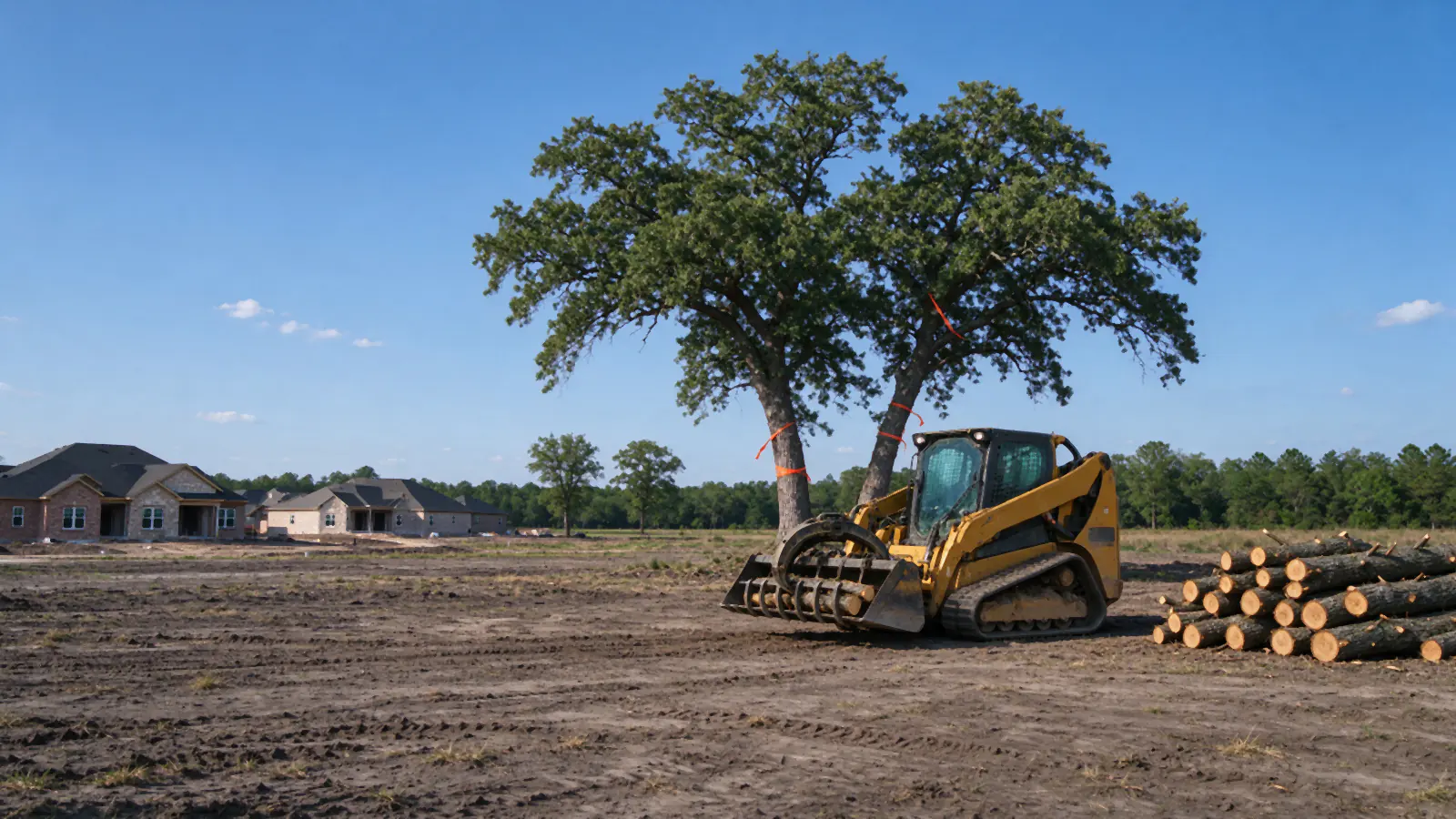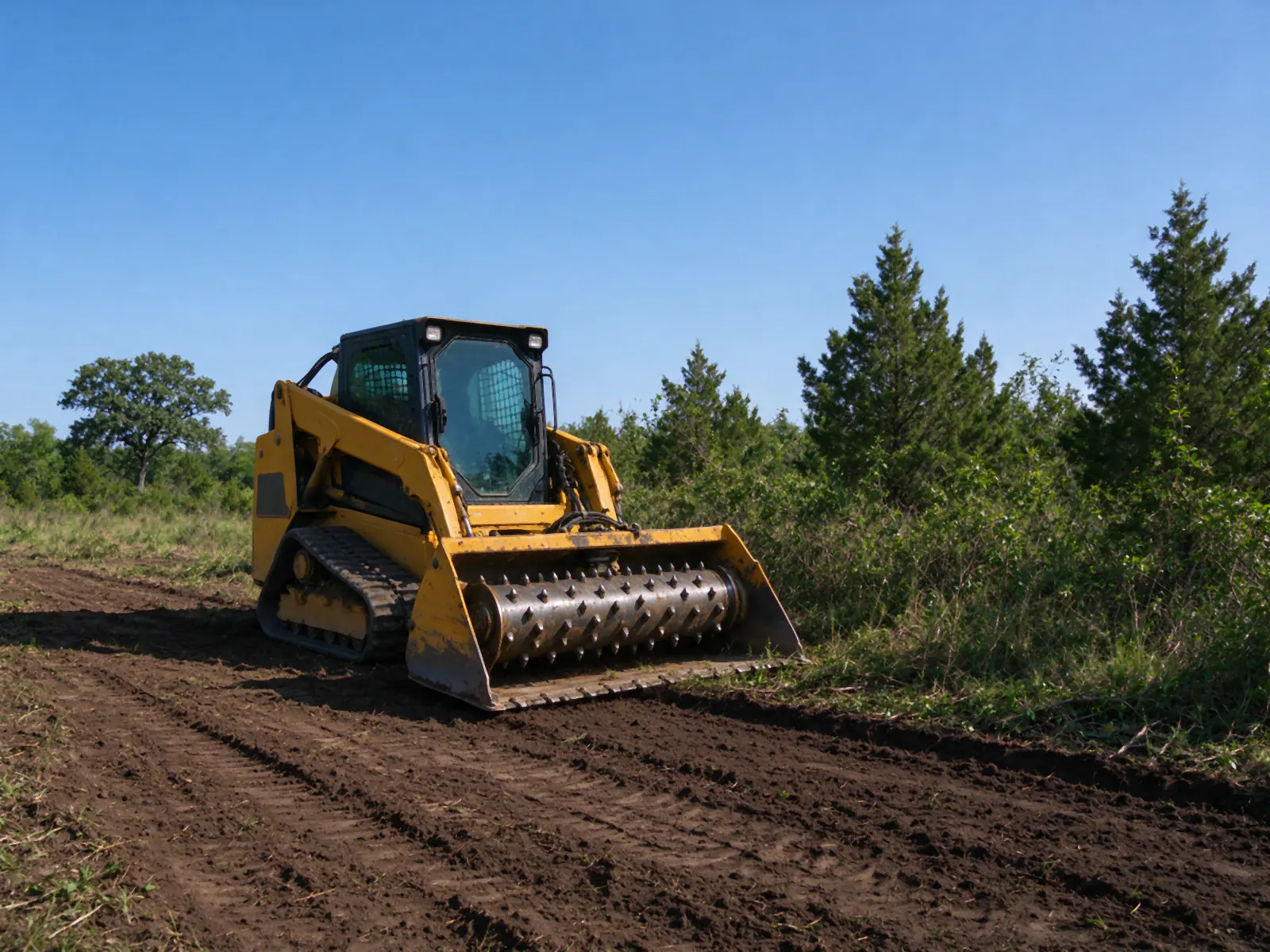
How long it takes to clear an acre of land depends on what is growing, what has to happen to the stumps and debris, and how firm the ground is. Light brush on dry, open ground goes quickly; dense cedar or hardwoods with stumps to pull take far longer. Around Denton, the permits, locates and weather around the job often take more time than the clearing itself. Post Oak Land Clearing Denton plans both parts.
That is why nobody honest publishes an “hours per acre” figure. The rest of this guide explains what stretches or shortens machine time, which steps sit on the calendar before a machine can start, and what you can do to keep a job moving. For the money side of the same questions, see the land clearing cost per acre guide.
What sets machine time on an acre
Machine time is the hours a mulcher, dozer or excavator actually works the ground. It is the part people picture when they ask how long clearing takes, and it moves with a handful of physical facts about the acre.
How much wood is standing
Stem count and stem size matter more than acreage. A mulching head walks through briars, saplings and young cedar in steady passes, but every extra inch of trunk diameter means more wood to grind. A thicket of eastern redcedar carries far more material per acre than scattered brush, even though each cedar grinds easily, so production drops and the mulch layer gets deeper. Post oaks, cedar elms and hackberries, the trees most common on Denton land, are hardwoods; once they pass mid-size, they are usually felled and handled rather than ground standing.
Whether stumps and roots come out
Leaving stumps at grade is one pass. Pulling them is another job entirely: each stump is dug or pushed out with its root ball, shaken clean, moved and stacked or loaded. Clearing and grubbing for a house pad, drive or pond therefore takes more time per acre than mulching the same growth, and grubbing deeper than 16 inches also needs its locate ticket in place first. On a pasture or trail, where roots can stay and hold the soil, that extra time is often unnecessary.
Where the debris goes
Debris handling is often the hidden half of the schedule. Mulched material stays where it falls. Hauled material has to be cut to length, loaded with a grapple, trucked and tipped, and each truck round trip to the City of Denton Landfill on South Mayhill Road adds drive time. Burning, where it is allowed at all, ties the job to the county’s daily burn-day call and to attended burning hours. The debris removal page covers haul-off in detail.
Hidden debris, keepers and edges
Old barbed wire, T-posts, buried concrete and dumped trash stop a mulcher cold, because teeth that hit steel or rock break. Fence rows and old farmsteads are where they hide, and they usually have to be found and pulled by hand. Trees marked to stay slow the work too: machines keep out of root zones, so the edges around each keeper are worked carefully or by hand. Selective clearing trades some speed for the trees you want.
Access and ground
A backyard behind a narrow gate limits the machine to what fits, and a smaller machine covers less ground in an hour. Slopes along creeks and draws slow every pass. Wet ground can stop the job outright, which the weather section below explains.
How the method changes the clock
The method is chosen for the finish you need, not for speed, but it does decide how many separate operations an acre gets. The forestry mulching vs land clearing guide compares the two main methods in depth.
| Method | Operations on the acre | What usually slows it |
|---|---|---|
| Forestry mulching | One: cut and grind in place | Dense cedar, larger hardwoods, rock, hidden wire |
| Brush clearing | Cut or mulch brush, then deal with the cut material | Volume of brush to move if it is not mulched |
| Clearing and grubbing | Fell or push trees, pull stumps and roots, stack or load debris | Stump count and size, haul distance, soft ground |
| Selective clearing | Mark keepers, clear around them, finish edges | Number of keepers and how tight the spacing is |
| Brush hogging | One: shred grass and light brush | Saplings too thick for the deck |
Many jobs combine methods. A homesite might be mulched across most of the acreage, then grubbed only where the house, drive and septic field will go. That is usually faster than grubbing everything, and it leaves fewer acres of bare clay to protect afterward.
The calendar around the clearing
On many Denton-area jobs, the days before the machine arrives are longer than the days it works. These steps run in sequence, and skipping one can stop a job once it has started.
| Step | When it applies | Lead time or rule |
|---|---|---|
| Clearing and grading permit | Inside Denton city limits, beyond 2,000 sq ft or 25 cubic yards of disturbance | Permit before work; it runs one year once issued |
| Tree removal permit | Protected trees on regulated land in Denton | Tree protection fencing must pass inspection before the permit is issued |
| Town permits | Justin requires a permit for any dirt work; Krum for clearing and grubbing; Sanger for early grading | Each town’s review time is confirmed per address |
| 811 locate | Any machine work 16 inches deep or more (grubbing, root raking, grading, deep stump grinding) | Called no earlier than 14 days and no later than 48 hours before digging, excluding weekends and legal holidays (Texas Utilities Code ch. 251) |
| Line operator notice | Work that could bring a person, machine or tree within 6 feet of a high-voltage line | At least 48 hours’ notice and an agreed safety arrangement first (Texas Health and Safety Code ch. 752) |
| Stormwater plan | An acre or more of disturbed soil | TCEQ construction permit coverage and a stormwater pollution prevention plan before disturbance |
| Burn day | Burning in unincorporated Denton County, only where no practical alternative exists | Decided each morning between 8 and 9 a.m.; call 940-349-2840 |
Permits and locates can run in parallel with scheduling, which is why it helps to start them early. The Denton tree removal permit guide walks through the city’s steps, and lines over the work area are covered in clearing near power lines.
Weather on Denton clay
Rain is the most common reason a scheduled clearing day moves. NOAA’s 1991 to 2020 normals for Denton Municipal Airport show about 35.6 inches of rain a year, with 22.2 days a year bringing half an inch or more. May, at 4.52 inches, and October, at 4.17, are the wettest months, with about 3.0 and 2.6 of those heavier rain days respectively. July, at 1.77 inches, is the driest.
The soil decides how much that rain matters. West and north of Denton, around Krum, Sanger, Ponder and Justin, the ground is mostly Sanger and Slidell clay: hydrologic group D soils that drain slowly and swell when wet. A tracked machine on saturated clay leaves ruts that dry into hard ridges, compacts the soil and mixes mulch into mud, so the usual answer after a soaking rain is to wait. A week of dry weather usually firms the ground enough to work, though creek bottoms stay soft longer. The sandier Cross Timbers soils toward Argyle dry faster but wash quickly once bare.
Midsummer brings firm ground but also the heaviest odds of a drought burn ban, which matters only if the plan relied on burning. The when to clear land in North Texas guide goes month by month.
Why small and large jobs scale differently
A machine has to be loaded, trailered, unloaded and set up whether it works two hours or two weeks. On a quarter-acre backyard, that setup can be a large share of the time on site; on a 20-acre tract it disappears into the total. That is also why small lots are priced around a machine day rather than strictly by the acre.
Large tracts gain efficiency from long, uninterrupted passes, but they add their own steps: more debris to stage, more silt fence along downhill edges, often two machines working in sequence, and, past 5 acres of disturbed soil, a TCEQ Notice of Intent rather than just an on-site plan. Overgrown lot clearing covers the small in-town jobs, and commercial land clearing the large ones.
How hourly rates fit in
Time and cost meet in the hourly rate. The Texas A&M AgriLife Extension custom rate survey for the East region, which includes Denton County, puts bulldozer land clearing at an average of about $159 an hour for machines under 160 horsepower and $207 an hour for larger ones. Those are farm-and-ranch custom hire rates for machine time, not quotes for a lot, and they describe what an hour costs, not how many hours an acre needs.
The missing piece is exactly the thing this guide describes: hours depend on the acre. That is the reason an hourly or day rate puts the risk of slow ground on you, while a per-acre or project price shifts it to the contractor, who prices it in. A good quote says which basis it uses and what happens if the ground turns out slower than expected; the what a land clearing quote should include guide has the checklist.
How to keep a clearing job moving
Most delays come from things that could have been known before the machine arrived. A few steps on your side shorten the calendar and the time on site.
- Know your lines. Find the survey pins or have the boundary staked, so the limits are not decided with a machine running.
- Flag what stays. Mark keeper trees, fences, wells, septic lids and anything else that must not be hit.
- Name the junk. Tell the contractor about old fences, wire, buried concrete or dumped debris you know of; they are the most common surprise.
- Measure the gate. Gate width and any soft spots on the way in decide which machine can reach the work.
- Decide on the debris. Mulch left in place, haul-off or a mix: the answer changes the schedule more than anything else.
- Start the paperwork early. Permits and fencing inspections inside Denton, town permits in Justin, Krum or Sanger, and an 811 ticket for any deep work.
When the clearing is the first step of a build, the order matters too: survey, tree plan, permits, protection fencing, clearing, grubbing of the structural areas, erosion control, then the handoff to grading. The clearing land to build a house guide follows that sequence.
Post Oak Land Clearing Denton offers and manages lot clearing and acreage work across Denton and the west and north of Denton County, with the work done by licensed and insured contractors. For a schedule that fits your ground: Call (940) 204-6191 or request an estimate with the address, rough acreage and a few photos.
Get a timeline for your acreage
Send the address, the acreage and photos of what is growing. The walk-through sets the method, the permits and a realistic start.