Last Updated:
Post Oak Land Clearing Denton offers and manages land clearing and grading across Denton and the west and north of Denton County, with the work done by licensed and insured contractors. On a home site, the clearing is only the first of three jobs. Trees and brush come off, the stumps and roots under the house and drive come out, and then the ground is shaped into a pad that sheds water. Keeping those three steps distinct, and knowing where they hand off to the builder, is what keeps a cleared lot from turning into a slab that settles.
What happens on the first visit
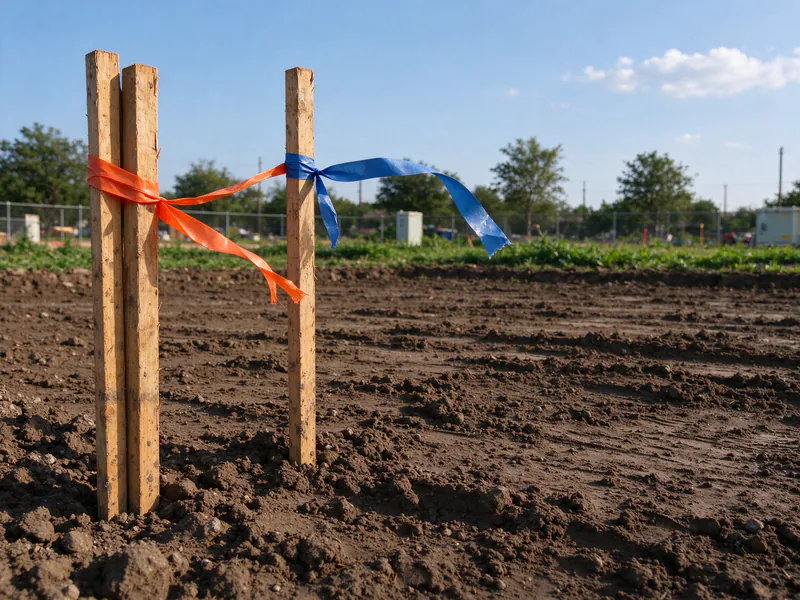
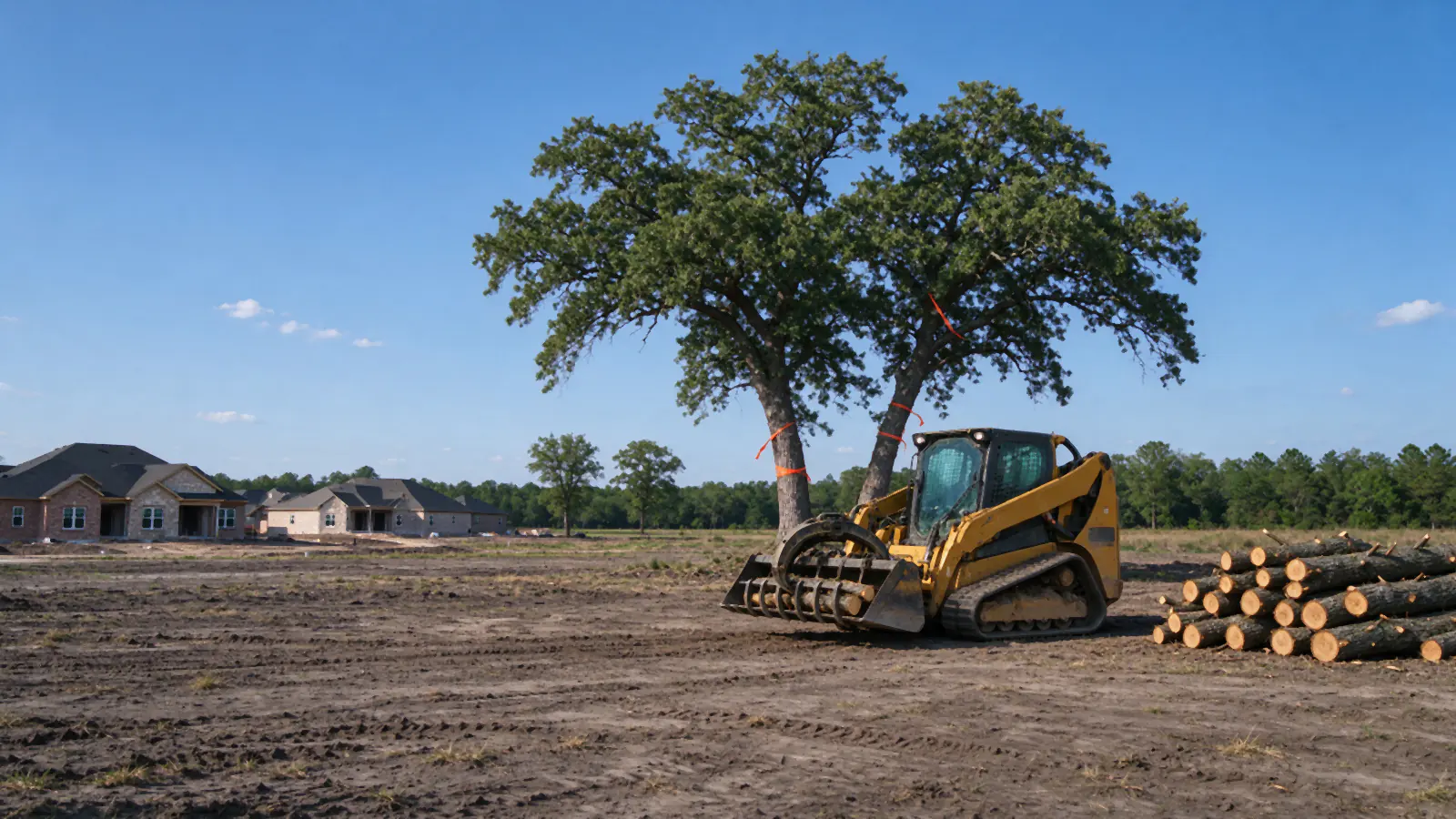
The first visit ties the clearing limits to the plan for the house. Expect a walk with the survey or site plan, stakes or flags at the pad, drive and septic area, keeper trees marked, a look at how water moves across the lot, a read on soil and wet spots, and a list of the permits the address needs.
The plan matters because grading has a target. A builder or engineer usually sets the pad elevation, the slab size plus working room around it, and how the lot should drain. Where no plan exists yet, the walk sets a sensible rough pad with the owner and leaves the finished elevations to whoever designs the foundation. The walk also checks for things grading cannot ignore: a creek or floodplain edge, a neighbor’s drainage arriving from uphill, utility lines that need an 811 ticket, and protected trees close enough to the pad that a grade change would damage their roots.
Clearing, grubbing, grading and excavation are four different jobs
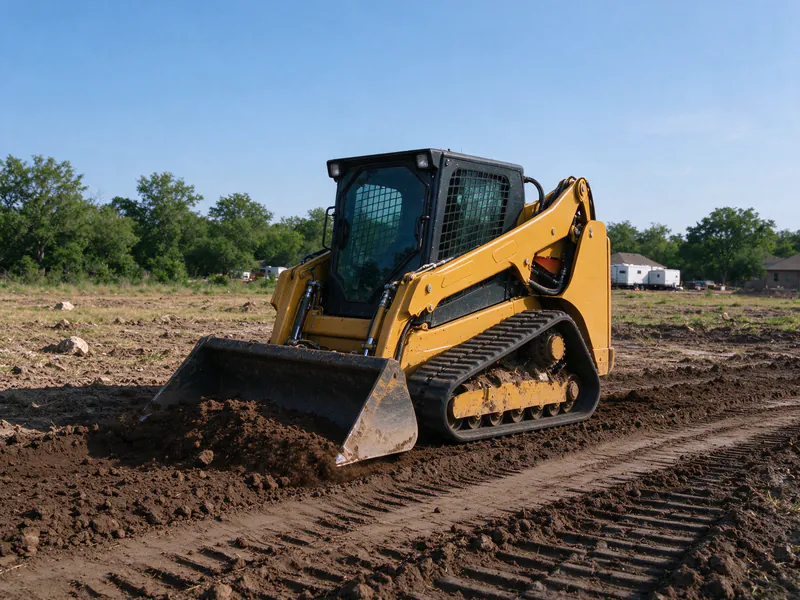
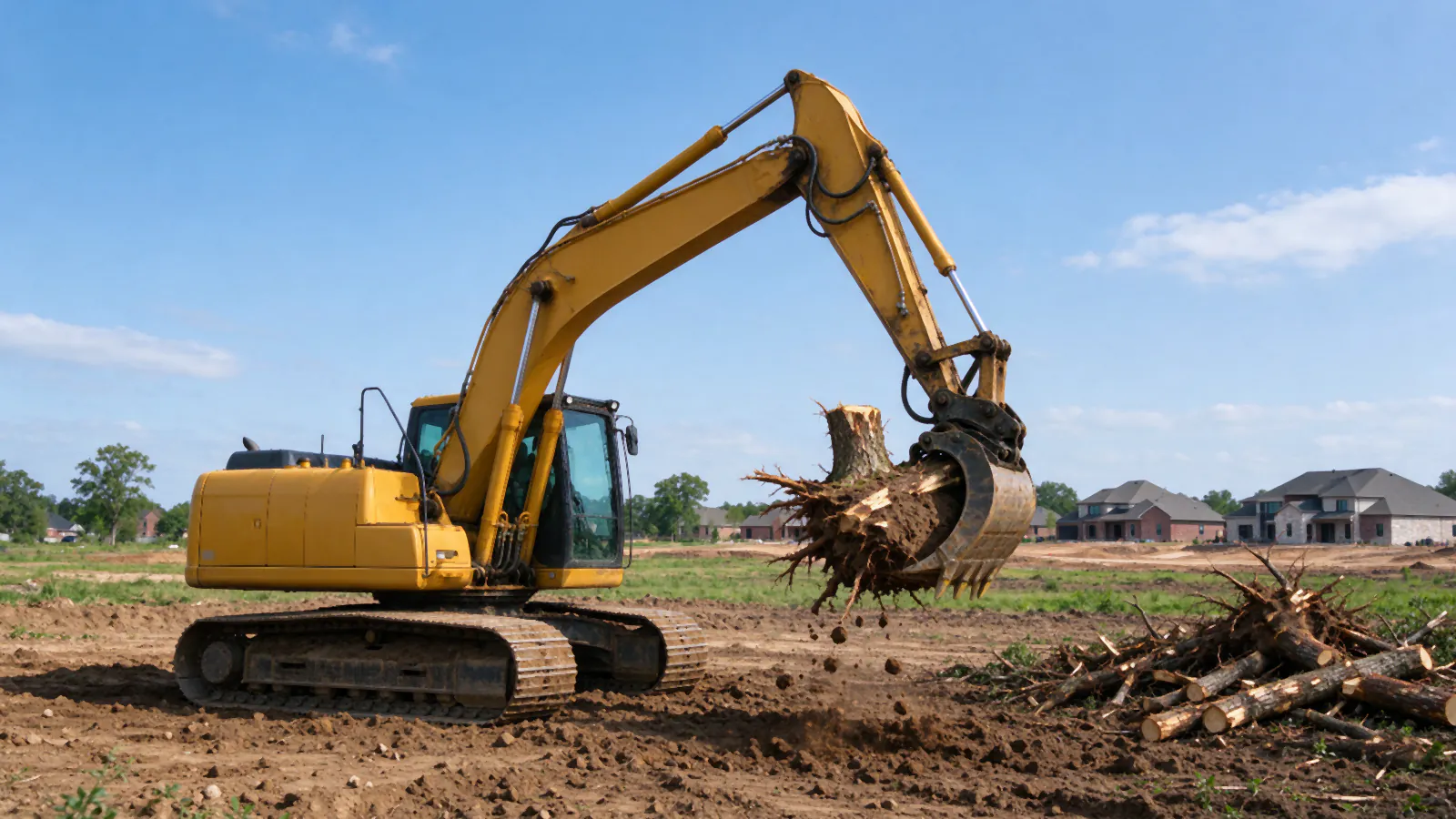
Clearing removes what grows above ground. Grubbing removes what the trees left below ground. Grading moves soil to change the shape of the land. Excavation digs and moves soil on a larger scale. Each needs different machines and has a different finish, and a quote that blurs them is hard to compare.
The City of Denton’s development code draws the same lines. It defines grubbing as removing stumps, underbrush and rocks before clearing and grading, with no change of grade, and it lists clearing, grading, grubbing, stockpiling, excavating and cutting as separate land-disturbing activities that each need permission. Texas law adds a twist: under the Texas Utilities Code, any mechanized work that disturbs soil 16 inches or deeper is excavation for locate purposes, which covers grading and grubbing as well as digging. So clearing is not excavation, but a clearing job that grubs and grades still calls Texas811 at least 48 hours ahead.
This page covers clearing, grubbing and rough grading for house pads, drives and small building sites. Ponds, basements, utility trenches and large cut-and-fill work belong to an excavation contractor, and the walk-through says so when a project needs one.
Rough grading and pad prep on Denton clay
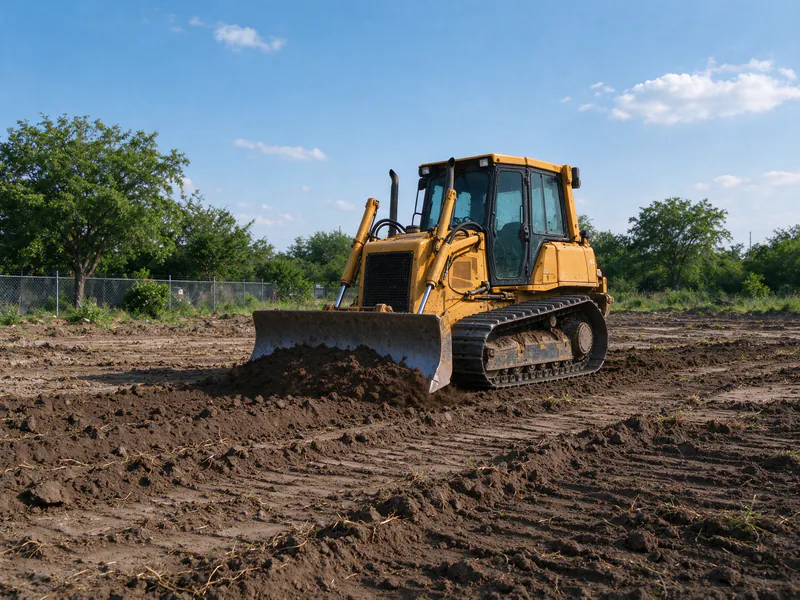
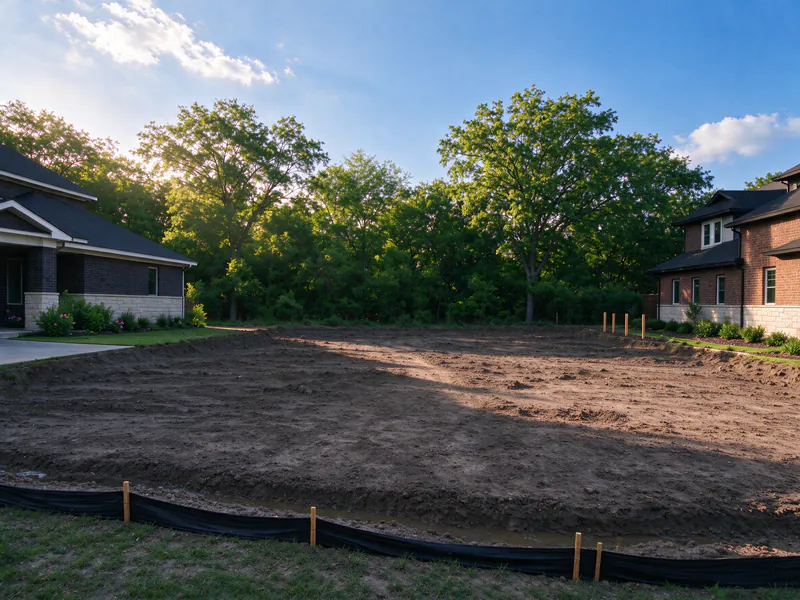
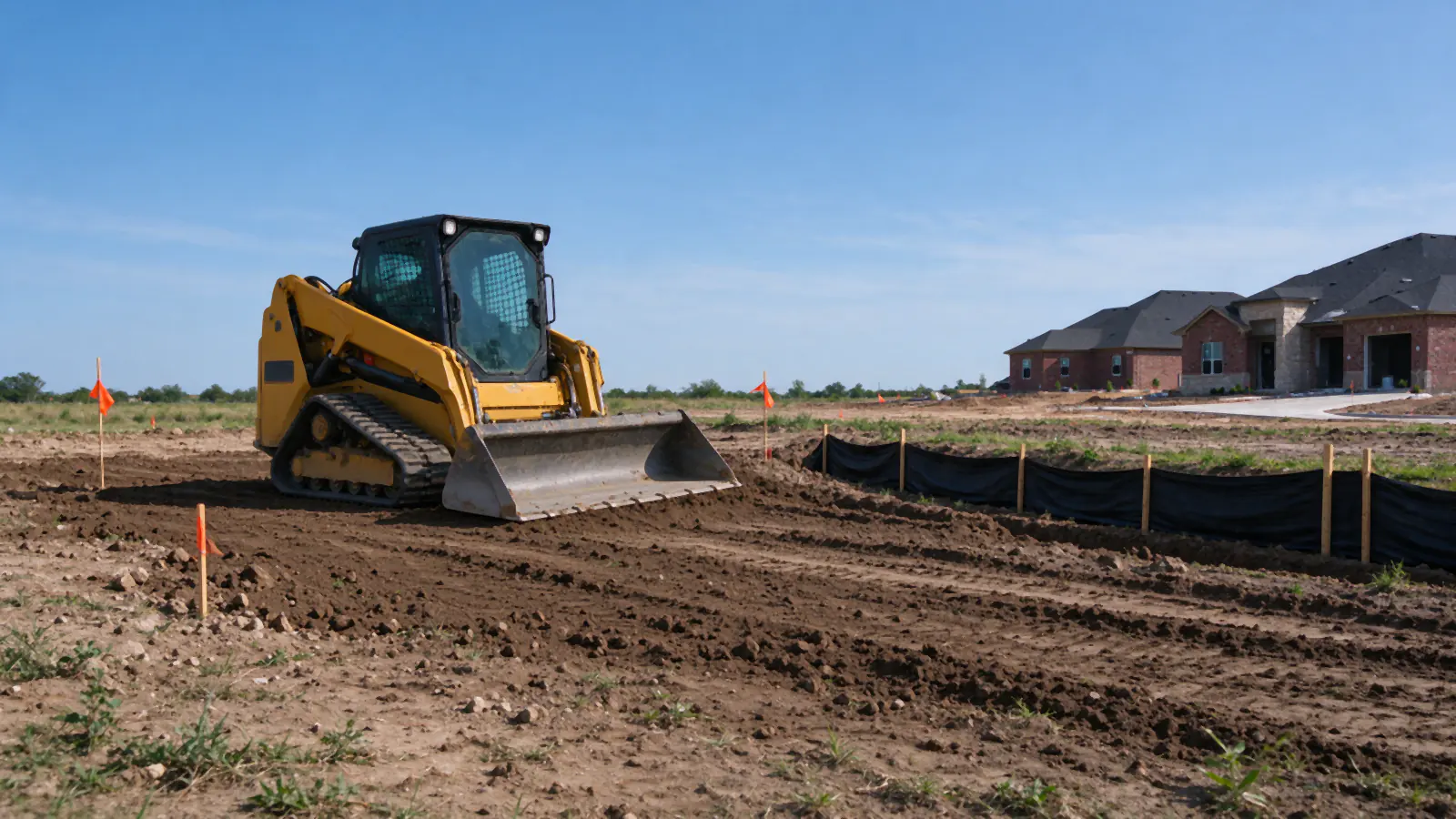
Rough grading takes a grubbed site and shapes it: high spots cut, low spots filled, the pad set level or at the planned slope, and the ground around it pitched so rain runs away from the future house. It is called rough because the final grade, after the foundation and utilities go in, is set later by the builder.
Organics out before any fill goes in
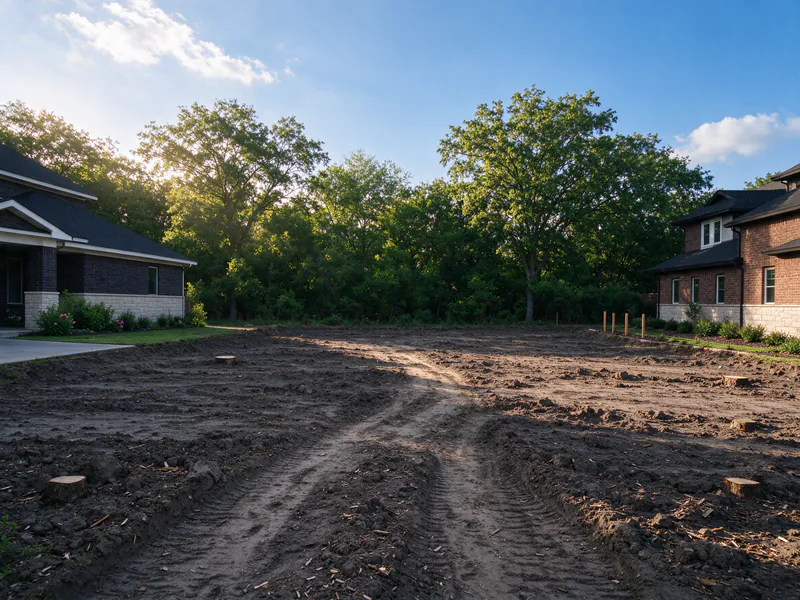
Everything organic under a pad has to go first. Stumps, roots and the dark topsoil layer full of decaying plant matter compress and rot under load, and fill placed over them settles unevenly as they break down. That is why clearing and grubbing strips the pad footprint before grading starts, and why stumps there are pulled rather than ground. Topsoil from the pad is pushed aside into a stockpile, because it is too soft to build on but useful later for the yard.
Shrink-swell clay and the pad
West and north of Denton, toward Krum, Sanger, Ponder and Justin, the USDA soil survey maps mostly Sanger clay, Slidell clay and similar clays. They are high shrink-swell soils: the survey lists a linear extensibility of up to 9.1% for Sanger clay and 10% for Slidell clay, against under 2% for the sandy loams of the Cross Timbers band south of town. In plain terms, these clays swell when wet and shrink and crack when dry, and that movement is what foundations here are designed around.
Grading cannot remove that behavior. What it can do is avoid making it worse: place fill in thin layers and compact each one rather than dumping a deep lift, keep the moisture of the fill reasonable, and pitch the ground so water does not pond against the slab. The depth of moisture conditioning, the type of fill and the compaction standard are set by the builder’s engineer, usually from a soils report, and compaction testing, where required, is arranged through the builder. Engineering is not part of this service, and no graded pad can promise a slab will never move; what it delivers is ground prepared to the plan.
Drainage away from the pad
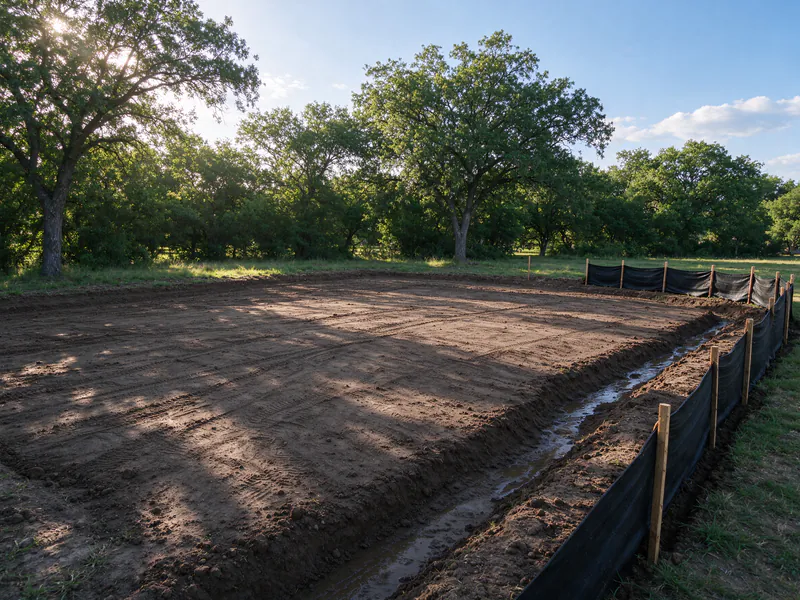
Water is the other half of grading. A pad that sits lower than the ground around it collects runoff, and runoff against clay under a slab is the movement problem in its worst form. Rough grading sets the pad above the surrounding ground, pitches the lot toward the street, a ditch or a swale, and leaves the path water will take visible. Where a creek, floodplain or neighbor’s drainage enters the picture, the creeks and floodplains guide explains the extra rules.
Clearing a lot for a new house?
Send the survey or site plan and a few photos. The walk-through separates the clearing, the grubbing and the grading, and lists the permits.
Grading permits from town to town
Grading triggers permits faster than clearing does, and each town handles it differently. The common thread: opened soil needs permission and erosion control first.
Inside Denton city limits, the development code requires a permit for clearing, grading, grubbing or other site earthwork, with narrow exemptions, the main one being work that disturbs no more than 25 cubic yards and 2,000 square feet outside floodplains and sensitive areas. The clearing and grading permit is currently $453, it expires one year after issue, and the city may deny it if the erosion and sediment controls are inadequate. An early clear-and-grade permit can be issued before the building permit once the plat is filed and state stormwater requirements are met.
In Justin, no dirt work, grading or earth disturbance may happen without a city permit, and erosion control must be kept in place at all times. Argyle charges $200 for a residential grading, drainage and erosion control permit and requires an approved tree survey and protection plan before any site-work or grading permit. Sanger issues no construction permits until plans and plat are approved, but allows early grading, listed at $400, once a final plat has been accepted, with an erosion control plan sealed by a licensed engineer and all controls in place before grading begins. Krum requires a land development permit for grading, clearing and grubbing. Ponder’s published permit forms list no grading permit, so the rule there is confirmed per address. In unincorporated Denton County, a development permit covers improvements and any excavation or fill in a flood zone.
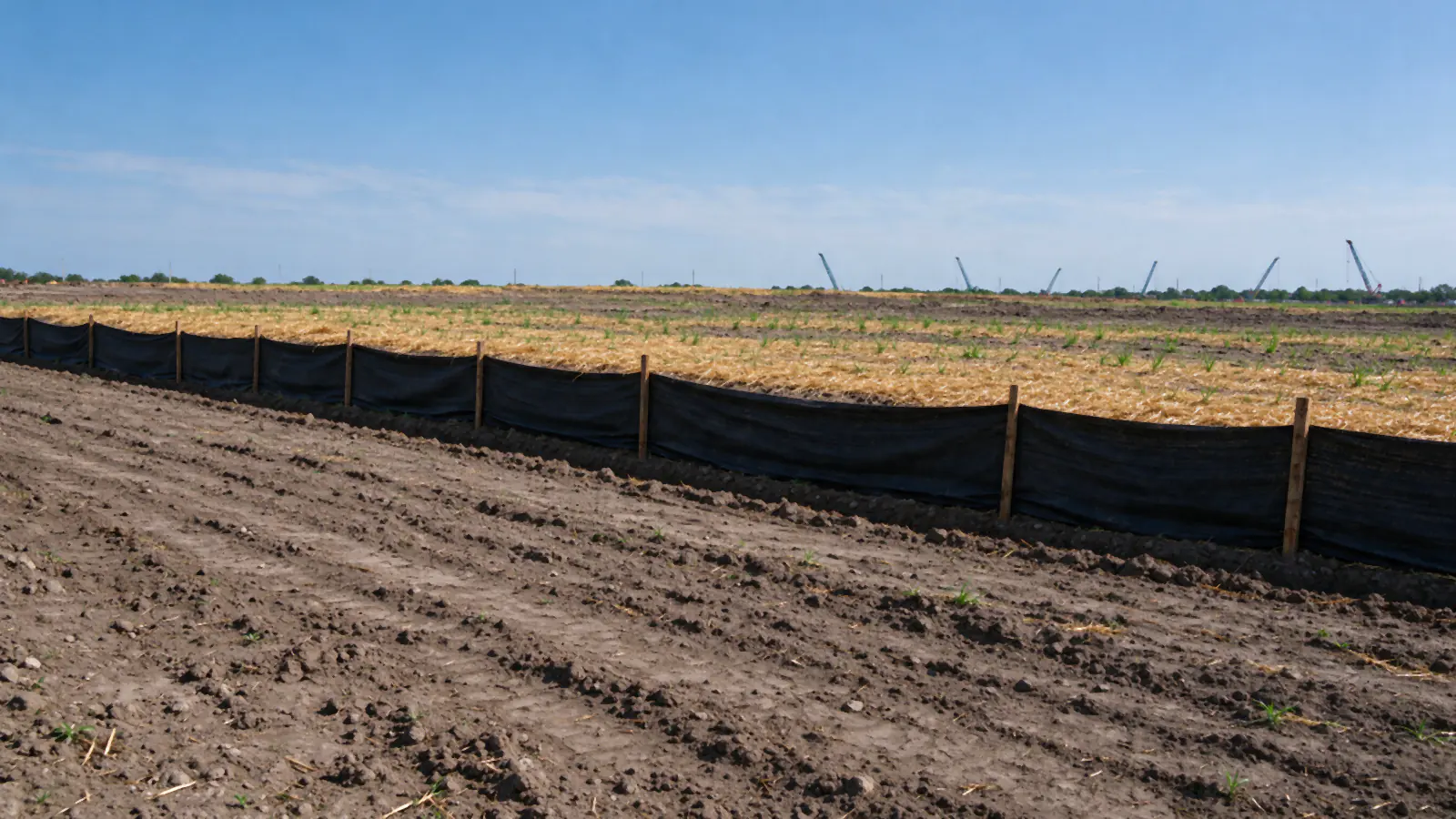
State rules sit on top. Disturbing 1 acre or more brings TCEQ construction stormwater coverage and a stormwater pollution prevention plan; at 5 acres or more, a Notice of Intent is filed. Erosion control covers what goes on the ground.
Where clearing and grading hands off to the builder
The finish of this work is a cleared, grubbed site with a rough pad, positive drainage, stockpiled topsoil and erosion control in place. It is not a finished foundation pad until the builder accepts it against their plans, and it is not build-ready by default: utilities, forms, final fill, and any testing the engineer specifies still come next. Clearing land to build a house lays out the whole sequence, and how long land clearing takes covers timing.
What clearing and grading costs
Clearing and grading are priced as parts. For the clearing, typical North Texas ranges run $1,500 to $3,500 an acre for light brush, $2,500 to $4,500 for moderate brush with small trees and $3,500 to $6,500 or more for heavy woods. Grubbing has no reliable public price and is set by stump and root volume. Grading is machine time: the Texas A&M AgriLife custom rate survey for the East region, which includes Denton County, reports dozer leveling at $100 to $250 an hour, and dozer clearing averaging about $159 an hour under 160 horsepower and $207 over it. Those are farm and ranch custom rates, not quotes for a house pad.
Operating engineers and other construction equipment operators in the Dallas-Fort Worth metro earn a mean $26.51 an hour against $31.87 nationally (BLS OEWS). A wage is not a billing rate; the billed rate carries the machine, fuel, insurance and overhead too. Add the permits that apply, such as Denton’s $453 clearing and grading permit, plus fill brought in, haul-off and silt fence. The land clearing cost calculator prices the clearing part, and what a land clearing quote should include shows how to read a quote that bundles all three. Most home sites start as lot clearing, and the cornerstone guide to clearing land in Denton covers the rules around it.