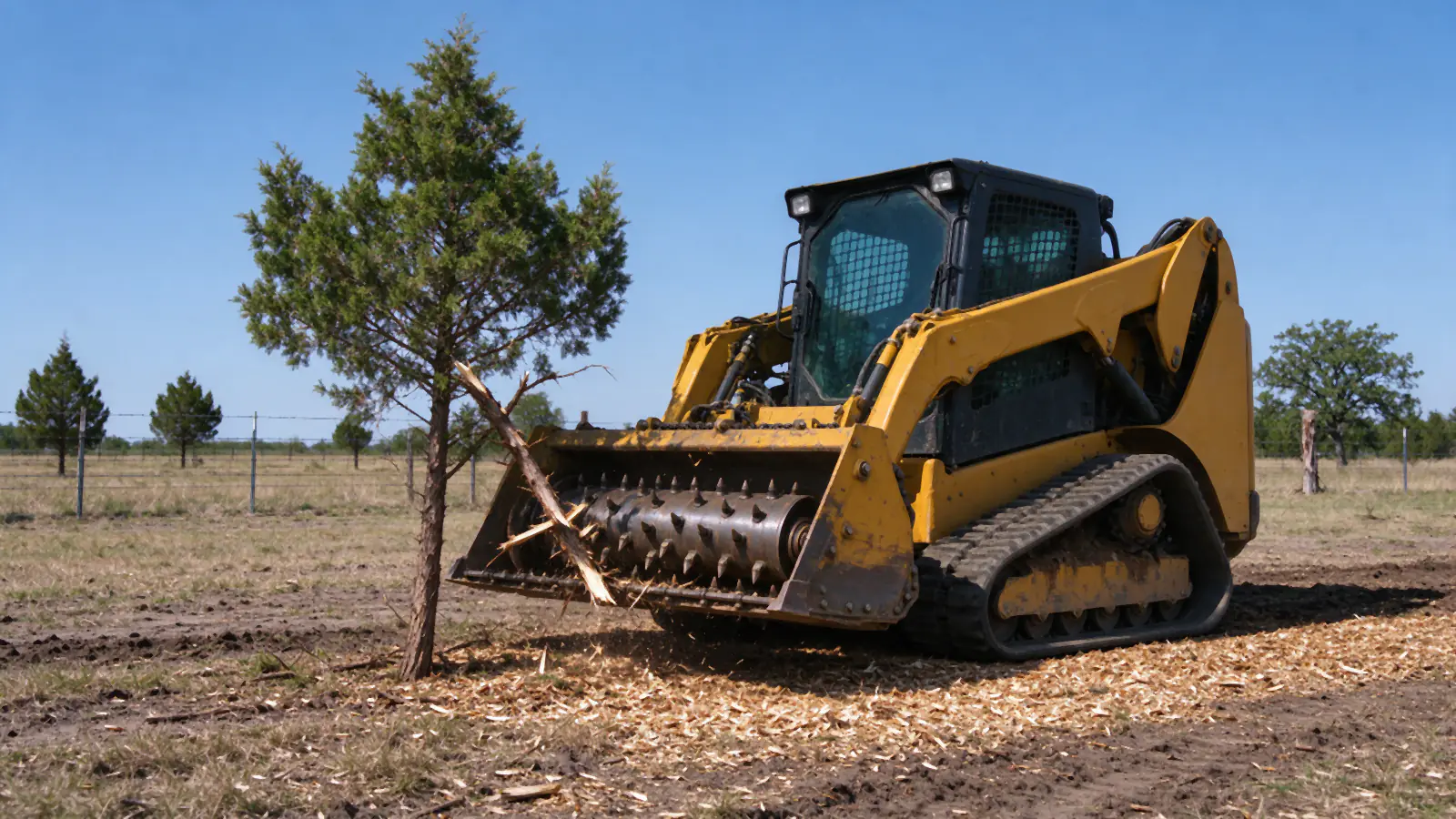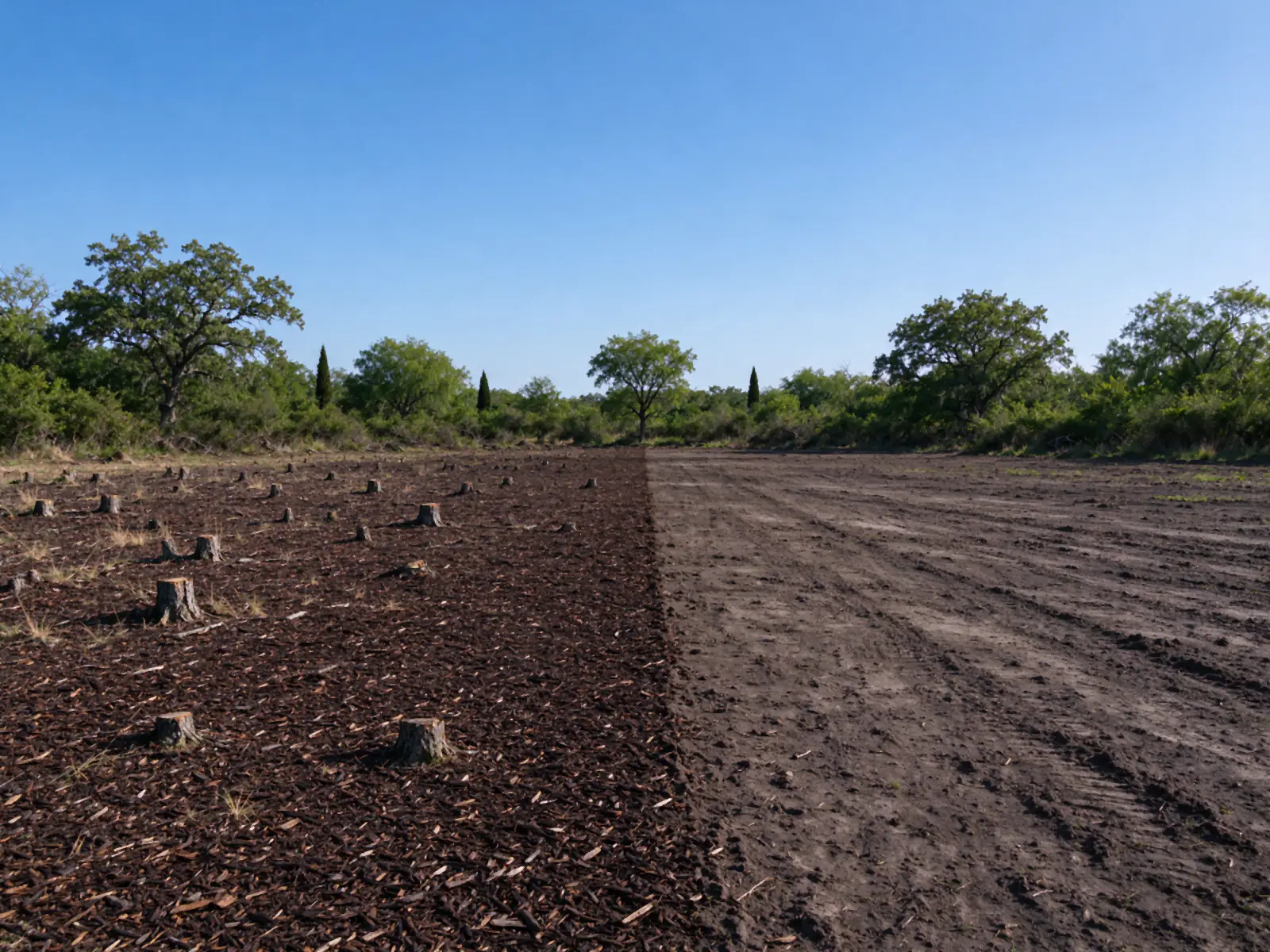
Forestry mulching grinds brush and small trees where they stand and leaves the roots, the topsoil and a layer of chips behind. Traditional land clearing fells or pushes the trees, then pulls stumps and roots and leaves bare soil. Pick by the finish you need: mulching for pasture, trails and open woods; clearing and grubbing for a house pad, drive or pond.
Post Oak Land Clearing Denton offers and manages both methods across Denton and the west and north of Denton County, with the work done by licensed and insured contractors. This guide sets the two side by side on local ground, so you can tell which one your land calls for, or whether it needs a mix.
What each method does to the ground
The two methods differ less in what they cut than in what they leave. One processes the vegetation and stops at the surface; the other removes the vegetation and then goes into the soil after what is left.
Forestry mulching
A forestry mulcher is a toothed drum on the front of a tracked carrier. It eats into a cedar or a thicket of saplings from the top down and drops the chips where the plant stood. Cutting and disposal happen in the same pass, which is why nothing needs piling or hauling. The stump is finished at or just above ground level, the roots stay where they are, and the topsoil is barely disturbed apart from track marks. The forestry mulching page covers the machine and its limits in more detail.
Traditional land clearing
Traditional clearing is a family of mechanical methods. A dozer pushes trees over, often with a root rake on the blade that combs stumps and roots out of the ground. An excavator with a thumb pulls individual stumps, sorts debris and works near things that must not be hit. Chainsaws drop the larger trees first. The material ends up in windrows or piles that are then hauled, ground or, where the rules allow, burned. When stumps and roots come out as well, the job is clearing and grubbing, and the result is open soil ready for the next trade.
Neither method changes the shape of the land. Clearing does not level a slope or build a pad; that is grading, a separate scope covered on land clearing and grading.
Side by side
| Forestry mulching | Clearing and grubbing | |
|---|---|---|
| What comes out | Brush, vines, saplings and small to mid-size trees, ground in place | Trees, stumps, root balls and buried organics |
| What stays | Roots, topsoil, stumps at grade, a chip layer | Bare mineral soil |
| Debris | None to haul in most cases | Logs, root balls and slash to haul, grind or burn where allowed |
| Soil disturbance | Low; tracks pass over the surface | High; the surface is torn open |
| Regrowth | Root-sprouting species come back from the roots left in place | Fewer root sprouts, but bare soil invites seedlings |
| Erosion | Chips and roots hold the surface | Bare soil until it is seeded or covered |
| Typical range | $1,400 to $3,500 an acre, light to moderate | $1,500 to $3,500 an acre light, up to $3,500 to $6,500 or more heavy |
| Fits | Pasture, trails, fire breaks, wooded acreage, fence lines | House pads, drives, ponds, roads, building sites |
Which method fits the finish you want
Start from what the land is for, not from the machine. The end use decides how clean the ground has to be, and the cleanliness decides the method.
- Pasture or hay ground. Mulching takes out brush and cedar while keeping the grass roots and seed bank, so grazing returns within a season or two. Where stumps would catch a mower, they are ground lower as a separate step. See pasture clearing.
- Walkable woods or a homesite under oaks. Mulching the understory and leaving marked trees is the usual approach, because a dozer working among keepers compacts the root zones that keep them alive. Selective clearing plans the machine routes.
- House pad, driveway or slab. Roots and stumps left under a foundation rot and leave voids, so these footprints need grubbing. Mulching alone is not enough, however neat it looks.
- Pond or tank. The basin is excavated anyway, so the area is cleared and grubbed and the spoil handled as part of the dig.
- Fence lines and trails. A mulcher works a narrow strip without piles. Fence line clearing adds the wire and post hazards that come with old boundaries.
- Fire breaks around buildings. Mulching is the method the Texas A&M Forest Service mechanical fuel reduction grant has funded, partly because the program does not allow debris to be burned.
The land clearing assessment tool asks these questions in order and suggests a method for your property.
What each costs around Denton
On light to moderate growth, mulching usually costs less per acre than clearing and grubbing, because one machine cuts and disposes in a single pass. Typical North Texas ranges run $1,400 to $3,500 an acre for mulching, and $1,500 to $3,500 for light land clearing, $2,500 to $4,500 for moderate brush with small trees and $3,500 to $6,500 or more for heavy woods.
The gap widens once you add what clearing creates. Every pile has to go somewhere. Brush hauled to the City of Denton Landfill costs $30 to $40 a ton depending on piece length and whether you are a Denton customer, before the truck time to get it there. Bare soil on an acre or more brings stormwater coverage and silt fence, which runs $3.40 to $5.00 a foot installed in Denton County TxDOT bids.
Dozer time is the other public benchmark. The Texas A&M AgriLife custom rate survey for the East region, which includes Denton County, puts dozer land clearing at about $159 an hour for machines under 160 horsepower and $207 an hour for larger ones. No equivalent public rate exists for mulchers, and an hourly rate says little until you know how many hours the ground takes. The cost per acre guide breaks a full price into its parts.
Is forestry mulching worth it?
It is worth it when you want the ground to stay usable and covered: pasture, woods, trails, a lot you plan to keep wooded. It is money spent twice when the area will become a pad, because the footprint still has to be grubbed after mulching. Dense cedar also pushes mulching toward the top of its range, because a thicket carries far more wood per acre than open brush and leaves a deep chip layer that has to be spread.
Regrowth after each method
Whether brush returns depends on the species and on what was left underground, not on how tidy the job looked. Eastern redcedar cut below its lowest green branch does not resprout, so mulching ends those trees and only seedlings come back. Mesquite and honey locust carry buds on the root crown below the surface, so mulching the top often produces several new stems from each stump.
Grubbing pulls many of those crowns out, which is a real advantage on mesquite ground. It also exposes a seedbed of bare soil, and the first rain brings up whatever seed is waiting there, from ragweed to greenbrier. Mulched ground has the opposite problem: fewer seedlings, because the chips shade the surface, but resprouts from the roots that stayed. Either way the first year decides the outcome, which is why the keeping brush from growing back guide sets out a follow-up plan, and the cedar guide covers juniper-heavy land.
Soil, erosion and wet clay
West and north of Denton, around Justin, Krum, Ponder and Sanger, the ground is mostly Sanger and Slidell clay, hydrologic group D soils that drain slowly and shrink and swell with moisture. Strip their cover and raindrops seal the surface, so water runs off instead of soaking in and carries sediment with it. A dozer-cleared acre on that clay is most exposed in May and October, the two wettest months in NOAA’s normals for Denton.
Mulching keeps roots binding the soil and lays down chips that break the impact of rain. That is the main environmental argument for it, and on sandier Cross Timbers ground toward Argyle it stops loose sand from gullying. Clearing and grubbing is not wrong, it just needs a cover plan: seeding, erosion control blankets or silt fence on the downhill edge. Under the TCEQ construction general permit, disturbing an acre or more needs stormwater coverage. Grubbing clearly counts as disturbance; whether a mulching job does depends on how much ground it actually opens. Erosion control covers the options.
Both methods rut wet clay. A tracked mulcher spreads its weight but still sinks into saturated group D soil, and a dozer pushing trees on it smears and compacts the surface. Waiting a few dry days after a soaking rain is cheaper than repairing the ruts.
Debris: the cost a per-acre number hides
A mulched acre has no debris line on the bill. A cleared acre has piles, and what happens to them depends on where the land sits. Inside Denton city limits the Fire Marshal does not allow open burning, so piles are hauled or ground. In unincorporated Denton County, TCEQ rules for the Dallas-Fort Worth ozone nonattainment area allow a land-clearing burn only when no practical alternative exists, and only on a county burn day. Where a mulcher can reach the brush, that alternative usually exists. The burning brush in Denton guide covers the rules in full, and land clearing debris removal covers hauling.
Large logs are the exception that cuts the other way. A mulcher slows sharply on hardwood trunks past mid-size, so big post oaks and pecans are often felled, bucked and handled separately even on a mulching job. That is a normal mixed method, not a failure of the plan.
Mulch, grub or both?
Send the acreage, a few photos and what you want the land to become. The walk-through marks which parts need which method.
Brush hog, brush cutter and goats: where they fit
A brush hog is a rotary mower on a tractor. It shreds grass, weeds and soft growth across open pasture, at about $40 an acre in the AgriLife custom rate survey for the East region, and it is the right tool for keeping cleared ground open. It is not a clearing method once woody stems get thick; it bounces off saplings that a mulcher takes in stride. Brush hogging covers where it fits.
A walk-behind or handheld brush cutter suits a small area of light growth, a few weekends of work on a backyard or a trail. Past a few inches of trunk, felling and stump handling become the slow, risky part, which the doing it yourself vs hiring guide weighs up.
Goats eat leaves, vines and tender shoots and leave the stems and roots, so they set brush back without clearing it. They are a grazing tool, not a clearing method, and they are not a service offered here; the goats vs mulcher post compares them honestly.
When one property needs both methods
Plenty of tracts are mixed, and pricing them as all-mulch or all-grub wastes money. A typical case: 6 wooded acres outside Krum where the owner wants a house, a gravel drive and the rest kept as open woods for grazing a few animals. The acreage is mulched, keeping the oaks that are worth keeping. The house footprint with a working margin, the drive line and the septic area are cleared and grubbed, the stumps pulled, and the debris hauled or ground. Erosion control goes on the grubbed areas before the next rain. That example is illustrative, not a quote, but the pattern holds on most homesites.
The clearing land to build a house guide follows the grubbed part of that job through to the grading handoff, and lot clearing covers smaller in-town lots where the whole lot is the building site.
Questions to settle before you choose
A short list makes the choice almost automatic:
- What will each part of the land be used for in five years?
- Which trees stay, and are any of them protected under city or town rules?
- Will anything be built, paved or dug where the brush now stands?
- Can debris stay on site as chips, or must it leave?
- Is the land inside Denton city limits, a nearby town, the ETJ or unincorporated county?
- How wet is the ground, and where can a machine get in?
Bring those answers to the estimate and the method follows. Call (940) 204-6191 or request an estimate with the acreage and a few photos, and the cost calculator gives a range in the meantime.