Last Updated:
Post Oak Land Clearing Denton offers and manages erosion control after land clearing across Denton and the west and north of Denton County, with the work done by licensed and insured contractors. Clearing changes how land handles rain. Take away the brush, roots and leaf litter, and the bare soil underneath takes every raindrop directly, seals over, and sends water and sediment downhill toward the street, the ditch or the creek. Silt fence, cover and seeding put back enough of that protection to hold the soil until grass does it on its own.
What happens on the first visit
The first visit works out where water will go once the cover is gone. Expect a walk of the slopes and low edges, a look at ditches, culverts, draws and any creek on or next to the property, a read on the soil, and a plan for the silt fence line, the cover and the seeding, along with the permits that set the rules.
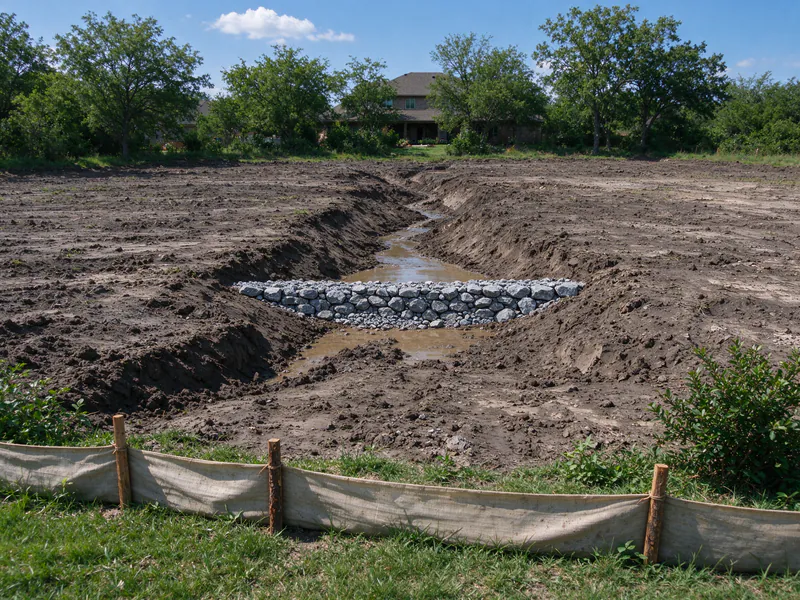
Water leaves most lots along one or two low edges, and that is where silt fence earns its place. The walk also notes where runoff concentrates into a small channel, since sheet flow and channel flow need different controls, and where trucks will come and go, because tracked mud on a road is erosion too. Creek edges get special attention: Denton protects riparian buffers along streams, and the cheapest erosion control is a strip of vegetation that never gets cleared.
Why cleared Denton ground washes
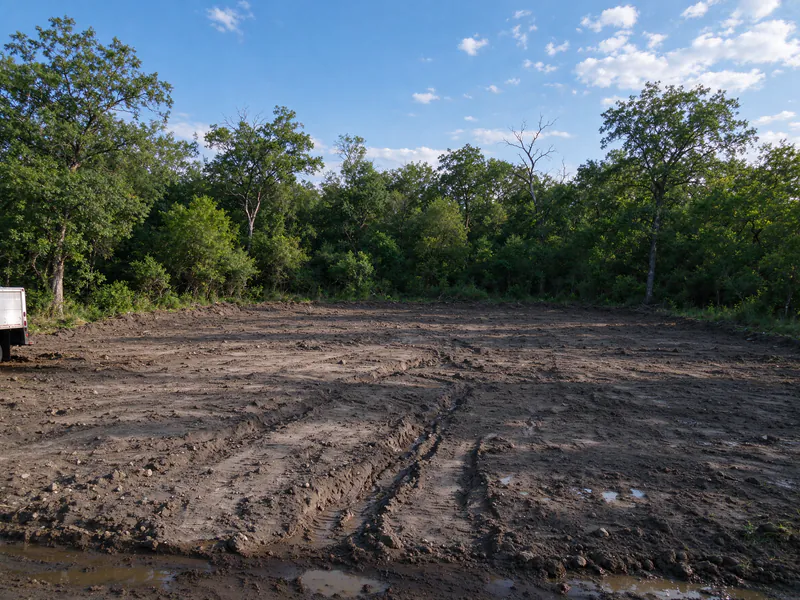
Bare ground erodes when raindrops hit it, loosen particles and then carry them off in runoff. Vegetation stops the first step, roots hold the second, and leaf litter slows the third. Clear all three away and the outcome depends on the soil, the slope and the rain.
Denton’s rain arrives in bursts. The 1991 to 2020 normals at Denton Municipal Airport give 35.60 inches a year, with the wettest months in May at 4.52 inches and October at 4.17, and about 22 days a year bring half an inch or more. Those heavy days do the damage, and they fall in the same months many clearing jobs are scheduled.
Clay west and north, sand to the south
The soil sets how the damage shows. West and north of Denton the USDA soil survey maps mostly Sanger clay, Slidell clay and Mingo clay loam, hydrologic group D soils that take in water slowly. Rain on bare group D clay seals the surface within minutes and runs off almost at once, carrying fine particles that turn the water the color of chocolate milk and stay suspended long after it stops moving. South-central Denton County, through the Cross Timbers band toward Argyle, has sandy loams such as Gasil fine sandy loam, which soak up water faster but loosen and cut into rills and gullies once runoff gathers.
Slope
Most of the county is gentle, with soil survey slopes mostly between 0 and 5%. The steeper ground sits beside creeks and draws, where slopes reach 8% and more, and that is also where runoff concentrates and where soil reaches water fastest. A few percent of slope on a long cleared run gathers more water than a steep but short bank, so the length of the bare run matters as much as its pitch. On ground that falls toward a creek, selective clearing that leaves the lower trees standing does more than any control installed afterward.
Silt fence, cover and seeding: what each one does
These three do different jobs, and erosion control that works on Denton clay uses all three. Silt fence catches what moves. Cover keeps it from moving. Seeding replaces the cover with something permanent.
Silt fence
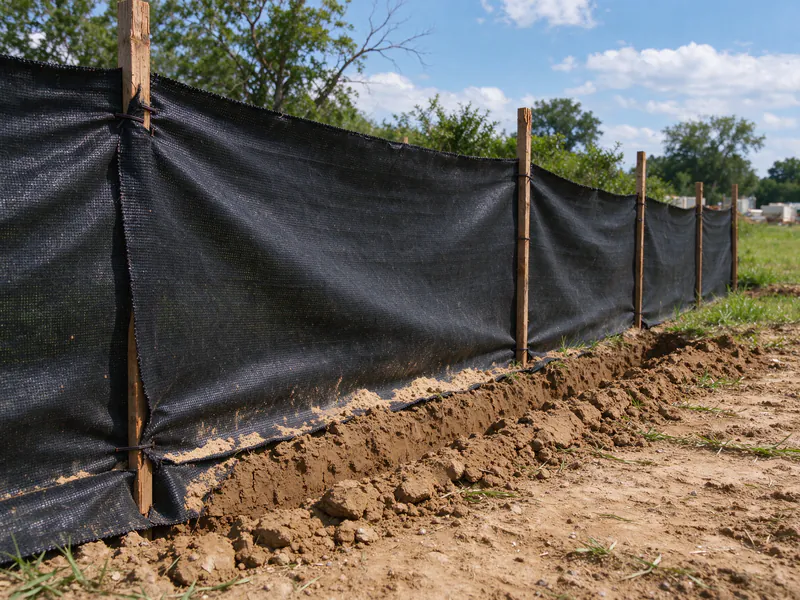
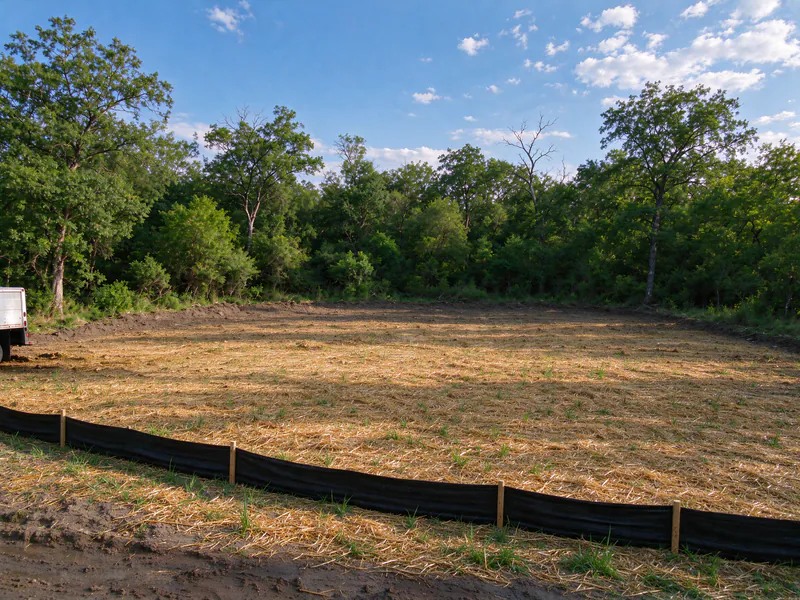
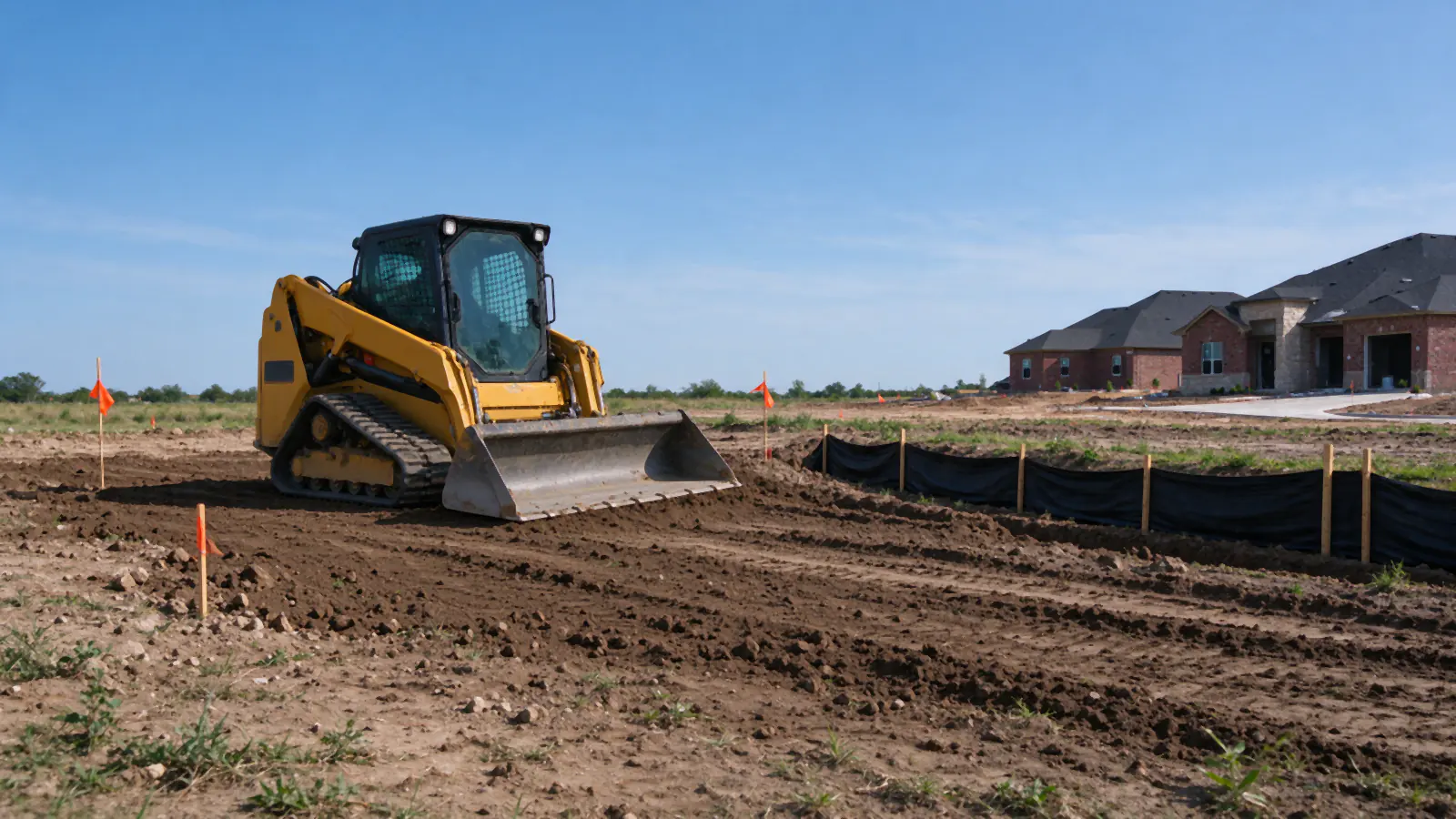
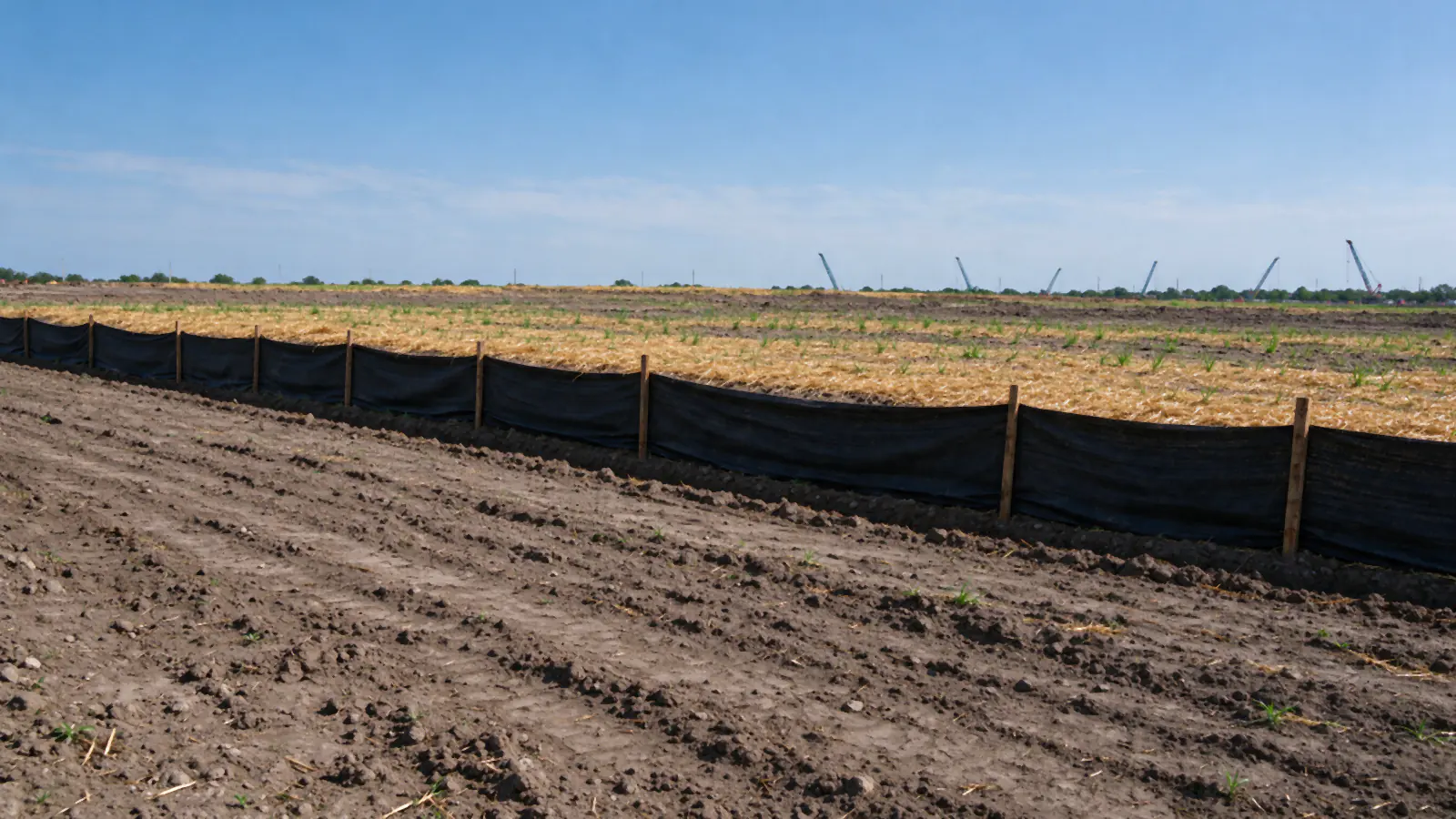
Silt fence is a woven geotextile on stakes, with its bottom edge buried in a trench so water cannot run under it. It goes along the contour on the downhill side of bare ground, with the ends turned uphill so water does not just flow around. It works by ponding runoff briefly so heavier sediment settles behind it. On clay that is a partial answer, because the fine particles settle slowly and some pass through. Fence also fails if it crosses a channel, gets overtopped or is left to sag, so it needs a look after every heavy rain and sediment cleared when it builds up.
Cover
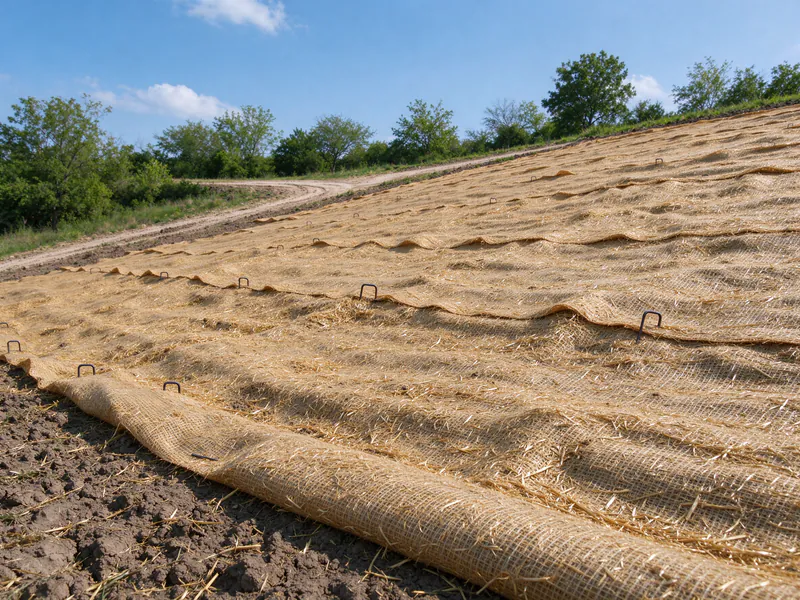
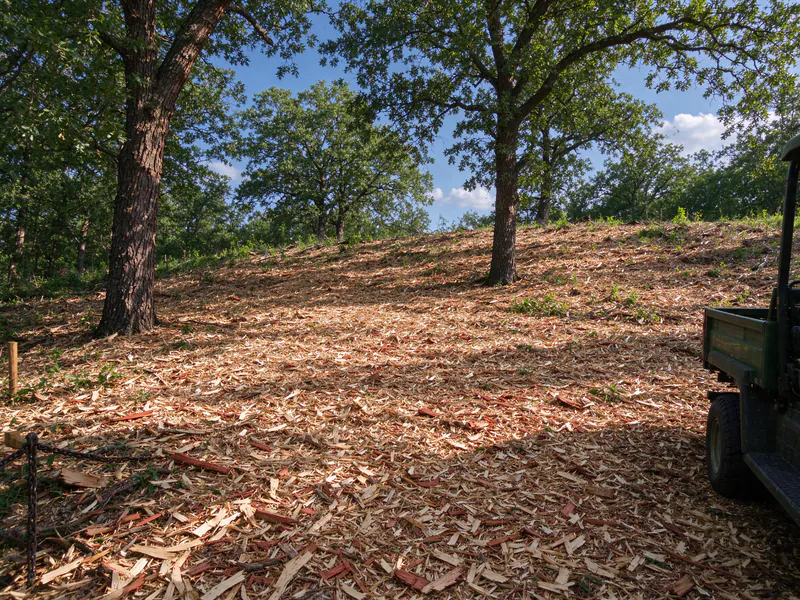
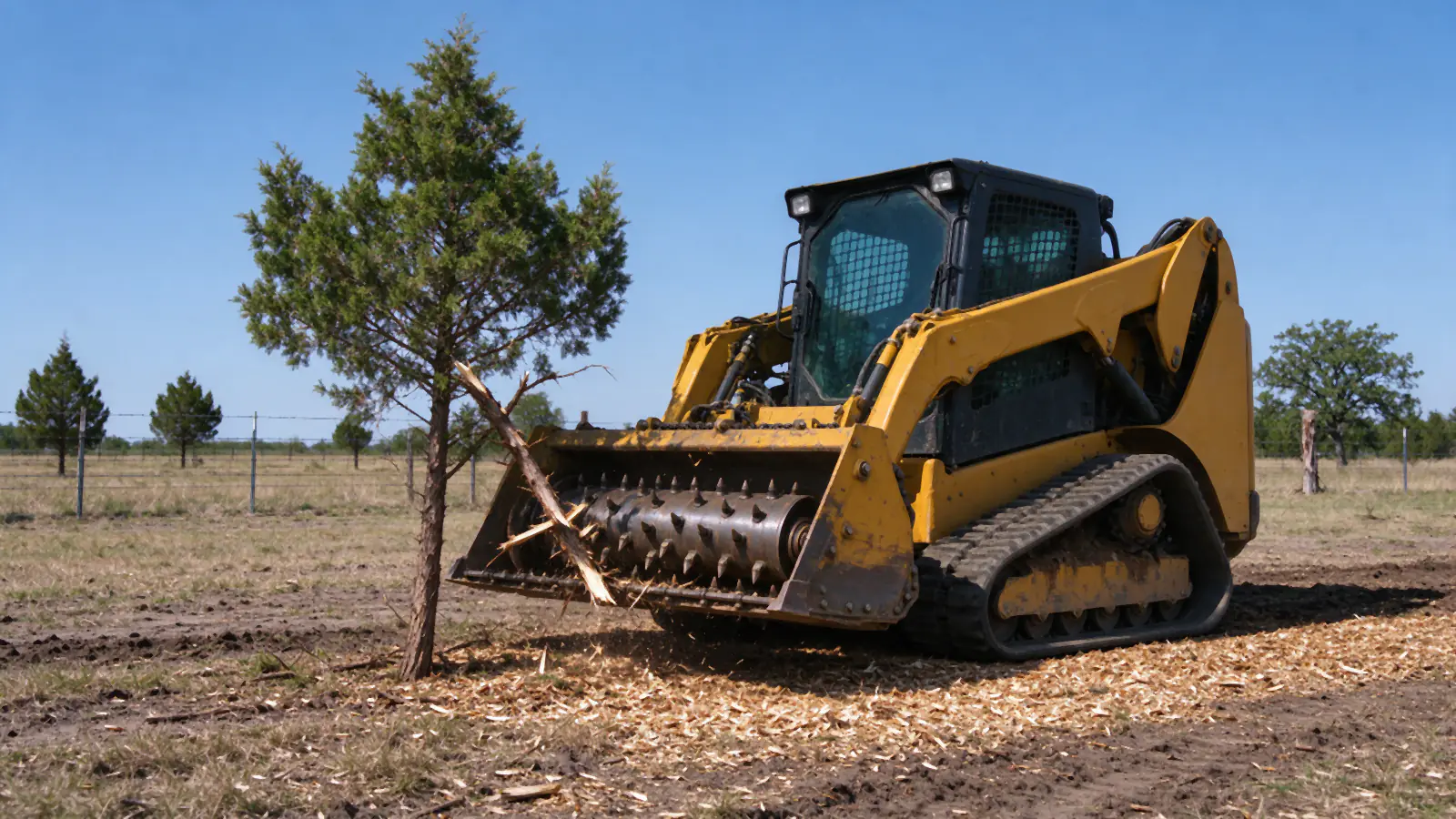
Cover is what stops erosion at the source. A layer of mulch takes the raindrop impact, keeps the clay surface open so water soaks in, and slows what runs off. On land cleared by forestry mulching, the cover is already there. On ground cleared by clearing and grubbing or grading, mulch from the job can be spread back over areas that are not being built on, and straw or other mulch covers the rest. Rock at the construction entrance belongs in this group, since it keeps trucks from tracking clay onto the road.
Seeding
Seed turns temporary cover into roots. Warm-season grasses establish from late spring into early summer when the soil is warm and before the dry stretch of July, Denton’s driest month at 1.77 inches. Ground cleared in fall or winter is usually mulched and given a quick cool-season cover to hold it until spring seeding. Seeding into mulch works where the layer is thin; a thick mat needs raking back first.
Ground already cleared and bare?
Send photos of the low side and where the water goes. The walk-through sets the silt fence line and the cover before the next storm.
Stormwater rules: TCEQ and the towns
Texas regulates erosion from clearing by the size of the disturbance, and the cities add their own requirements. Under the TCEQ construction general permit, TXR150000, clearing, grading or excavating that disturbs 1 acre or more needs coverage, including a stormwater pollution prevention plan, called a SWP3, and posted site notices. At 5 acres or more, or as part of a larger plan that will disturb 5, the operator also files a Notice of Intent, at $225 electronically or $325 on paper (TCEQ). Under 1 acre, TCEQ coverage does not apply unless the work is part of a larger common plan. Grubbing and grading clearly count as disturbance; whether a mulching job that leaves roots and groundcover counts depends on how much soil it actually opens.
Local rules come with the clearing or grading permit. Inside Denton, the city may deny a clearing and grading permit when erosion and sediment controls are inadequate, and violations bring a short cure period, then a stop-work order, referral to TCEQ and city cleanup billed to the permit holder. Inspections run through the Watershed Protection Division. Justin requires erosion control to be installed and maintained at all times during dirt work. Sanger requires every control in place before grading starts, an erosion control plan sealed by a licensed engineer for early grading, and no brush placed where it can drain to the storm sewer or a creek. Argyle folds erosion control into its residential grading and drainage permit. Ponder’s rules are confirmed per address.
Creek buffers and floodplain edges
The cheapest erosion control along a creek is not clearing it. Inside Denton, environmentally sensitive area rules protect riparian buffers of 50 feet from the stream centerline where the stream drains 1 square mile or less, and 100 feet where it drains more. Tree and understory removal is prohibited in those buffers, and private yard clearing may disturb no more than 10% of a buffer, never closer than 25 feet to the centerline. Undeveloped floodplain is protected the same way. Land disturbance in a mapped sensitive area needs a field assessment by a qualified biologist or wetland specialist, with a city fee of $1,118. In unincorporated Denton County, excavation or fill in a flood zone needs a county development permit.
Even where no rule applies, a vegetated strip left along a creek or draw filters runoff better than any fence, and it costs nothing to keep. The clearing near creeks and floodplains guide covers the details.
What erosion control costs
Silt fence has a public benchmark. On seven Denton County highway contracts, TxDOT low bids for installed silt fence ran $3.40 to $5.00 a foot, and removal ran about $0.85 to $1.50 a foot. Those are large, open public jobs; a short run on a single lot usually costs more per foot because setup is spread over fewer feet. The TCEQ Notice of Intent, where needed, is $225 electronic or $325 paper, and Denton’s clearing and grading permit, which carries the city’s erosion review, is $453.
Cover and seeding are priced from the ground: the bare area, whether mulch from the clearing can be reused, seed type and season, slope, and how far materials must be carried. NRCS estimates the cost of critical area planting, its seeding practice for eroding ground, at $578.25 an acre, an agency estimate behind cost-share payments rather than a market price. Land clearing and grading and the cost per acre guide show where erosion control sits in a larger job, when to clear land in North Texas covers timing around the wet months, and clearing land to build a house puts it in the building sequence. The wider rules are in clearing land in Denton.