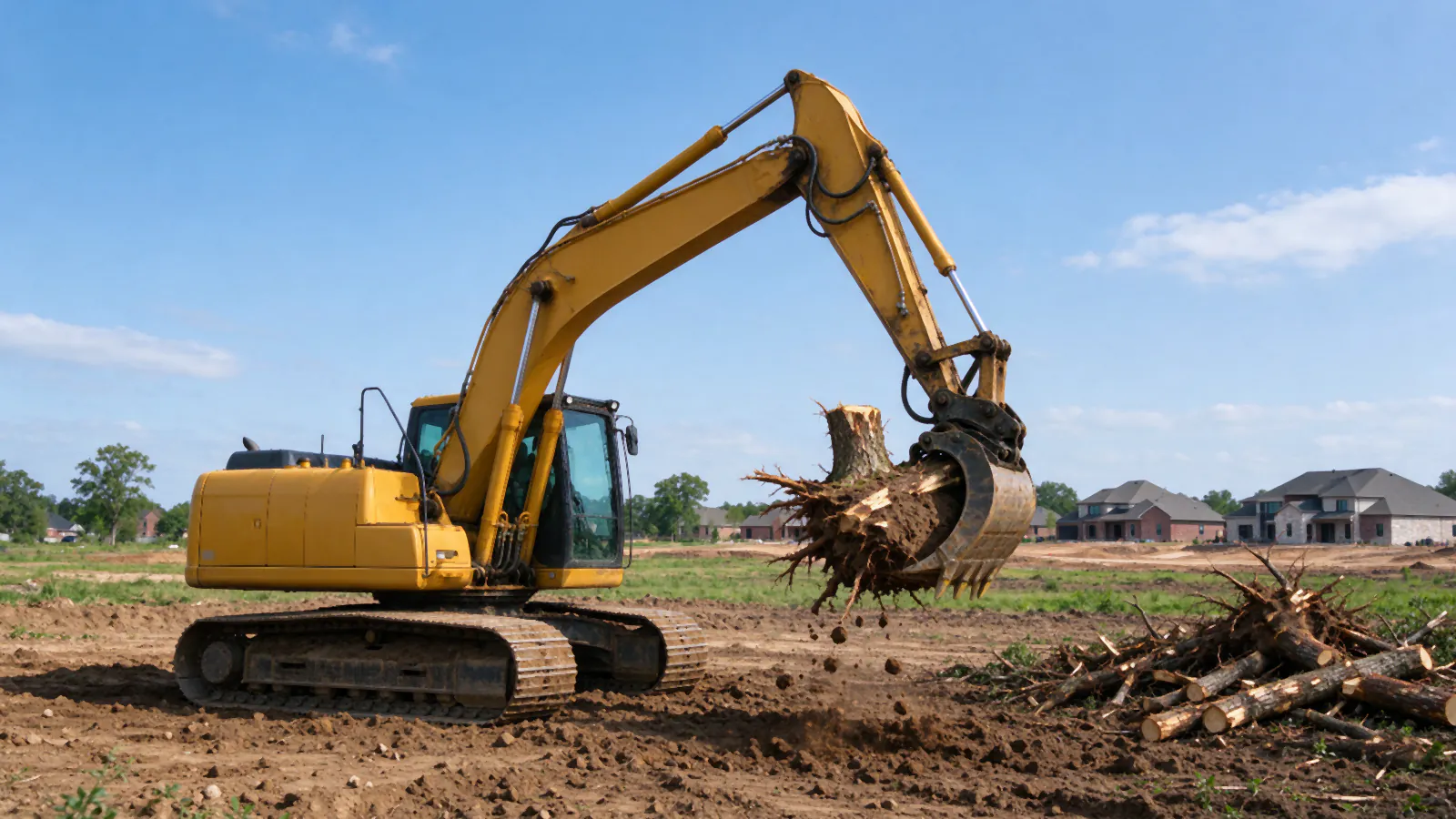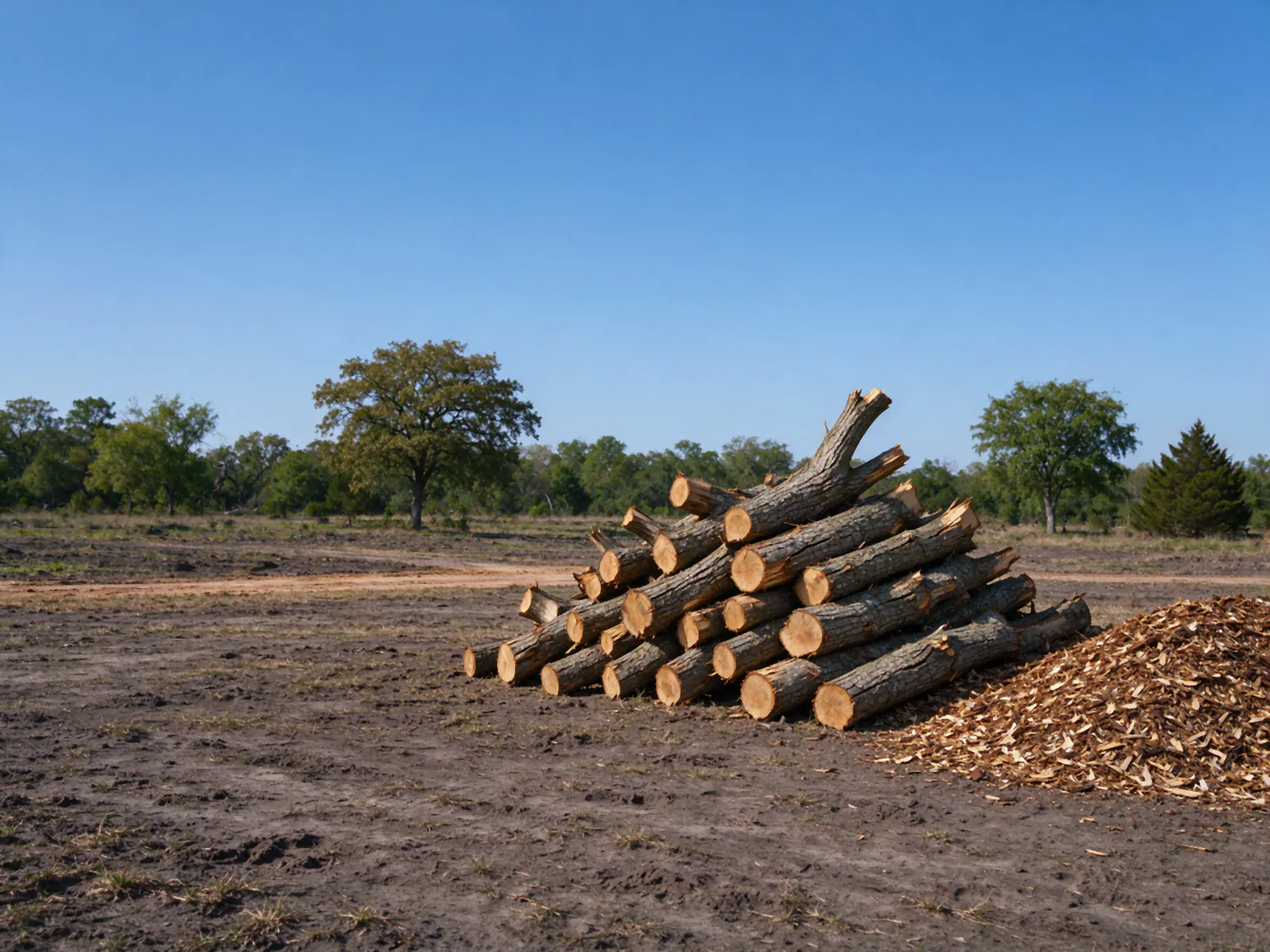
Selling timber rarely pays for clearing land around Denton. Most trees on local lots are post oak, cedar elm, hackberry and cedar of mixed size and form, which sawmills seldom want, and no sawlog buyers serving Denton County turned up in research. Post Oak Land Clearing Denton treats timber value as something to evaluate, never something to promise or subtract from a quote in advance.
That does not mean the wood is worthless to you. It can become firewood, mulch that protects bare clay, or, now and then, a few logs someone wants. The sections below explain what makes a tree merchantable, why Denton’s trees usually fall short, what the rules say about cutting and moving wood, and how to find out for certain on your own land.
What makes a tree worth money to a mill
A tree has timber value when a buyer will pay for it standing or delivered, after the cost of cutting and trucking it. That takes several things lining up at once, and missing any one of them usually ends the conversation.
- Species. Mills buy the species they can sell as lumber, ties, pallets or pulp. A species with no nearby market has no stumpage value, however large the tree.
- Diameter and length. Sawlogs need enough diameter and a clear, straight length of trunk below the first big limb. Short, forked trunks yield little usable lumber.
- Form and defects. Crooks, rot, hollow centers, large knots and fire scars cut the grade. Metal is the worst defect of all: nails, staples and fence wire grown into fence-row trees damage saw blades, which is why mills are wary of logs from yards and fence rows.
- Volume. A log truck and a crew cost the same to send whether the tract holds a few good trees or a full load, so small volumes rarely attract bids.
- Access and distance. Firm ground for loading and a short haul to the mill keep the buyer’s cost down. Long hauls eat the margin.
The trade term for the value of standing timber is stumpage. It is a forestry idea, and on most residential and site-clearing jobs it never comes into play, because the wood never reaches that threshold.
What grows on Denton-area land
The City of Denton’s urban forestry program, working from a 2016 i-Tree Eco study, counts about 3.46 million trees in the city, 95.5% of them native. The most common species are sugarberry (hackberry), cedar elm and post oak, and ash makes up about 4%, roughly 138,000 trees. Outside town, west and north of Denton toward Sanger and Justin, the land is Grand Prairie with its clays, and toward Argyle it is Eastern Cross Timbers with sandy soils and post oak woodland.
Measured against a mill’s checklist, that mix is a hard sell. Hackberry and cedar elm are common, often multi-stemmed, and seldom sought as sawlogs. Post oak is a white oak and can make lumber, but on lots shaped by grazing, fence lines and past clearing, trees are often open-grown, short-trunked and forked, which is the wrong form for a sawlog. Eastern redcedar is soft and aromatic but usually small and branchy where it has spread into pasture; the cedar guide covers what to do with it. Mesquite and honey locust thickets are brush, not timber, and belong on the brush clearing side of the ledger.
None of that rules out an exception. A creek bottom with tall, straight trees, or a farmstead with a few big walnuts or pecans, is worth a look from someone qualified. But it is the exception that needs the evaluation, not the starting assumption.
Where Texas timber markets are
Texas’s commercial timber industry is centered in East Texas. Texas A&M Forest Service’s Harvest Trends reports cover the 43-county East Texas timber region, which does not reach Denton County, and its Texas Timber Price Trends report tracks the prices paid for standing timber in Texas. Those reports are useful for understanding how timber is valued, but their prices describe East Texas stands with mills nearby, not scattered hardwoods in Denton County.
Distance is the practical problem. A log has to pay for its own trip to a mill that buys that species, and from Denton County that trip is long. That is why cleared wood around here is usually a disposal cost, handled by mulching, haul-off or firewood, rather than a crop to sell.
The ash quarantine and moving wood
Denton County is inside the Texas Department of Agriculture’s emerald ash borer quarantine, along with neighboring Cooke, Wise, Collin, Dallas and Tarrant counties. The quarantine regulates moving ash wood and firewood out of quarantined areas, and the TDA lists treatment measures for anything that must move. The beetle was identified in Denton in May 2020, and the city’s urban forestry program recommends removing and replanting ash, or treating trees worth keeping.
For a clearing job, that settles where ash goes: mulched or chipped on site, burned only where burning is legal (see burning brush in Denton), or taken to a facility inside the quarantine area. Ash logs cannot simply be sold to a buyer outside the county. If ash is part of your stand, say so before the quote, because it changes the debris plan.
Rules that apply to cutting the trees
Outside voluntary water-quality practices, Texas sets few rules on harvesting timber from private land. Texas A&M Forest Service publishes those voluntary forestry best management practices that protect streams during harvests, such as keeping equipment out of stream channels and leaving buffer strips. The rules that actually bind a Denton-area clearing are local ones, and they can change the economics more than any timber sale.
- Inside Denton city limits, a post oak 6 inches or more across counts as a heritage tree, other healthy trees 6 to 18 inches are quality trees, and hackberry and ash over 6 inches are secondary trees. On regulated land, a tree removal permit costs $425, and mitigation paid in lieu runs $200 per caliper inch. A single 20-inch post oak removed beyond what a plan preserves can owe more in mitigation than it would fetch as a log. The Denton tree removal permit guide explains which land is regulated.
- In Argyle, listed species become protected at 3 inches of trunk caliper, and the rule reaches easements; payment in lieu is $350 per caliper inch.
- In Roanoke, clear-cutting is not allowed, and development sites need a council-approved tree preservation plan.
- Near creeks, Denton’s riparian buffers and undeveloped floodplain rules restrict tree removal outright. See clearing near creeks and floodplains.
- Anywhere, disturbing an acre or more of soil brings TCEQ construction stormwater coverage, which skidding logs and pulling stumps can trigger; erosion control covers what follows.
What realistic value looks like
On most Denton-area jobs the wood’s value shows up in other ways than a check from a mill.
Firewood for your own use. Asking for logs to be bucked to length and stacked instead of mulched or hauled is the most common way owners get something back. It can trim the haul-off line of a quote, since fewer loads go to the landfill. Ash stays in the county.
Mulch that does a job. Forestry mulching turns brush and small trees into a layer that shields bare clay from rain, slows runoff and breaks down into the soil. On pasture and wooded acreage that is worth more than the wood would sell for, because it replaces erosion control you would otherwise buy.
Lower disposal cost. Every ton that does not leave the site avoids trucking and tipping. Brush at the City of Denton Landfill costs $30 a ton for a Denton customer with pieces up to 12 feet, $35 for longer pieces and $40 for non-Denton customers, with a $26.50 minimum a load. Land clearing debris removal covers the haul-off side.
A few logs for a hobby sawyer. Where someone with a portable mill wants a handful of straight logs, giving them away can save handling those logs. It does not offset the clearing.
How to get a stand evaluated
If you think your land holds real timber, have it looked at before anyone clears it. A consulting forester can walk the stand, estimate volume by species and grade, and tell you whether any buyer would bid. Texas A&M Forest Service offers landowner resources, including its timber price reporting and an example timber sale contract, which is worth reading before you sign anything with a buyer.
Keep the two conversations separate. A timber buyer cuts what is merchantable and leaves the tops, limbs, brush, small trees and stumps; a clearing contractor deals with everything that is left. Selling the top logs first can leave a messier site, and the clearing quote should reflect the slash and stumps a harvest leaves behind. Never let a buyer’s offer stand in for a written contract that names what is cut, how the ground is left and who handles the debris.
How timber changes a clearing plan
When logs are being kept, sold or given away, the plan changes in small but real ways. Trees are felled and limbed rather than mulched standing, logs are bucked to length and decked where a truck can reach them, and the site needs a firm, dry loading spot. On wet clay that may mean waiting for dry weather. Stumps of felled trees still need a decision: left, ground or pulled by clearing and grubbing where a pad or drive will go.
Write that into the quote. It should say which logs are kept and where they are stacked, what happens to tops and limbs, and whether firewood bucking is included. The what a land clearing quote should include guide has the full checklist, and the cost per acre guide shows how debris choices move the price.
Post Oak Land Clearing Denton offers and manages land clearing across Denton and the west and north of Denton County, with the work done by licensed and insured contractors. Call (940) 204-6191 or request an estimate and say whether you want any wood kept.
Plan the wood before the clearing
Tell us what is growing and whether you want firewood or logs kept. The quote will say exactly where every part of the wood goes.