
Last Updated:
Three inches of trunk, measured 4.5 feet off the ground, is the number that shapes almost every clearing plan in Argyle. Since the Town Council adopted Ordinance 2026-42 on September 21, 2026, a tree of a listed species that size counts as protected, and removing it takes a town permit plus replacement planting. Post Oak Land Clearing Denton offers and manages land clearing, selective clearing and forestry mulching in Argyle, with the work done by licensed and insured contractors, and an Argyle plan is drawn around that threshold before any brush comes down.
Which Argyle trees need a permit
Any tree of a species on the town’s list with a trunk 3 inches or more across at 4.5 feet is protected, on public and private land alike, including rights-of-way and utility and pipeline easements. Trees 10 to 15 inches are specimen trees; 16 inches and up are majestic. Removing any of them needs a tree removal permit unless one of the town’s exceptions applies.
The exceptions are narrow. An existing owner-occupied homestead is excepted for the primary residence on that property, but undeveloped land and commercially zoned land are not, even when the owner plans to build a home there. Trees shown for removal on a tree protection plan the council approved, removals the town determines in writing are needed for public safety, storm damage that disrupts utility service, licensed nurseries and a fence line within 10 feet of the property line also fall outside the permit. Dead or diseased trees can come out after a certified arborist’s survey is approved, yet they are still mitigated: one 3-inch tree for each tree removed on new residential and non-residential land, one 1-inch tree for every two removed on an owner-occupied homestead.
Two details set Argyle apart from Denton’s tree rules. No agricultural exemption appears in the town’s list, so pasture and acreage are not excused because they are farmed. And because a 3-inch trunk is little more than a sapling, much of what looks like brush on an Argyle woodlot can be protected stock once its species is listed. Whether a given oak, elm or cedar is on the list is checked tree by tree on the walk. Work along an easement or right-of-way needs a certified arborist’s tree protection plan, which a third-party arborist hired by the town reviews, so easement clearing in Argyle starts with an arborist’s plan rather than a mower.
What replacing a protected tree adds to the bill
Replacement is counted in caliper inches. The trees planted must total at least 20% more caliper than the trees removed, at minimum sizes of 3 inches for protected trees, 5 inches for specimen trees and 8 inches for majestic trees, each at least 8 feet tall. They go in within 365 days and are replaced if they die within three years. Instead of planting, the owner can pay into the town’s reforestation fund at $350 per caliper inch for protected trees; specimen and majestic trees are priced at current market cost.
An illustration shows the scale. Removing ten protected 6-inch trees takes out 60 caliper inches, so the replanting total is at least 72 inches. Paid in lieu at $350 an inch, 72 inches would come to $25,200, more than the clearing itself on many small tracts. How the town counts a particular plan is settled in permit review, not here. Removing a protected tree without a permit risks a fine of up to $2,000 per tree, with each day a separate offense. That arithmetic is why selective clearing is the starting point in Argyle: keeping a few more trees in the plan often costs less than replacing them.
Argyle also charges $200 for a residential grading, drainage and erosion control permit, and it will not issue a site-work or grading permit until the tree survey and tree protection plan are approved. No Argyle-specific clearing rate exists; per-acre figures are the same North Texas ranges set out in the land clearing cost per acre guide.
How an Argyle job usually runs
Counting trees is the step that sets an Argyle price, so it happens before any number is quoted. After that come the town filings, the clearing and cover for the sand.
On the phone, the useful facts are whether the house is owner-occupied, how many acres are involved and what the land is for, because the homestead exception turns on the first. The walk is done with a diameter tape: keepers are flagged, and every protected-size tree inside the work area is logged by species and trunk size. Any power line crossing the property is noted too, since state law sets a 6-foot clearance for machines and falling trees, and the provider here differs by address.
Where permits apply, the tree survey and protection plan go to the Town of Argyle at 308 Denton St., followed by the $200 grading, drainage and erosion control permit if soil will be opened. Grubbing that reaches 16 inches down needs a Texas811 locate first, and opening an acre or more of ground brings TCEQ construction stormwater coverage.
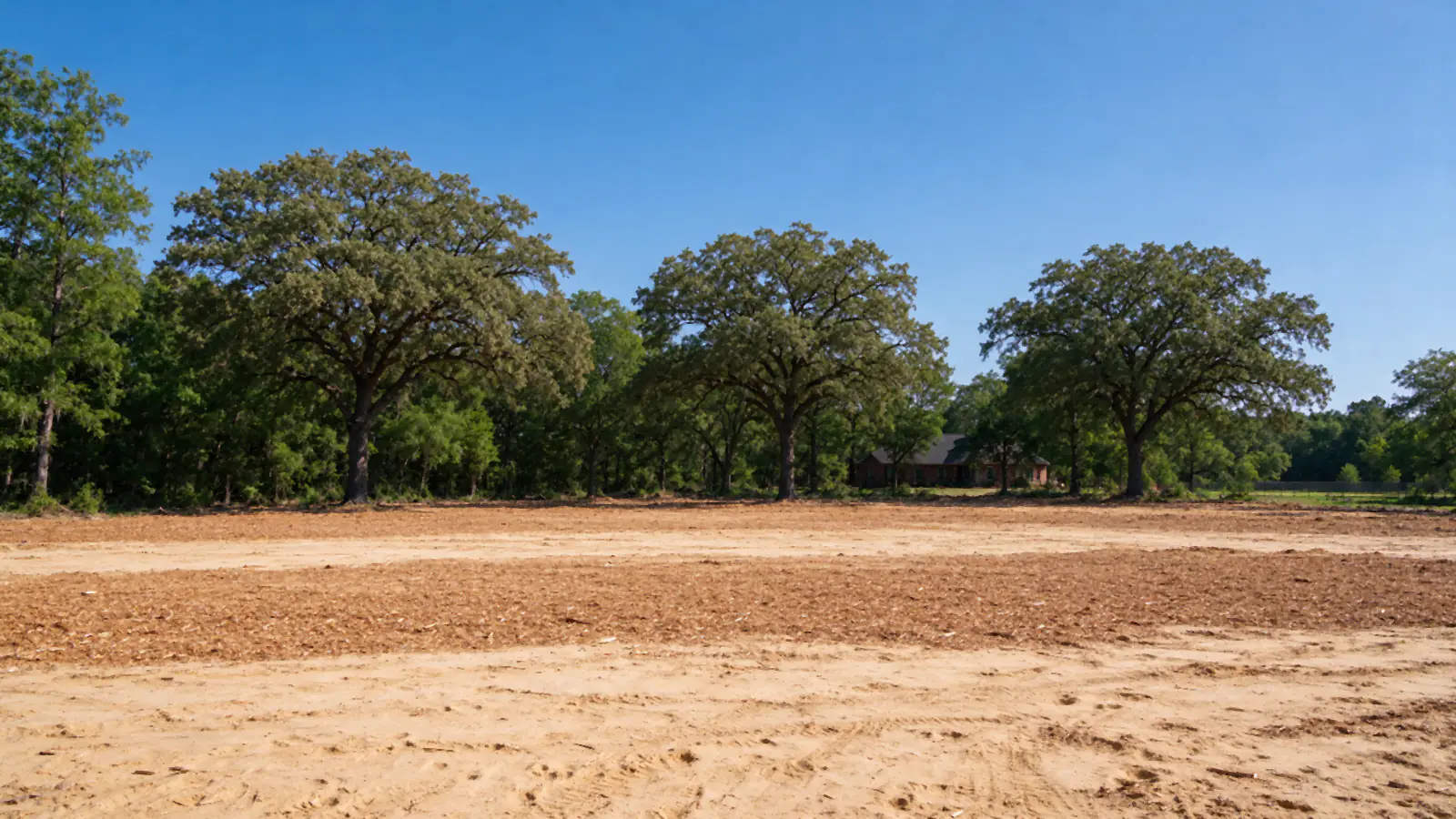
The clearing itself is usually forestry mulching of the understory around marked trees, with clearing and grubbing held to the pad and drive. The finish matters more on sand than on clay: the mulch layer stays as cover, and opened ground gets seed and silt fence through erosion control.
Post oak woods on Cross Timbers sand
Argyle lies in the Eastern Cross Timbers, the band of post oak and blackjack oak woodland on sandy soil running through south-central Denton County, while Justin, Roanoke and Sanger sit on Grand Prairie clay. The USDA soil survey maps Silstid loamy fine sand, Gasil fine sandy loam and Birome fine sandy loam at sample points around town, with some Wilson clay loam. Silstid and Gasil fall in hydrologic groups A and B: rain soaks in fast, and machines can usually return to the ground sooner after a storm than on the clay belt to the west. Birome has a clay subsoil, so a deep cut on those spots can reach sticky ground.
Erosion is the tradeoff. Sand stripped of its cover moves with the first hard rain, and the survey maps sloping sandy units and frequently flooded bottoms along creeks near Argyle. On a wooded lot the plan keeps leaf litter and mulch where it can, routes machines away from slopes that fall toward a creek, and sets silt fence on the downhill edge before grubbing starts. The wider rules for those bottoms are in clearing near creeks and floodplains.
The town’s history follows the land. The Texas Historical Commission marker at Argyle Town Hall, on Denton St. 0.2 mile east of US 377, records Peters Colony settlers in the 1850s and the town’s founding in 1881, when a railroad line came through. Argyle had an estimated 6,372 residents in mid-2025 against 4,399 at the 2020 Census base, and the town permitted 46 and then 10 new single-family homes over the two most recent years of Census permit data. That suggests fewer subdivision lots than Justin and more wooded acreage and homesites, where the question is how to get a lot cleared without losing the oaks that make it worth building on.
Mulching the understory and leaving the oaks
On much wooded Argyle land, the useful work sits below the protected size: shrubs, vines, saplings and dead wood that have filled in under the canopy. A forestry mulcher grinds that material in place and leaves stumps near grade with roots in the soil, which on sand is the point, since roots and mulch hold it. Roots stay behind, and woody brush can resprout from what stays, so a follow-up mowing or treatment pass belongs in the plan. Protected trees stay out of the machine’s path, and keeping tracks off the root zones of the oaks that stay matters as much as the cut, because compacted or scraped soil over the roots can weaken a tree for years.
A cleared Argyle lot is not ready for a foundation the day the mulcher leaves; the pad still needs grubbing, grading and a builder’s plan. The clearing land to build a house guide covers those steps, and the Justin page shows how the same questions play out on clay.