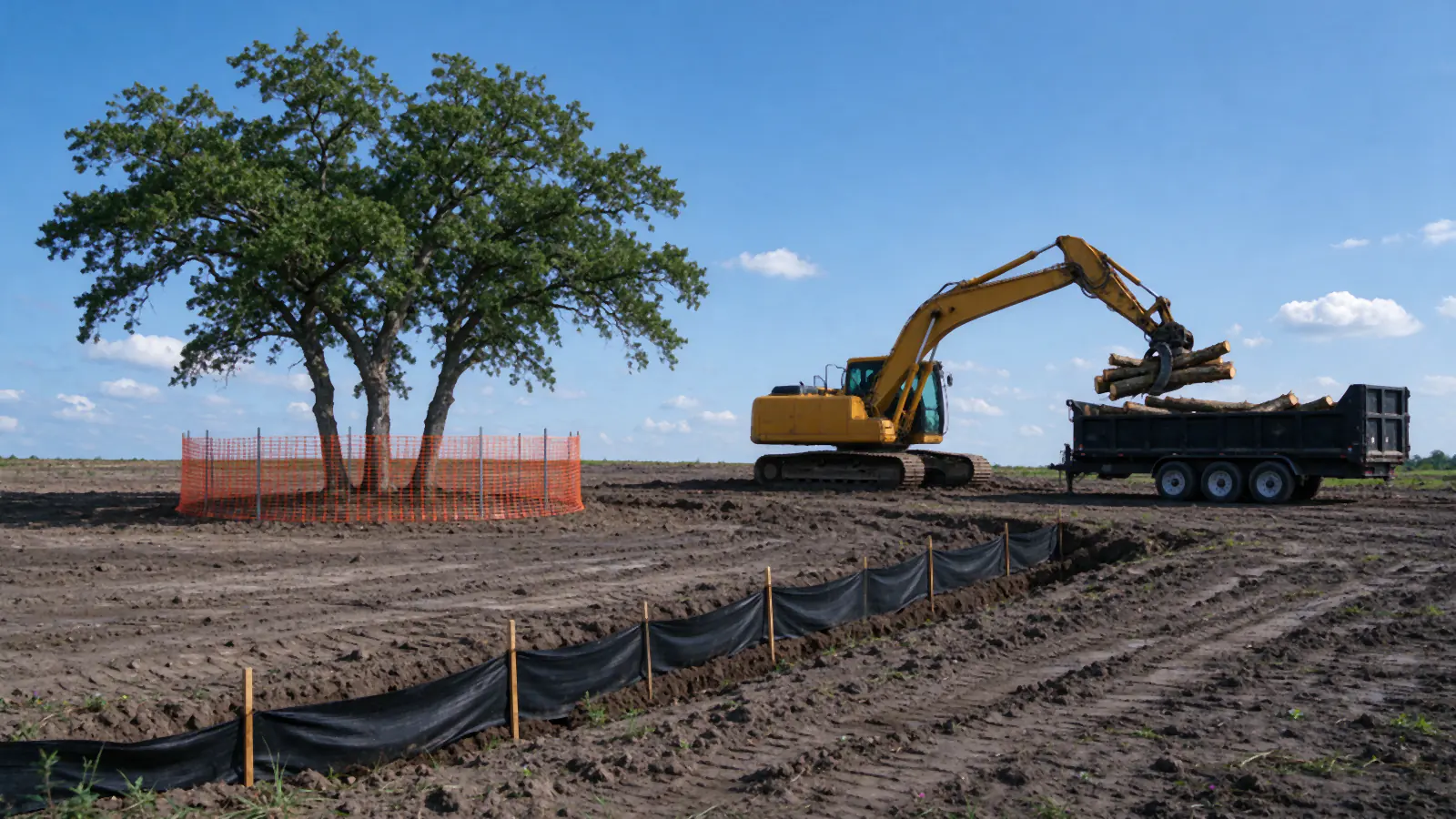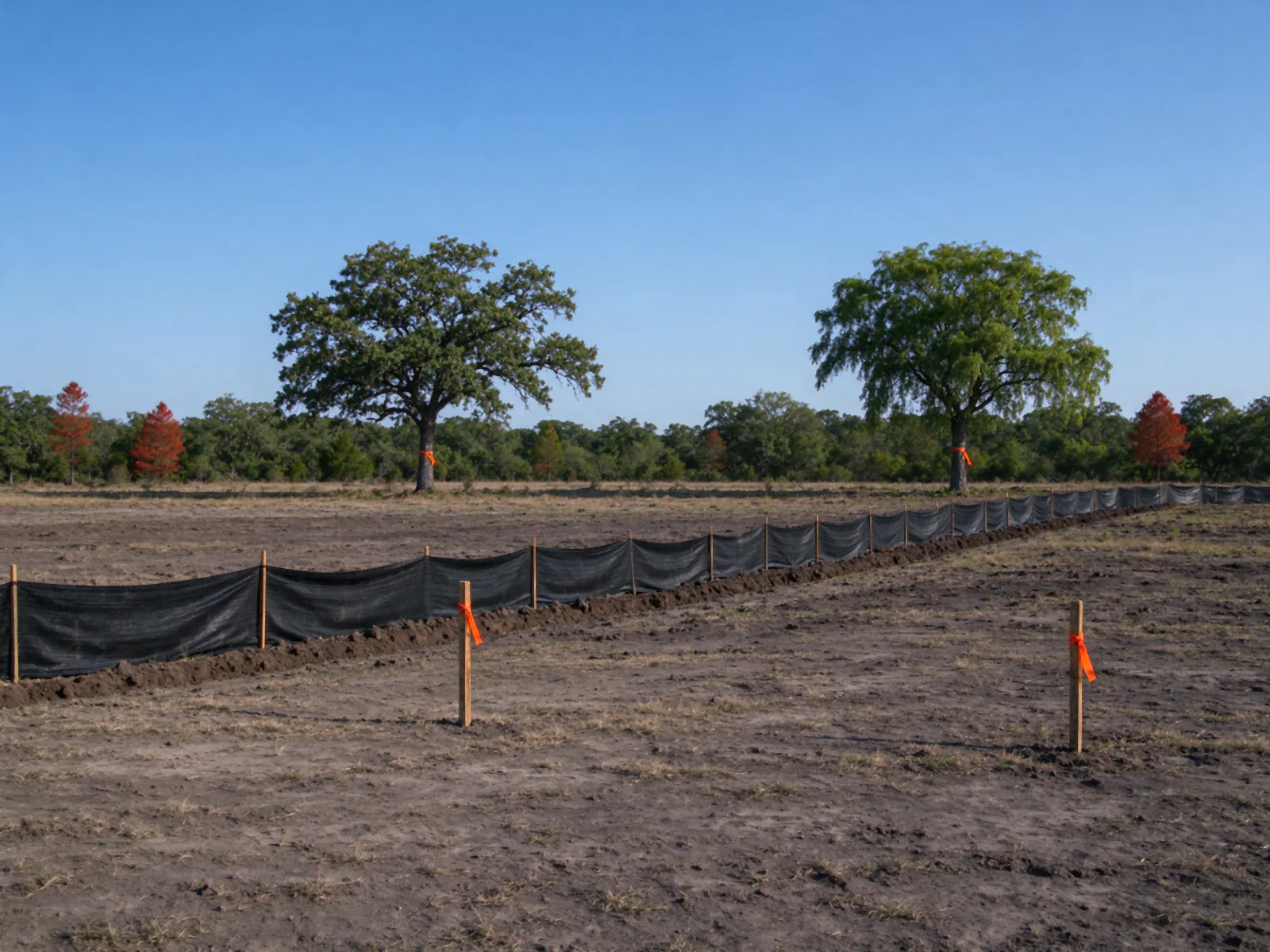
A land clearing quote should name the area to be cleared, the method, the finish level, how stumps and roots are handled, where the debris goes, which permits, locates and erosion controls are included, what is excluded, how the price is calculated and what changes it. It should also come with a certificate of insurance. Post Oak Land Clearing Denton uses the checklist below so bids can be compared line by line.
A price without those lines is not a cheaper job; it is an unknown one. On commercial and development sites the stakes rise further, because the clearing sits inside a permit, a stormwater plan and a schedule that other trades depend on.
The line-item checklist
Use this table to read any land clearing quote, whether it is for a half-acre homesite or a commercial tract.
| Line | What it should say | Why it matters |
|---|---|---|
| Clearing limits | Acreage plus the boundary: survey, site plan, staked or flagged limits | Prevents clearing past a line or stopping short of one |
| Keepers and protection | Which trees stay, how they are marked, protection fencing and who installs it | Root damage from machines kills preserved trees years later |
| Method | Forestry mulching, clearing and grubbing, selective clearing, brush hogging, or a mix by area | Each method leaves a different site |
| Finish level | Stumps at grade, ground below grade or pulled; roots grubbed or left; mulch spread; ruts smoothed | Defines the condition you are paying for |
| Debris disposition | Mulched in place, chipped, hauled (to where), firewood kept, or burned where legal | Haul-off and tipping can be a large share of the price |
| Permits | Which permits apply, who applies, whether fees are included | Work without a permit can stop the job and add a penalty |
| Utilities | 811 locate for work 16 inches deep or more; overhead line clearance plan | Required by Texas law before deep or near-line work |
| Erosion control | Silt fence by length, cover or seeding, stormwater plan where an acre or more is disturbed | Bare clay washes in the first heavy rain |
| Access and restoration | Entry route, gate or fence panels removed, mats on soft ground, what is put back | Driveway, turf and fence damage are common add-ons |
| Price basis | Per acre, hourly, day rate or lump sum, plus mobilization | Decides who carries the risk of slow ground |
| Changes | What triggers extra charges: hidden debris, rock, wet-weather standby, added area | Avoids disputes in the middle of the job |
| Exclusions | Grading, pad work, seeding, stump work or haul-off not included | What is left out is part of the comparison |
| Schedule | Start window, expected days on site, weather conditions | Lets the next trade plan |
| Insurance | Certificate of insurance on request | Protects you if something goes wrong on site |
Method and finish level
The method follows what the land is for. For pasture, trails or wooded acreage, forestry mulching grinds brush in place and leaves stumps at grade and roots holding the soil. For a building pad, drive or pond, stumps and roots have to come out, which is clearing and grubbing. Where good trees stay, selective clearing works around them. The forestry mulching vs land clearing guide compares them in detail.
Finish level is the part quotes most often leave vague. “Clear the lot” can mean brush mulched with stumps sticking up a few inches, or a clean, root-free surface ready for a grading contractor. Ask the quote to describe the ground on the last day: what height stumps are left at, whether roots are removed and to what depth, whether mulch is spread or piled, and whether ruts are smoothed. Clearing is not grading, and cleared land is not build-ready on its own; if pad grading is needed, the quote should say that it is excluded or name it as a separate line handled by land clearing and grading.
Stumps and roots, in words you can check
Stump wording is where two bids that look alike often differ most. “Stumps removed” can mean ground below the surface or pulled out whole. Ground stumps leave roots in the soil, which is fine under a lawn or pasture and wrong under a slab. Pulled stumps leave holes and root balls that need filling and hauling. The quote should give a grinding depth where grinding is used, and say where pulled stumps go.
Depth also carries a legal step. In Texas, machine work that disturbs soil 16 inches deep or more needs an 811 locate request no earlier than 14 days and no later than 48 hours before digging, excluding weekends and legal holidays. A quote that includes deep grinding or grubbing should say who places that ticket. Stump grinding and removal covers the options.
Debris disposition
Every quote should answer one plain question: where does the wood go? Mulching in place costs the least to handle. Hauling adds loading, trucking and tipping; brush at the City of Denton Landfill costs $30 a ton for a Denton customer with pieces up to 12 feet, $35 for longer pieces and $40 for non-Denton customers, with a $26.50 minimum a load. Construction debris, old fencing or dumped trash found during clearing is charged at different rates, so the quote should say how found junk is handled.
Burning is not a default. The Denton Fire Marshal’s Office does not allow open burning inside city limits, and in unincorporated Denton County a land-clearing burn is allowed only when no practical alternative exists and only on a county burn day. A quote that assumes burning should say where and under which rule. Denton County is also inside the emerald ash borer quarantine, so ash wood stays in the area. Land clearing debris removal and the burning brush in Denton guide go further.
Permits, locates and erosion control
Permits depend on where the land sits. Inside Denton city limits, clearing, grading or grubbing beyond 2,000 square feet or 25 cubic yards needs a $453 clearing and grading permit; protected trees need a $425 tree removal permit, with mitigation at $200 per caliper inch where it applies; and starting before the permit adds a $453 penalty. Justin requires a permit for any dirt work, Krum for clearing and grubbing, and Sanger an early grading approval before construction plans are approved. The quote should list which apply and who handles them.
Erosion control is a line, not an afterthought. Under the TCEQ construction general permit, disturbing an acre or more of soil needs permit coverage and a stormwater pollution prevention plan, and at 5 acres the Notice of Intent fee is $225 filed electronically or $325 on paper. Silt fence in Denton County TxDOT bids ran $3.40 to $5.00 a foot installed; on a single lot, short runs can cost more per foot. A quote should give the length of silt fence and what cover or seeding is included. See erosion control.
How the price is calculated
Land clearing is priced by the acre, by the hour, by the machine day or as a lump sum, and each moves risk differently. Hourly and day rates put the risk of slow ground on you; per-acre and lump-sum prices put it on the contractor, who prices it in. Mobilization, the cost of trailering a machine to the site, is usually separate or built into a minimum, and it is why small lots cost more per acre.
Ask what changes the price once work starts. Fair triggers are things nobody could see: buried concrete, wire grown into trees, rock, a wetter site than the walk showed, or added area you request. Those should be listed with how they will be charged. Payment terms, including whether a large job is paid in stages, belong on the quote too. The cost per acre guide explains the drivers and typical ranges, and the how long land clearing takes guide why hours vary.
Insurance and who is on site
Ask any contractor for a certificate of insurance, and read what it covers and the policy dates. General liability covers damage to your property or a neighbor’s. Workers’ compensation matters too, and in Texas it is a real question: according to the Texas Department of Insurance, Texas does not require most private employers to carry it, so ask whether the people on site are covered.
Also ask who will actually do the work and run the machines. Post Oak Land Clearing Denton offers and manages land clearing, with the work done by licensed and insured contractors, and the quote names the scope those contractors will carry out.
Commercial and development sites
On a development tract, the quote sits inside a larger set of documents. Clearing limits should match the approved site plan and the staked survey. Where Denton’s tree rules apply, the tree survey and preservation plan decide what stays, and development sites must keep at least 30% of heritage and quality tree diameter inside the development impact area. Tree preservation plan review alone runs $5,857 to $15,807 at the City of Denton, which shows how much of the tree work is settled before a machine arrives.
A commercial quote should also state the sequence and the handoff: clear, grub the structural areas, strip topsoil if specified, install erosion controls, then hand over to the grading contractor at a defined point. It should name documentation, such as photos of installed controls for the stormwater plan, and how site access and other trades are coordinated. Commercial land clearing covers these jobs.
Comparing two bids
Lay the quotes side by side against the checklist and mark the lines each one leaves blank. A lower total that mulches and leaves stumps is not comparable with a higher one that grubs, hauls and installs silt fence. Homeowners report receiving quotes that list only an acreage and a price; ask for the missing lines in writing before choosing.
Then ask the questions the quotes do not answer: what happens if it rains for a week, who calls 811, what the drive will look like afterward. The answers tell you as much as the numbers. The land clearing cost calculator gives a typical range to test both against.
Post Oak Land Clearing Denton offers and manages land clearing across Denton and the west and north of Denton County. Call (940) 204-6191 or request an estimate and send your site plan or survey if you have one.
Get a quote you can compare
Send the address, acreage, site plan or photos, and what the land is for. The quote lists method, finish level, debris and permits line by line.