Last Updated:
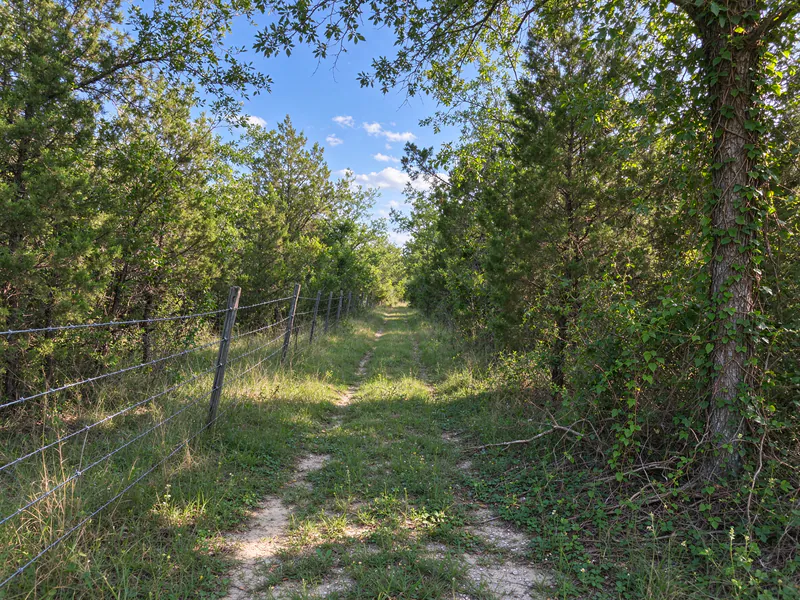
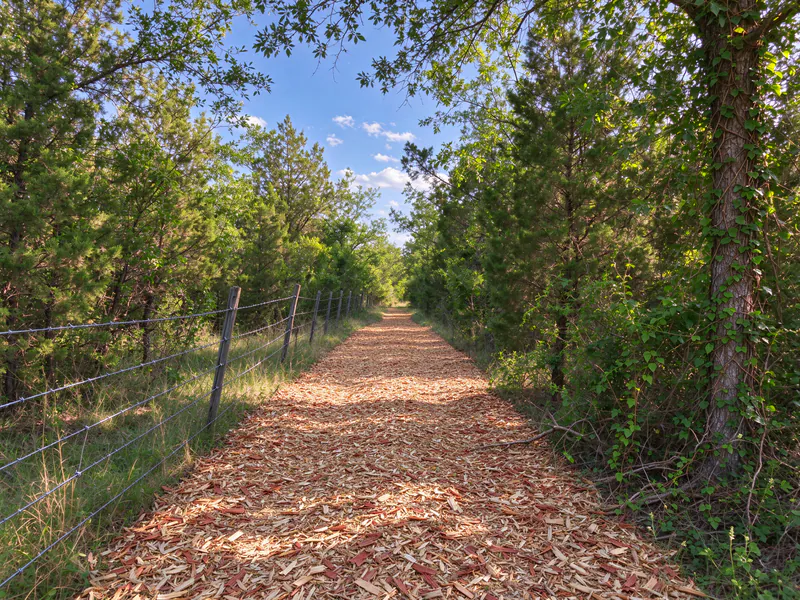
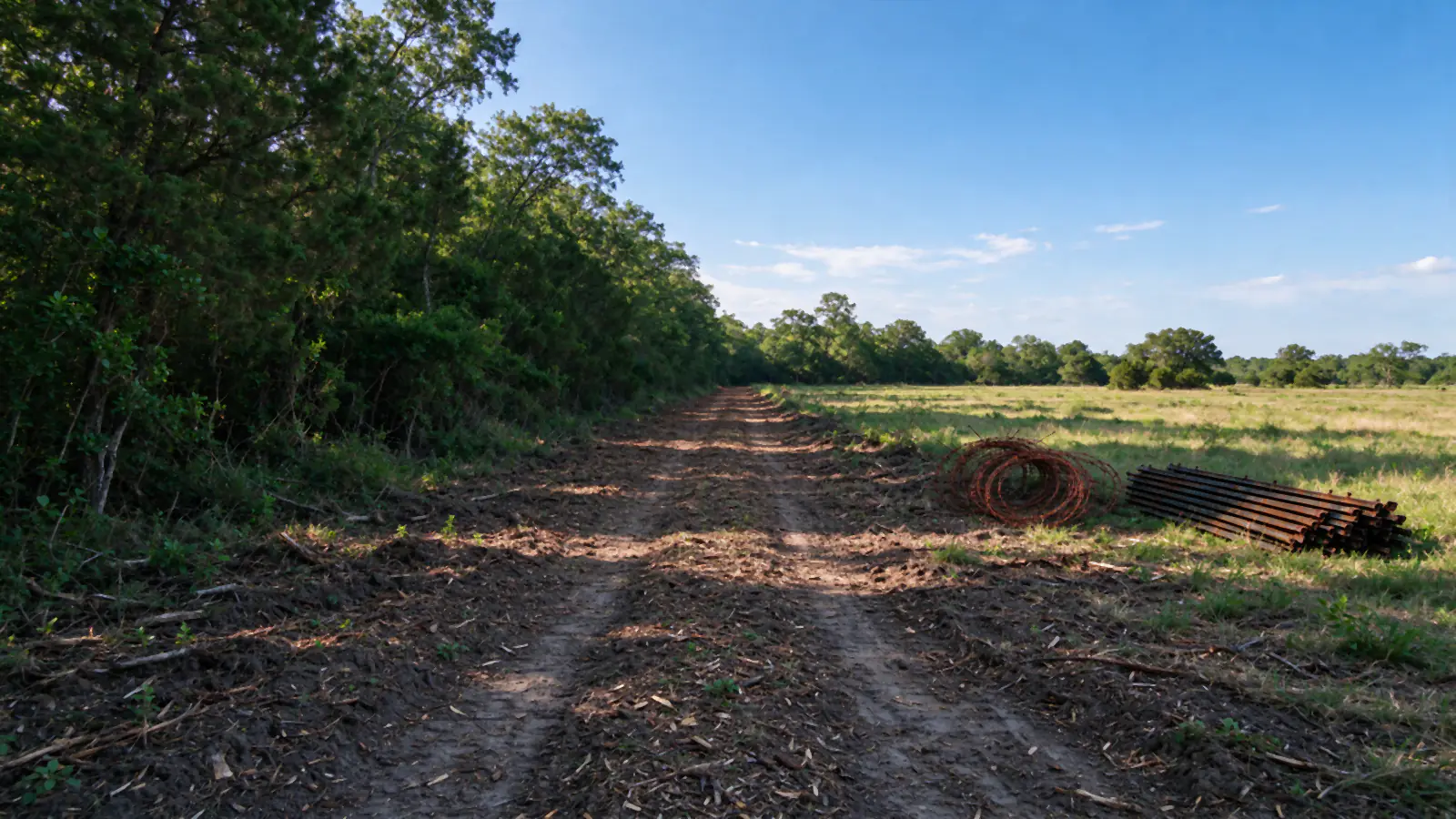
Post Oak Land Clearing Denton offers and manages easement clearing across Denton and the west and north of Denton County, with the work done by licensed and insured contractors. An easement is a strip of land that someone other than the owner has a right to use or cross: a shared drive to a back parcel, a ranch road along a neighbor’s fence, or the ground under a power line or above a pipe. Cutting the brush is the easy part. The hard part is knowing whose strip it is, how wide and tall the opening should be, and which pieces belong to the utility, so that is where every easement job begins.
What happens on the first visit
The first visit pins the strip down before anything is cut. Expect a walk of the full length, from the road to the far parcel, with the easement document or plat in hand, flags at both edges, a check of what runs overhead and underground, and a list of anything that stays with the utility.
Paperwork helps. A recorded easement usually states its purpose and often its width; a subdivision plat may show utility easements along lot lines. Where neither exists, the width is set with the owners on site and written into the scope. The walk notes poles, guy wires, pipeline markers, water meter boxes, culverts where the route crosses a draw, gates and cattle guards, and the soft spots where a loaded truck would sink.
Permits come next. Inside Denton city limits, clearing more than 2,000 square feet generally needs the city’s clearing and grading permit, currently $453, unless an exemption applies, and protected trees need a tree removal permit at $425. Every post oak 6 inches in diameter or more counts as a heritage tree there, and a long corridor through Cross Timbers woods can cross several. In Argyle, tree work inside a right-of-way or utility easement needs a tree removal permit backed by a certified arborist’s tree protection plan, which a third-party arborist hired by the town reviews; Argyle protects listed species from 3 inches of trunk caliper. The Denton tree removal permit guide and the Argyle page cover both.
Private easements and utility rights-of-way are different jobs
A private access easement and a utility easement can look identical from the road, a mown or overgrown strip running across someone’s land. Who clears each one, and how far they may go, is completely different.
Private access easements
A private access easement gives one parcel the right to cross another to reach a road. They are common where farms have been split into homesites, and Denton’s subdivision code, which the city applies in its extraterritorial jurisdiction, has specific rules for lots served only by a private access easement; variances from those rules come before Planning and Zoning. On the ground, the question is upkeep. Many recorded easements say which owner maintains the road surface and how costs are shared. Others say nothing. Where the document is silent, the workable route is a short written agreement between the owners on width, height, cost split and where the debris goes, signed before the machine arrives. A clearing contractor can price and clear the strip; settling a boundary or the scope of the easement belongs to the deed, a survey and, if needed, an attorney.
Utility easements and line clearance
A utility easement gives the electric, gas or pipeline company the right to keep its line clear, and the utility does that clearance itself. Denton Municipal Electric contracts a professional arboricultural service to prune trees within a minimum of 10 feet of its lines, using directional pruning, and its own guidance tells residents not to trim near the wires but to call DME at (940) 349-7000. CoServ, the cooperative serving much of the rural county, maintains trees along its lines on a three-year cycle and takes vegetation requests through an online form, with hazards reported at 855-938-3496. Oncor takes service requests at 888-313-6862. Service territories overlap across the county, so the utility for a given strip is confirmed from the meter or the bill, not assumed from a map.
What stays with the landowner is the ground: mowing, brush and saplings well below the conductors, and keeping fences and landscaping clear of pad-mounted transformers, where CoServ asks for 10 feet in front and 3 feet on the sides and back.
The 6-foot rule
Texas Health and Safety Code chapter 752 sets the hard line. Unless a high-voltage line, anything over 600 volts, is guarded, no person and no part of a tool, machine or material may come within 6 feet of it. Work closer than that needs the operator notified at least 48 hours ahead and an agreed arrangement, such as de-energizing, moving the line or barriers, paid for by whoever asked. Someone who causes contact is liable to the operator for all damages. Utility employees and the contractors the utility authorizes are exempt, which is exactly why clearance near the wires is the utility’s job.
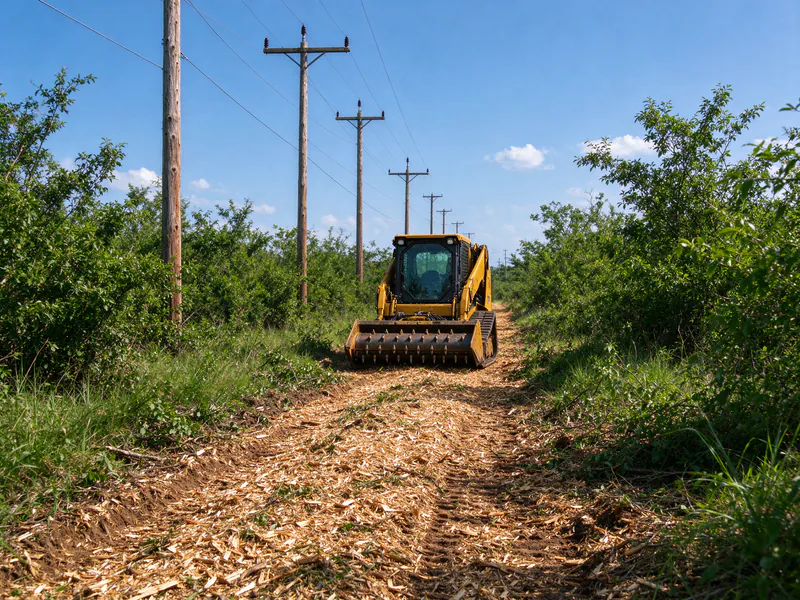
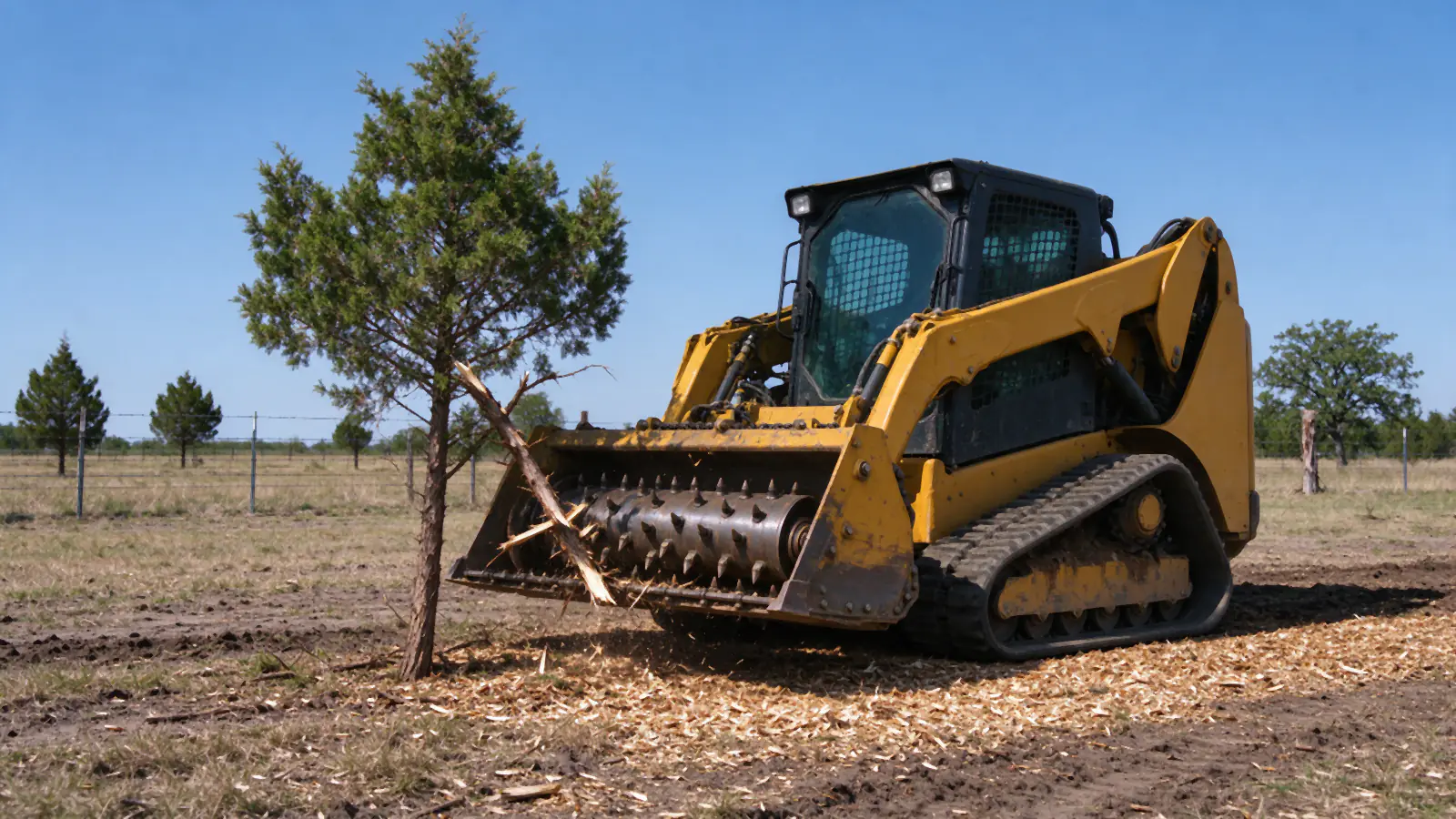
Six feet goes quickly. A mulching head on a loader arm reaches up as it climbs into brush, and a 40-foot tree standing 30 feet from a line can fall into it. Trees taller than their distance to the wires are left for the utility, and that list goes to the owner in writing. The clearing near power lines guide goes further.
Have an easement that has closed in?
Send the length of the strip, a few photos and the easement or plat if you have it. The walk-through sorts what you can clear from what the utility handles.
Access roads and shared drives: width, height and footing
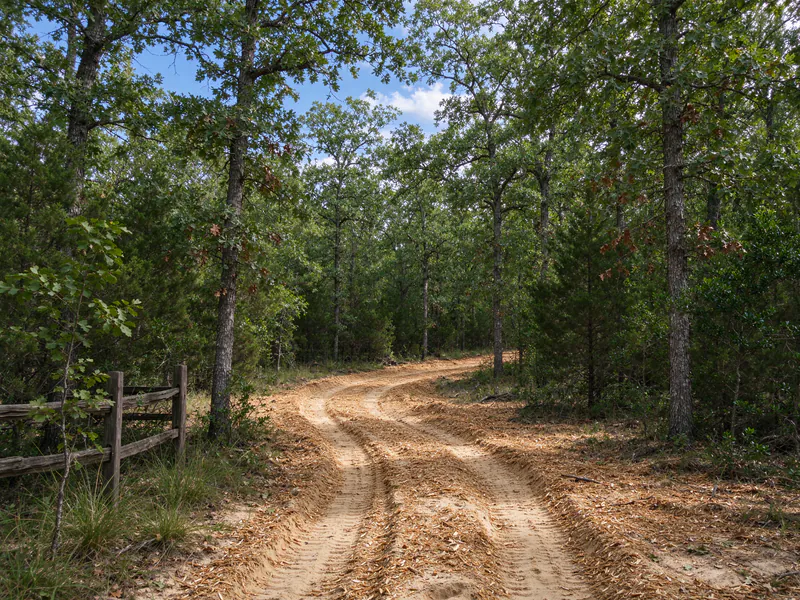
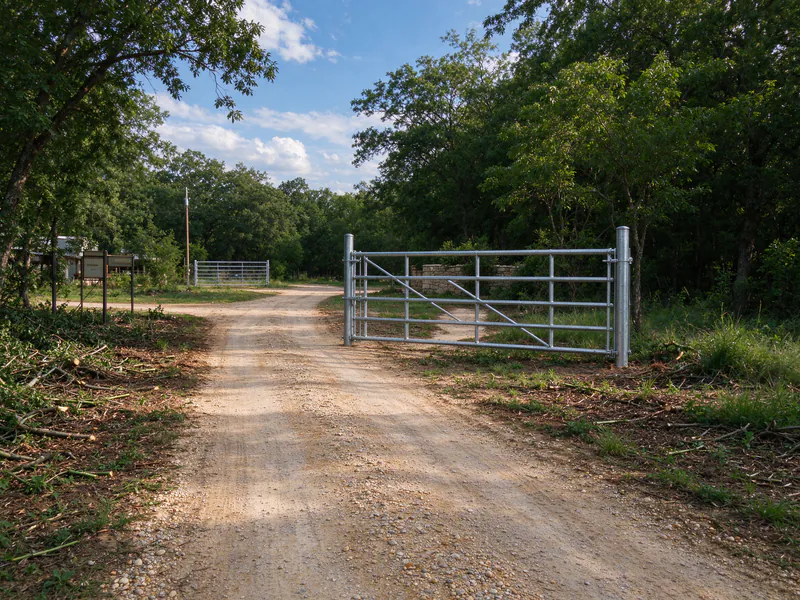
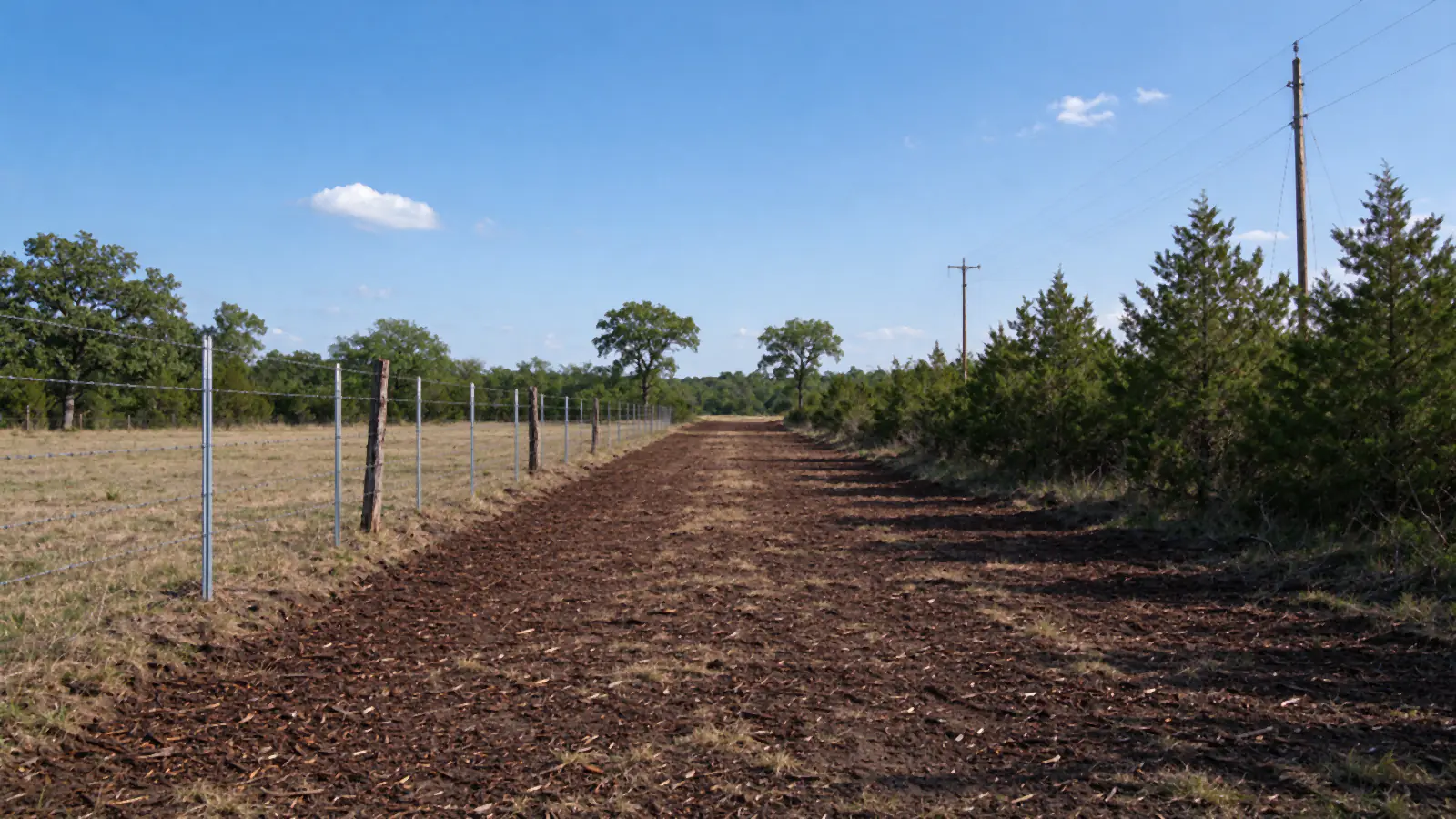
An access corridor is cleared for the vehicles that will use it. That means a travel lane plus a shoulder on each side so branches do not scrape mirrors, enough height for a loaded truck, and stumps low enough that tires and mowers pass over them.
Width comes from the easement if it names one. Height is set by the tallest vehicle: a moving truck, a fuel or feed delivery, a concrete truck for a future slab. City street rules offer a yardstick even though they do not govern a private drive. Denton’s code asks owners to keep limbs at least 13.5 feet over streets, 12 feet over alleys and 7 feet over sidewalks, and Krum asks for 14 feet of traffic clearance over its streets. If a fire truck or a builder’s deliveries must reach a back parcel, the access the fire department expects is confirmed for that address.
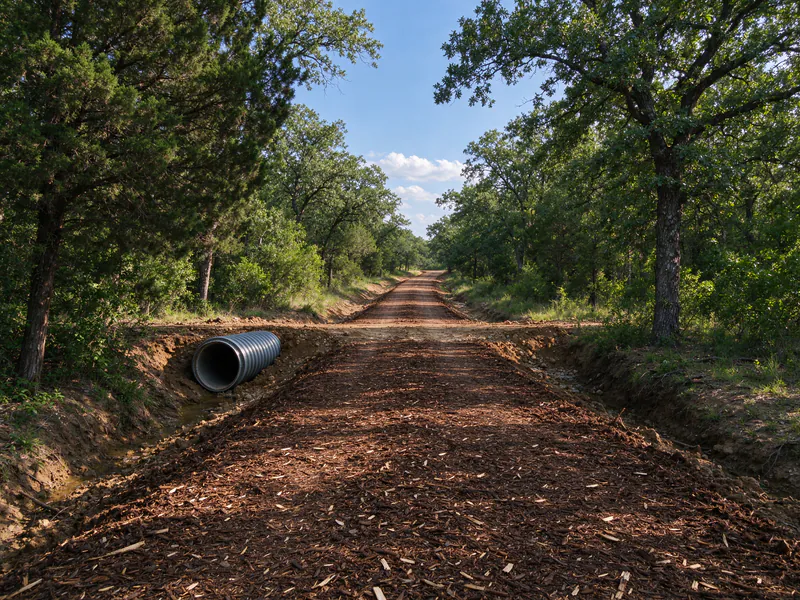
Clearing does not make a road. West of Denton the strip usually runs over Sanger or Slidell clay, hydrologic group D soils that shed water and turn slick when wet. Denton’s wettest months are May and October, at 4.52 and 4.17 inches, and a freshly cleared track over clay ruts quickly under traffic in those months. A gravel base, a culvert at a draw or a crown to shed water is earthwork; land clearing and grading covers the rough shaping, and stumps in the future travel lane are pulled with clearing and grubbing or ground below grade so the base does not settle over rotting wood.
Debris follows the shape of the job. A long strip makes a long line of material. Mulching spreads it along the shoulders, where it holds the soil beside the lane; forestry mulching explains the method. Hauling needs places for a truck to load and turn, which a narrow easement may not have, so debris removal is planned with the route in mind.
Keeping the strip open
A cleared easement starts closing again within a season or two. Eastern redcedar cut below its lowest green branch does not come back from the stump, but mesquite, honey locust and privet sprout from the roots left in the strip, and fence lines along easements seed new brush from birds perching on the wire. A shredding pass once the regrowth is knee high keeps it cheap; waiting until saplings reach wrist thickness turns maintenance into clearing again. Brush hogging handles the routine pass, fence line clearing handles wire-side strips, and keeping brush from growing back covers follow-up treatment.
Inside Denton, the vegetation code keeps grass and weeds at 12 inches or less. On tracts of 5 acres or more, that applies within 100 feet of an open street or a neighbor’s improved property, which often includes the front stretch of an access easement.
What easement clearing costs
No public price exists for private easement clearing, so it is priced from the strip itself. Length and width set the area: a strip 1,000 feet long and 20 feet wide is under half an acre, yet the machine travels the whole length, turns at the ends and may have to back out where there is no exit. Stem size and density set the pace, as on any clearing job. Work beside energized lines goes slower, while trees left for the utility come off the scope. Access at both ends, wet clay, culverts that must be protected, debris haul-off and erosion control on a slope all move the number, as does the cost of moving a machine for a small job.
The typical North Texas range for clearing light brush, $1,500 to $3,500 an acre, is a starting point only, because a narrow corridor costs more per acre than an open block. Inside Denton, add the $453 clearing and grading permit where it applies and the $425 tree removal permit for protected trees. The land clearing cost calculator gives a rough range, and what a land clearing quote should include shows how to compare written scopes for a corridor job. For a wider look at Denton rules, start with clearing land in Denton.