Inside Denton city limits, the answer is usually yes on undeveloped land and on sites being redeveloped, and usually no for a tree on an existing single-family or duplex lot. The city’s own wording is that any tree to be removed requires a permit submittal and exemptions may apply, so even exempt work starts with a filing.
Post Oak Land Clearing Denton offers and manages land clearing and selective clearing across Denton and the west and north of Denton County, with the work done by licensed and insured contractors. This guide reads Denton’s tree rules the way a clearing job meets them. The city reviews these rules from time to time, so check the current Denton Development Code before relying on any single figure here.
Which land the Denton tree rules cover
The preservation rules apply to three kinds of property inside city limits: undeveloped land, nonresidential and multifamily property being redeveloped, and existing single-family or duplex lots whose owners apply for a demolition permit for the main building. On those demolition lots, the protected-tree threshold rises to 10 inches in diameter.
That scope is why two neighbors can get different answers. Someone trimming out a dead hackberry behind an occupied house is on exempt property. Someone clearing a vacant 3-acre tract for a future house is on undeveloped land and squarely inside the rules, even if no building plans exist yet.
The rules stop at the city limit. In Denton’s extraterritorial jurisdiction the city applies its subdivision and platting rules, but state law limits what a city can regulate there, and the city-limits tree preservation section generally does not reach ETJ tracts. Nearby towns run their own codes: Argyle’s tree rules apply throughout its ETJ and protect listed species from 3 inches, and Roanoke bans clear-cutting outright. The Argyle and Roanoke pages cover those. Check which jurisdiction a tract sits in before reading anything else.
Exemptions, and why you still file
The city lists these exemptions from tree preservation:
- Agricultural operations as defined in Texas Agriculture Code 251.002(1).
- Property with an existing single-family or duplex dwelling, except trees set aside for preservation on an approved tree survey, plan or plat.
- Dead, diseased or nuisance trees, or trees damaging a foundation, confirmed by a qualified professional.
- Trees made hazardous by a storm or other act of nature.
- Trees on the Texas Department of Agriculture Noxious and Invasive Plant List.
- Understory clearing for soil borings, surveys, tree surveys or protection fencing, up to 4 feet wide for a general survey and 8 feet for a boundary survey, with no protected tree of 10 inches or more removed.
An exemption is claimed, not assumed. The application goes through Building Safety on eTRAKiT with a site plan or aerial, photos and the signed form. If the exemption holds up, no fee is charged; the city may inspect first. Two traps are worth knowing. The agricultural exemption in the tree rules does not carry over to the clearing and grading permit, whose own agricultural exemption covers normal crop soil work and excludes tree removal. And on multifamily or nonresidential sites with an approved landscape plan, any tree that comes out, even a dead one, has to be replaced. The ag exemption and land clearing guide covers the farm side in more depth.
Which trees are protected: the four classes
Denton sorts trees by species and by diameter at breast height (dbh), measured 4.5 feet above the ground. A multi-trunk tree counts as its largest stem plus half of each other stem.
| Class | What qualifies | What it means on a clearing job |
|---|---|---|
| Heritage | All post oaks 6 inches dbh or more, and any quality tree over 18 inches | The trees most worth planning around; replaced at the highest rate |
| Quality | Healthy trees 6 to 18 inches that are not post oaks or secondary species | Includes cedar elm and, under the current text, eastern redcedar |
| Secondary | Healthy ash, bois d’arc, hackberry or cottonwood over 6 inches | Lower replacement requirement, counted per tree |
| Non-protected | Dead or unhealthy trees, imminent hazards, crepe myrtles, ornamental pears, mesquite, honey locust and listed invasive species | No preservation or mitigation, unless inside a preserved habitat or conservation easement |
The post oak rule matters most on Cross Timbers ground. A post oak only 6 inches across, the kind that fills the understory of an old oak motte, is already a heritage tree. The city’s urban forestry figures name post oak among Denton’s three most common species, with hackberry and cedar elm.
Ash deserves a separate note. Emerald ash borer was identified in Denton in 2020 and Denton County sits inside the Texas Department of Agriculture quarantine. A dead or dying ash confirmed by a qualified professional falls under the dead-and-diseased exemption, and ash wood should be chipped on site rather than moved out of the county.
How preservation is counted
On regulated land, the code sets a floor for what stays before it talks about what is replaced. All landmark trees are preserved. At least 30% of the combined diameter of heritage and quality trees inside the development impact area must be kept. That share can drop to 20% where a conservation easement or preserved habitat covers at least 10% of the property or 5,000 square feet, whichever is greater, or where the missing 10% is mitigated at 2.75 to 1 for heritage trees and 2.25 to 1 for quality trees. If a site has no heritage or quality trees, 20% of secondary-tree diameter is kept instead.
Preserved trees earn credit against replacement: 3 to 1 for heritage trees, 2 to 1 for quality, 4 to 1 for landmark or conservation-easement trees and 0.5 to 1 for secondary trees. That is the logic behind most selective clearing in town. Keeping a big post oak can be worth more on the worksheet than planting a row of new trees.
Replacement and mitigation
Trees removed beyond the preserved share are replaced in caliper inches: 2.5 inches for each inch of heritage tree removed, 2 inches for each inch of quality tree and 4 inches for each secondary tree. Texas Local Government Code 212.905 then applies an automatic credit of 50% on residential and mixed-use projects and 40% on nonresidential ones. Replacement trees must be at least 2 inches in diameter, no single species may make up more than 30% when 20 or more are planted, and a preserved or replacement tree that dies within 3 years has to be replaced.
Inches that are not planted can be paid into the city’s tree fund at $200 per caliper inch. The payment is due before the final plat is filed or, with no plat, before the tree removal permit is issued.
An illustrative example, not a city calculation: a residential project removes 12 inches of heritage post oak beyond its preserved share. At 2.5 to 1 that is 30 replacement inches; the 50% residential credit brings it to 15. Planted on site, that is a handful of 2-to-3-inch trees. Paid in lieu, it is 15 times $200, or $3,000. The city’s own worksheet decides the real figure.
State law also caps what a city can charge on a home lot. Under LGC 212.905, a city may not require a mitigation fee for a tree under 10 inches in diameter on an existing one- or two-family home that is the owner’s residence, and planting a tree of at least 2 inches earns credit against any fee.
Clearing around protected trees?
Send the address and photos of the trees you want to keep. The walk-through marks keepers and lists the permits before any machine arrives.
The steps, in order
- Confirm the jurisdiction. City limits, ETJ, another town or unincorporated county; the county’s appraisal and GIS maps show it.
- Get a tree survey and plan. It must be prepared by an ISA or ASCA arborist, an SAF forester, a botanist, a trained surveyor or a registered landscape architect. If no protected trees exist, one of them signs a notarized letter saying so. A survey and preservation plan are required with a site plan, preliminary plat, replat, gas well site plan or clear-and-grade permit, whatever the tree count.
- Wait for the plat where one is needed. No protected tree may be removed for development until the final plat is approved and the Building Official issues the tree removal permit.
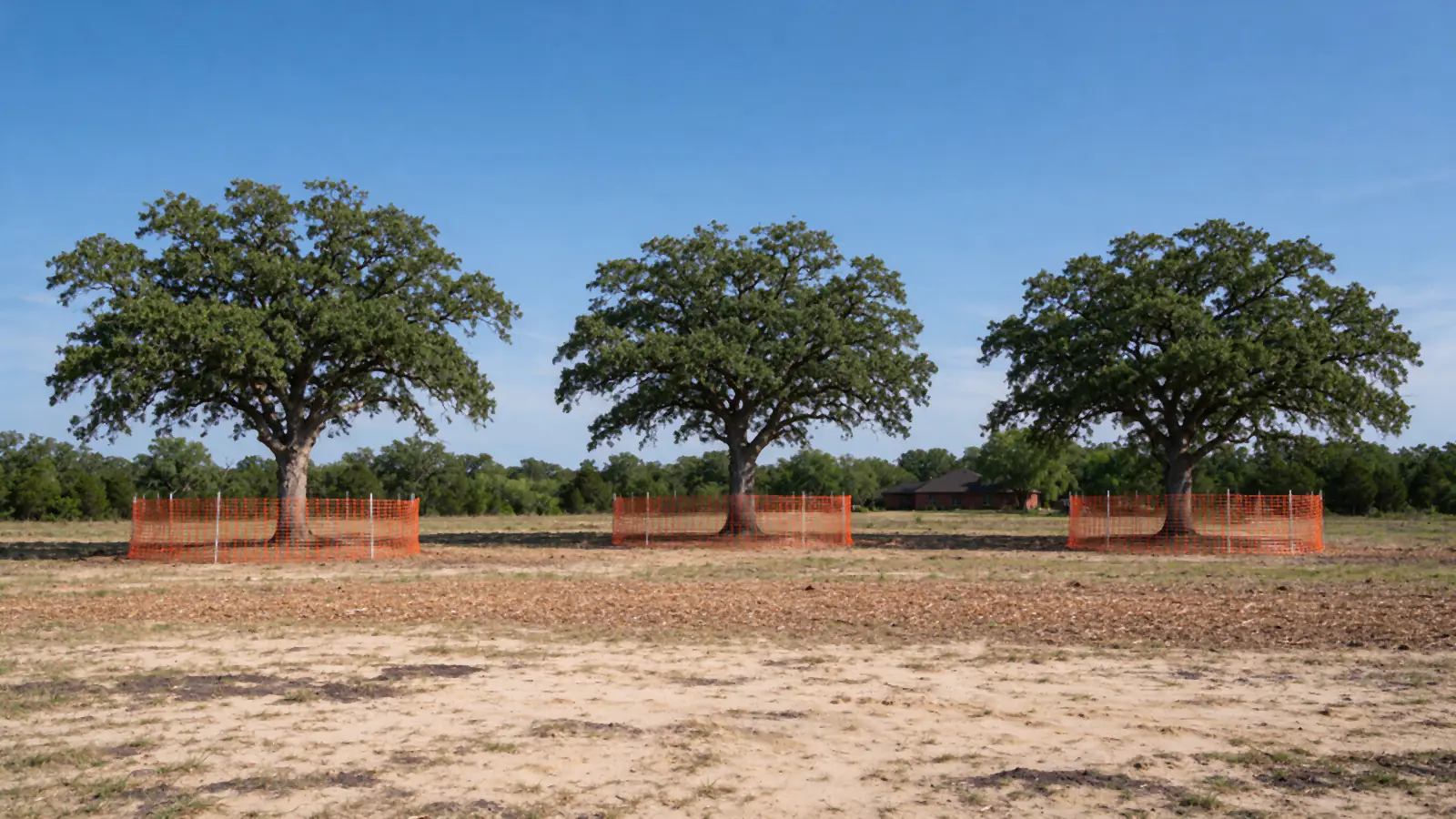
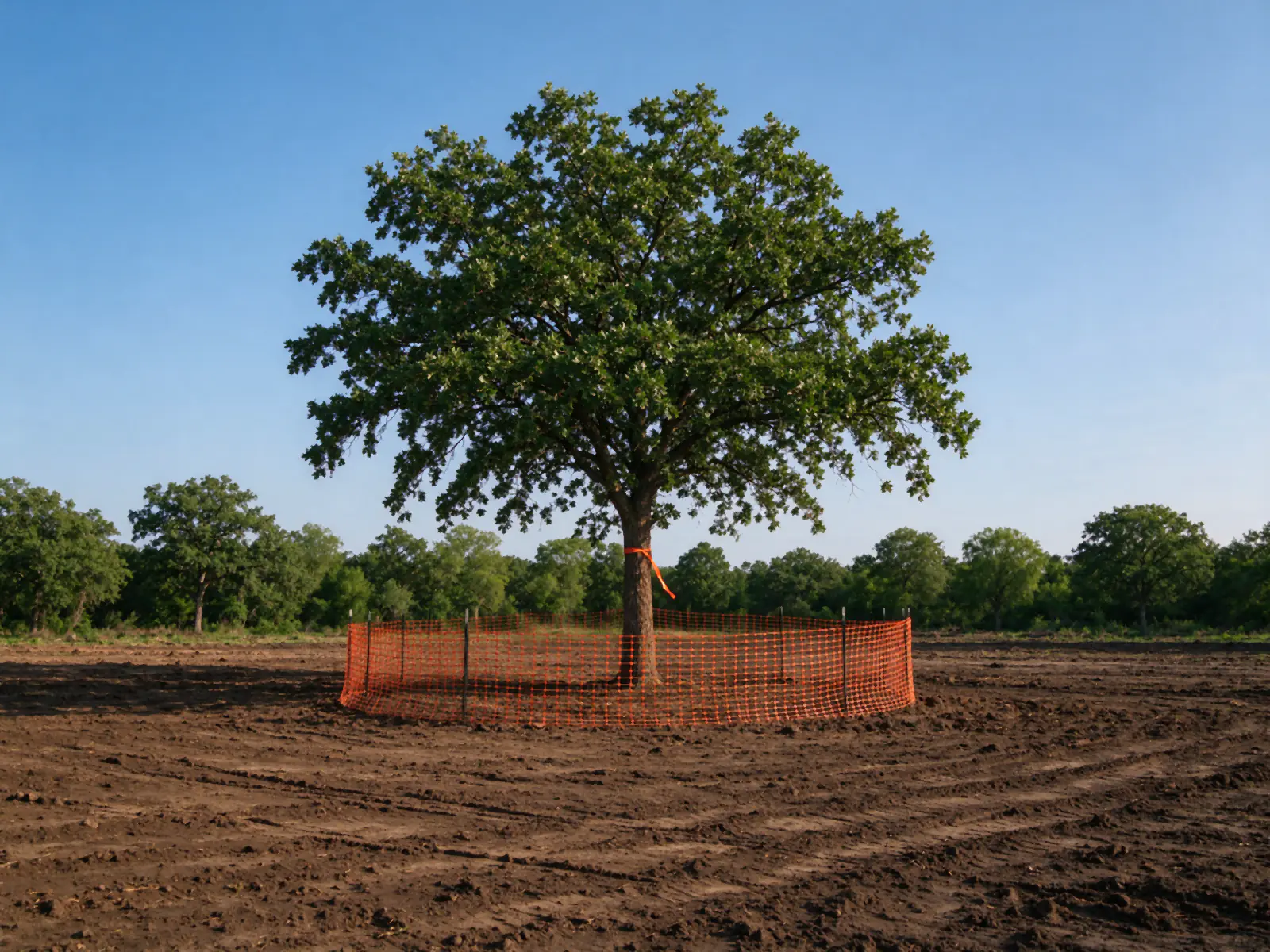
- Install protection fencing. Orange mesh at least 4 feet tall goes up around preserved trees before any permit is released and before grading or brush removal starts. No fill or digging inside the dripline. The fencing inspection, scheduled on (940) 349-8600, must pass before the permit is issued.
- Pay fees and mitigation, then clear. The permit is valid for 180 days or the life of the associated building, clearing-and-grading or clearing-and-grubbing permit.
Fees that come with it
| Fee | Amount |
|---|---|
| Tree removal permit | $425 |
| Clearing and grading permit, when the job disturbs more than 2,000 square feet or 25 cubic yards | $453 |
| Working without a permit | $453 |
| Tree mitigation paid in lieu | $200 per caliper inch |
| Tree preservation plan review, development sites, by tree count | $5,857 to $15,807 |
These are City of Denton fees. Most clearing jobs that need a tree removal permit also need the clearing and grading permit, because the same machines are opening the ground. The cost per acre guide shows how they sit inside a full price.
How the rules shape the clearing work itself
The tree code changes the method as much as the paperwork. A tract with heritage post oaks scattered through it is a selective job: understory mulched in place, keepers fenced, machine routes kept outside the driplines so tracks do not compact the roots. A dozer clearing and grubbing everything into windrows is the wrong tool there, even before the mitigation bill. Where trees sit on or near a creek, the city’s environmentally sensitive area rules add another layer, covered in the creeks and floodplains guide.
Mesquite and honey locust thickets are the opposite case. Both are non-protected, so a pasture overgrown with them can be cleared without mitigation, though root crowns left in the ground resprout. Cedar is the reverse surprise: a healthy redcedar 6 to 18 inches across on regulated land is a quality tree, which changes the plan for cedar clearing inside the city. Trees near Denton Municipal Electric lines are a third case, covered in the power lines guide: DME’s contractors prune within at least 10 feet of its lines, and the utility asks residents not to trim there. For a homesite, the clearing land to build a house guide puts the permit steps in the order the build needs them, and lot clearing covers the work.
If you are not sure whether your trees are protected, a few photos and the address are enough to start. Call (940) 204-6191 or request an estimate, and the walk-through will list the permits your property needs.