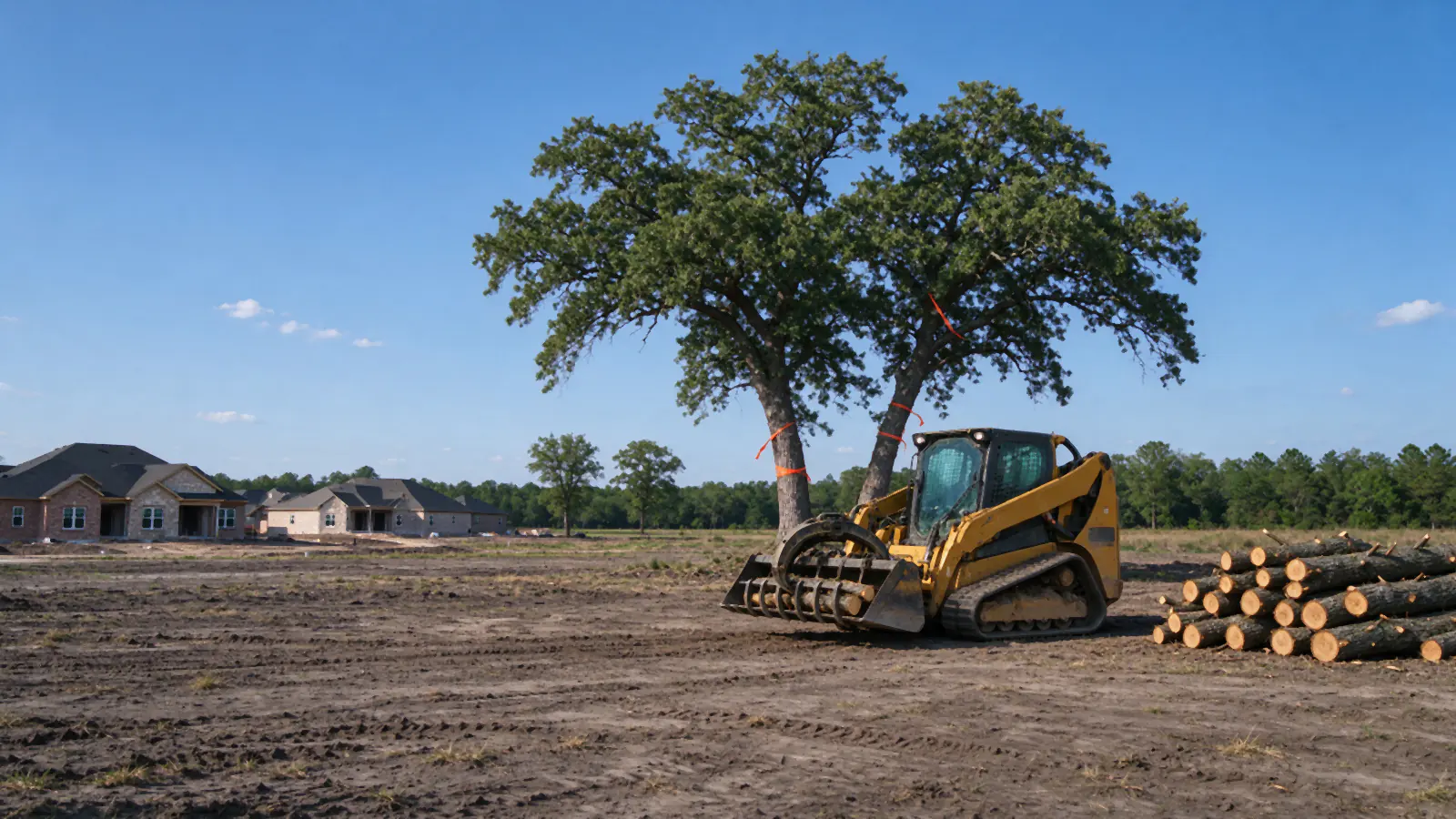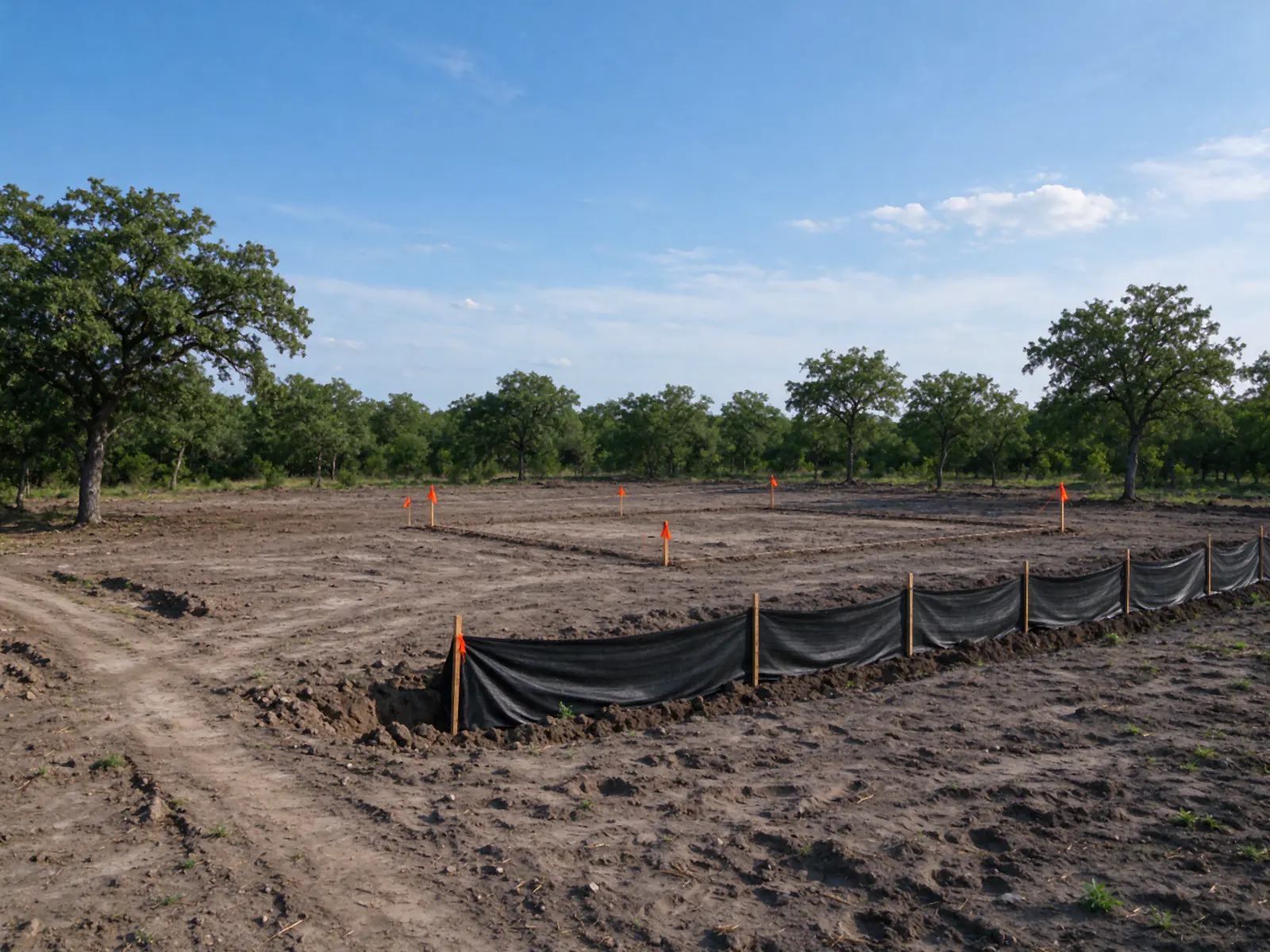
Clearing land to build a house happens in stages. The footprint, drive and utility routes are staked and keeper trees protected, permits are pulled, the vegetation comes down, and then the stumps, roots and topsoil under everything that carries weight are removed. Erosion control goes in, and the site passes to grading. Cleared land is a starting point, not a pad.
Post Oak Land Clearing Denton offers and manages lot clearing for homesites across Denton and the west and north of Denton County, with the work done by licensed and insured contractors. This guide walks through the order the work follows and the local rules that set it.
Why cleared ground is not a building pad
A slab or pier-and-beam foundation needs firm, uniform soil under it. Clearing alone leaves stumps, root systems and a layer of dark, organic topsoil, and all three are poor under a foundation. Roots rot and leave voids. Topsoil compresses more than the mineral soil below it. Chips and grindings break down and settle.
The clay west and north of Denton makes this sharper. Sanger clay and Slidell clay are high shrink-swell soils, with linear extensibility up to 9.1% and 10% in the USDA soil survey, which means they swell when wet and shrink as they dry. A pad built over pockets of rotting roots or uneven organic soil gives that movement places to concentrate. The builder’s or engineer’s pad requirements decide how deep the stripping goes and what replaces it; the clearing job’s part is to leave clean ground for them to work from.
Clearing also does not change the shape of the land. A lot that slopes before the trees come down still slopes afterward, and leveling it is grading. Keep those two scopes distinct on every quote, and see land clearing and grading for the earthwork side.
Plan the footprint before anything is cut
The most expensive mistake on a homesite is clearing the wrong area: too much, so trees worth thousands in shade and mitigation are lost, or too little, so a machine comes back later. Start with a site plan, even a rough one, that shows:
- The house footprint plus a working margin for forms, scaffolding and equipment, agreed with the builder.
- The driveway line from the road, including where it crosses any ditch.
- The septic field area your designer lays out, if the lot is not on sewer; its rules are confirmed per address.
- Water, electric and gas routes, and any overhead lines the drive or house will sit under.
- Trees to keep, each with a protection line around its root zone.
On a wooded lot that plan usually splits the land into three zones. The structural zone is cleared and grubbed. The yard zone is cleared with stumps ground below the surface. The kept-woods zone is mulched underneath or left alone. Pricing each zone for what it needs is far cheaper than grubbing the whole tract, and the forestry mulching vs land clearing guide explains how the methods divide.
Permits for a homesite, place by place
The permit path depends on the jurisdiction more than on the size of the lot.
| Where the lot is | What applies before clearing for a house |
|---|---|
| City of Denton | Tree survey and plan with any clear-and-grade permit; no protected tree removed until the final plat is approved and the tree removal permit ($425) is issued; clearing and grading permit ($453) beyond 2,000 square feet or 25 cubic yards; an early clear-and-grade permit can come before the building permit once the plat is filed |
| Denton ETJ | City subdivision and platting rules apply; city-limits tree rules generally do not; floodplain standards still reach |
| Unincorporated Denton County | County development permit for improvements to a property, and for any digging, fill, culvert or pond work in a flood zone |
| Justin | City permit before any dirt work, grading or earth disturbance; erosion control maintained at all times |
| Sanger | Early grading only with written approval after a final plat is accepted, an engineer-sealed erosion control plan and a stormwater plan; early grading fee $400 |
| Krum | Land development permit for clearing, grubbing and other land-disturbing work |
| Argyle | Tree survey and tree protection plan approved before any site-work or grading permit; residential grading, drainage and erosion control permit $200 |
| Roanoke | Council-approved tree preservation plan where protected trees exist; no clear-cutting |
| Ponder | No clearing or tree permit listed; confirmed per address |
Inside Denton, the tree rules apply to undeveloped land, so a vacant lot bought for a new house is covered even though a house will soon sit on it. The Denton tree removal permit guide explains the preservation share, replacement rates and the 4-foot protection fencing that must pass inspection first. Lots near a creek can fall under the city’s environmentally sensitive area rules, covered in the creeks and floodplains guide.
The sequence, step by step
- Survey and stake. Boundary corners, the house footprint and the drive line are marked so nobody clears to a fence that sits a few feet off the true line.
- Tree survey and protection. Keepers are tagged and fenced outside their driplines. Inside Denton, the fencing inspection comes before the permit.
- Permits. Each one in the table above that applies, in the order the town requires.
- Utility locates. Texas law requires a Texas811 notice at least 48 hours ahead, excluding weekends and legal holidays, for machine work that disturbs soil 16 inches or deeper, which grubbing does.
- Erosion control on the low side. Silt fence goes in along the downhill edge before the soil is opened, not after the first storm.
- Clearing. Trees are felled or pushed, brush mulched or piled, working from the footprint outward.
- Grubbing the structural zone. Stumps and root balls are pulled and buried organics raked out under the house, garage and drive. See clearing and grubbing.
- Topsoil stripping and stockpiling. Where the pad specification calls for it, the organic topsoil is stripped and piled for later use in the yard.
- Debris out. Logs, root balls and slash are hauled or ground. Burning is not allowed inside Denton city limits; outside, the county’s rules are tight, as the burning brush in Denton guide explains.
- Handoff to grading. The cleared, grubbed footprint is turned over for cut, fill and compaction to the builder’s elevations.
A mobile home site follows the same order on a smaller footprint: a clean, root-free pad and a drive firm enough for the delivery truck, with stumps pulled where the piers and the drive will sit.
Clearing for a new house?
Send the address, the rough house location and a few photos. The walk-through maps which areas get grubbed and which only get cleared.
Stumps, roots and buried debris
Under a building, the stump has to go with its root ball, and the large lateral roots are raked out. A stump ground 12 inches down still leaves the main roots in place, which is acceptable under a lawn and not under a slab. A grubbing pass also turns up what years of brush hid: old fence wire, concrete from a past outbuilding, dumped trash. A walk-through reduces those surprises but cannot rule them out, so a good quote says how found debris is handled.
Burying the stumps on the property is tempting and wrong anywhere near the house. Buried wood rots for years and the ground above it settles, so a burial pit belongs, if anywhere, far from anything built. Grinding or hauling is the usual answer, and stump grinding and removal covers the yard-zone stumps.
Erosion and stormwater on a homesite
A grubbed footprint is bare clay, and bare clay sheds rain. Under the TCEQ construction general permit, construction that disturbs 1 acre or more, or is part of a larger common plan that will, needs stormwater permit coverage and a stormwater pollution prevention plan. Sites of 5 acres or more also file a Notice of Intent, at $225 electronically or $325 on paper. A single house on a large tract can cross the 1-acre line once the pad, drive, septic field and staging areas are added together.
Silt fence along the low edge is the usual first control, at $3.40 to $5.00 a foot installed in Denton County TxDOT bids. Sanger’s grading rules add a line worth following anywhere: cleared weeds, grass and brush must not be left where they will wash into the storm sewer or a creek. Erosion control covers cover, seeding and the controls that come after.
When to clear, and how long it takes
Clear as close to the start of construction as the schedule allows. A cleared lot left for months regrows, washes and may need a second pass. In Denton, a tree removal permit lasts 180 days or the life of its associated permit, and a clearing and grading permit expires a year after issue, so clearing too early can also run the paperwork out.
Weather sets the rest. May and October are the wettest months in NOAA’s normals for Denton, and saturated group D clay ruts under tracked machines and will not compact properly for a pad. A week of dry weather after heavy rain is often needed before grubbing and grading. On a single homesite the machine work can take days rather than weeks once permits are in hand, while permits and weather often take longer; the how long land clearing takes guide gives the factors.
What clearing for a house costs
Typical North Texas ranges for land clearing run $1,500 to $3,500 an acre for light brush, $2,500 to $4,500 for moderate brush with small trees and $3,500 to $6,500 or more for heavy woods. A homesite adds what those ranges leave out: grubbing of the footprint, haul-off, permits, mitigation inside Denton, erosion control and grading. Small lots also carry a full machine move whatever their size. The cost per acre guide includes an illustrative budget for a wooded acre in the city, and the quote checklist helps compare bids that split the work differently.
To start, send the address, a rough sketch of where the house and drive will go and photos of the trees you want to keep. Call (940) 204-6191 or request an estimate.