
Last Updated:
In Justin the first question on a clearing job is not how thick the brush is but whether the dirt will move. Post Oak Land Clearing Denton offers and manages land clearing, lot prep and forestry mulching in Justin, with the work done by licensed and insured contractors, and every plan here starts from the city’s rule that no dirt work, grading or earth disturbance may happen without a permit.
What changes inside Justin city limits
Two city rules shape a Justin job before a machine is unloaded. The grading permit covers any earth disturbance, and the burn rule makes burning off a lot a supervised exception rather than a cleanup option. Both push the work toward methods that keep soil in place and debris on site or on a truck.
The grading rule comes from the City of Justin’s residential inspection guidelines: no dirt work, grading or earth disturbance without a permit, with erosion control installed and maintained at all times. Permits run through Development Services at 415 N. College by way of the city’s iWorQ portal. In practice, clearing and grubbing, root raking and pad prep all open soil and need that permit. Mulching that leaves roots and topsoil in place is not described in the guidelines, so the walk-through notes it as a question for the city on that address.
The burn rule is narrower still. Justin’s code makes it unlawful to burn weeds or grass off any lot, except that a vacant-lot owner may apply to the fire chief for a permit; the burn then happens at a time the building official sets, with the city fire department in attendance. On top of that, Denton County sits in the Dallas-Fort Worth ozone nonattainment area, so state TCEQ rules allow a land-clearing burn only when no practical alternative exists. For most Justin properties, forestry mulching or debris removal is the practical alternative.
How a Justin job usually runs
A Justin job usually runs in five steps: the call, a walk of the property, the permit, the clearing itself, and stabilizing whatever soil was opened. The permit sits before the work rather than after it, which is the main difference from rural tracts outside city limits.
The call covers acreage, the address, what is growing and what the ground is for. On the walk, trees and features that stay are flagged, wet spots and creek edges are noted, and overhead lines are checked, since no machine or falling tree may come within 6 feet of a high-voltage line without the line operator’s arrangement. Electric service in this part of the county varies by address, so the provider for that parcel is confirmed rather than assumed.
Next comes paperwork. Where the scope includes grubbing, grading or pad work, the City of Justin grading permit is pulled and erosion control goes in first, usually silt fence along the low side. Any digging 16 inches or deeper gets a Texas811 locate ticket at least 48 hours ahead. If the job opens 1 acre or more of soil, TCEQ construction stormwater coverage applies as well.
The clearing follows the method agreed on the walk: mulching for brush and pasture, cutting and grubbing for a pad or drive, selective clearing where trees stay. The finish is covered ground, either the mulch layer or seeded and fenced bare soil, with erosion control left in place until grass takes hold.
Clay, creek bottoms and fast-growing farm ground
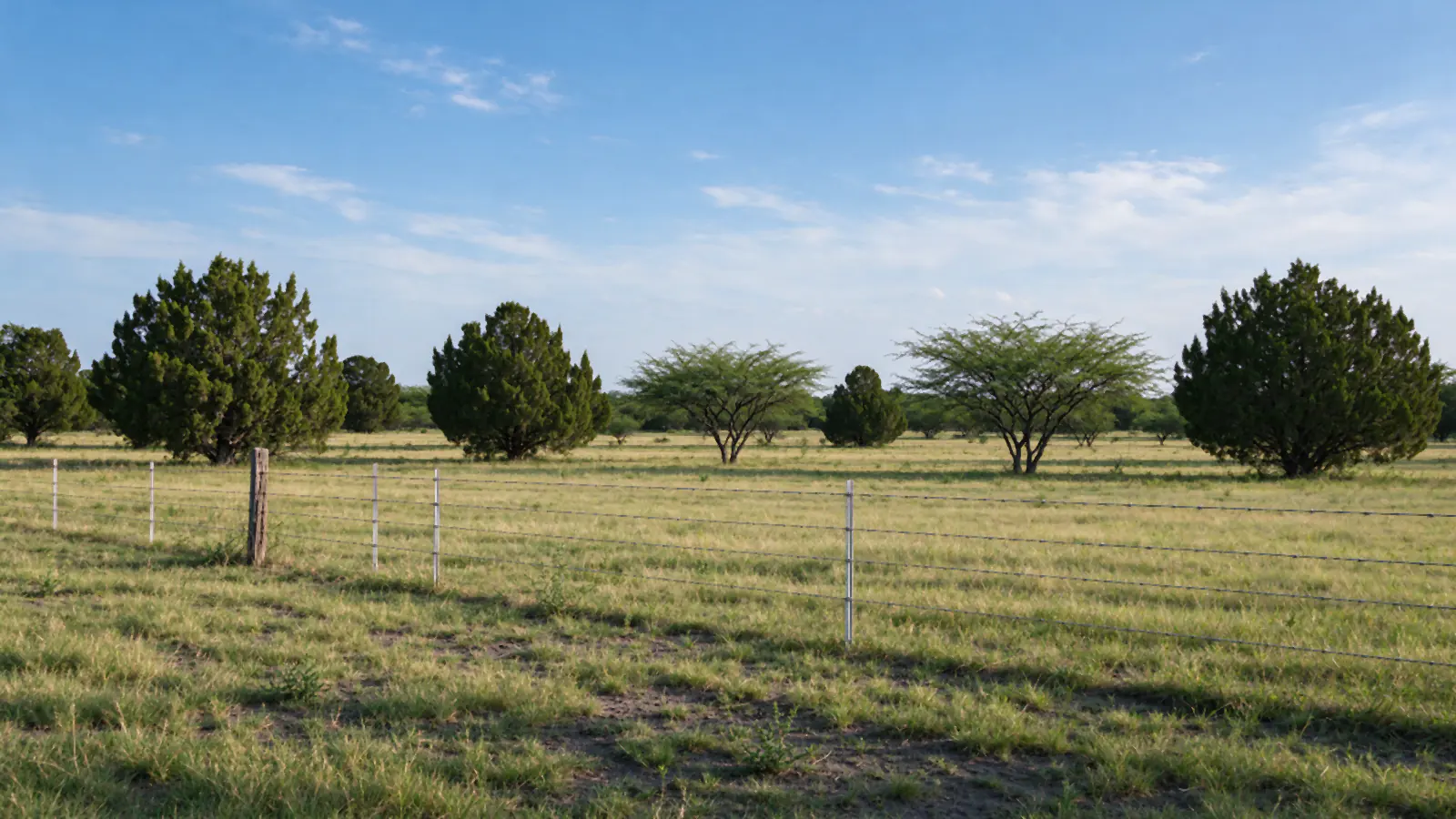
Justin sits on the Grand Prairie side of Denton County, not in the sandy Cross Timbers band that runs through Argyle. The USDA soil survey samples around town come back as Sanger clay, Slidell clay and Ponder loam. Sanger and Slidell clays are hydrologic group D soils with high shrink-swell, which means they shed rain quickly, stay sticky long after a storm and crack deeply in August. For a clearing job that sets two priorities: keep tracked machines off saturated ground, and leave cover on the soil, because bare clay seals under rain and runs off toward the nearest ditch. Grand Prairie ground is old prairie and pasture, and the clearing here is mostly brush that moved in over time, cedar, mesquite and honey locust, rather than closed woods.
Water is the other local driver. The Texas Historical Commission marker in Bishop Park, on FM 156, places Justin at the confluence of Denton, Oliver and Trail creeks, and the soil survey shows frequently flooded bottomland soils along creeks near town. Those bottoms are the last ground to dry after a wet May or October, the most likely to rut, and the place where stripped soil does the most harm downstream. Creek-side work is planned around dry weather and keeps a vegetated edge; clearing near creeks and floodplains explains the wider rules, and flood-zone status is checked per parcel.
The rest of the picture is growth. Census estimates put Justin at 7,285 residents in mid-2025, up from 4,399 at the 2020 base, and the city issued 435 and then 363 permits for new single-family homes in the last two annual counts. The main roads through town are FM 156 and FM 407, which share about four blocks in Justin, and parts of the 76247 ZIP code reach out to SH 114. Growth on that scale means former farm ground is being cut into lots, and the questions shift from pasture brush to lot clearing, pad prep and keeping silt off new streets. None of that tells you what a given lot needs; the walk does.
Picking a method for a Justin property
The method follows the end use. Pasture and acreage with cedar and mesquite usually suit pasture clearing or mulching, which leave roots holding the clay and need no burn. A home site needs the pad grubbed and then rough graded, which is where land clearing and grading comes in, under the city grading permit. A lot with good trees gets selective work so machines stay out of root zones.
Price follows the same logic. Typical North Texas ranges apply here, with no separate Justin rate, and the land clearing cost calculator gives a range for your acreage. For a house project, clearing land to build a house covers the steps between cleared ground and a foundation. Nearby, Argyle’s sandier ground and stricter tree rules make for a different job, covered on the Argyle page.