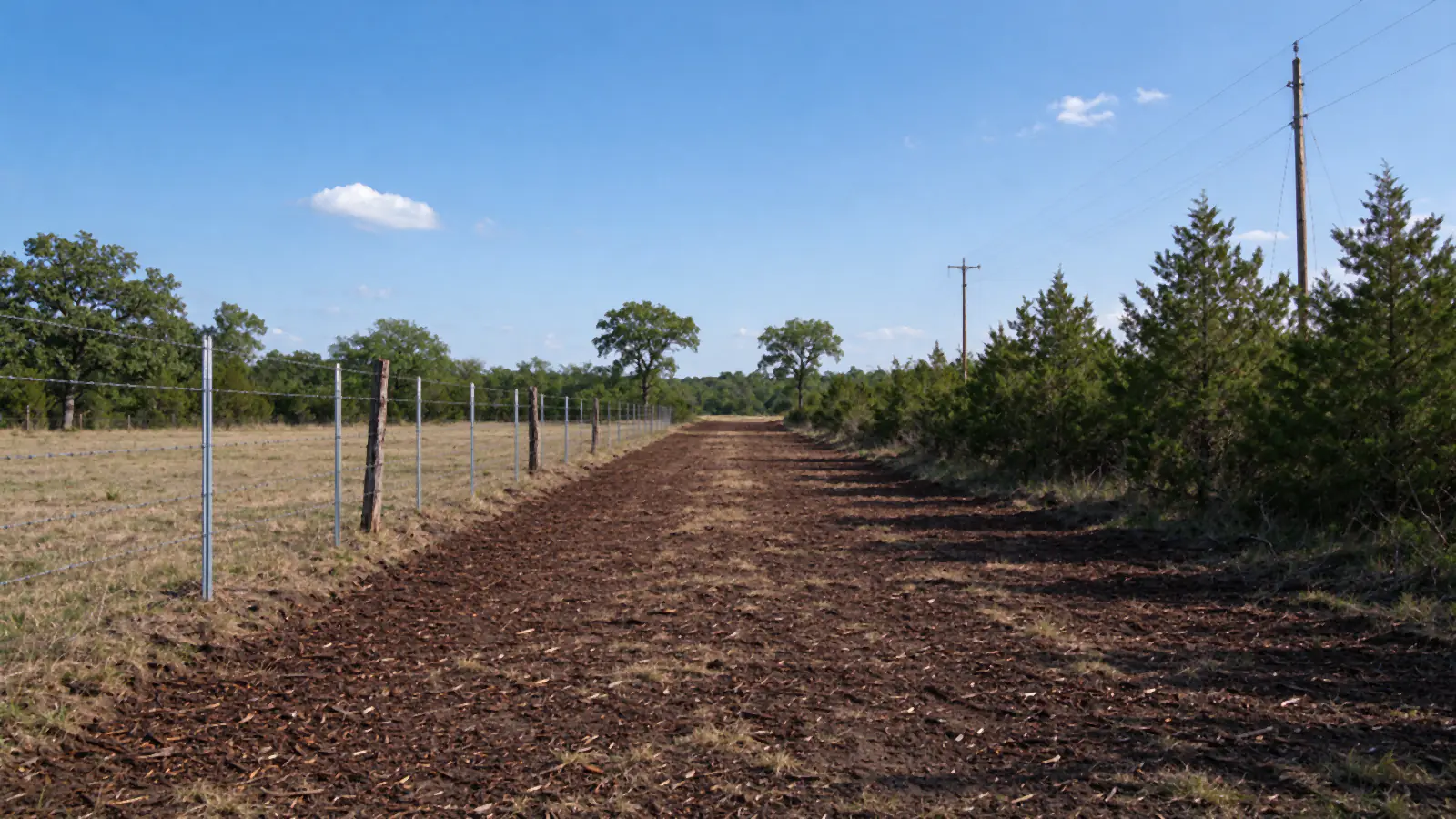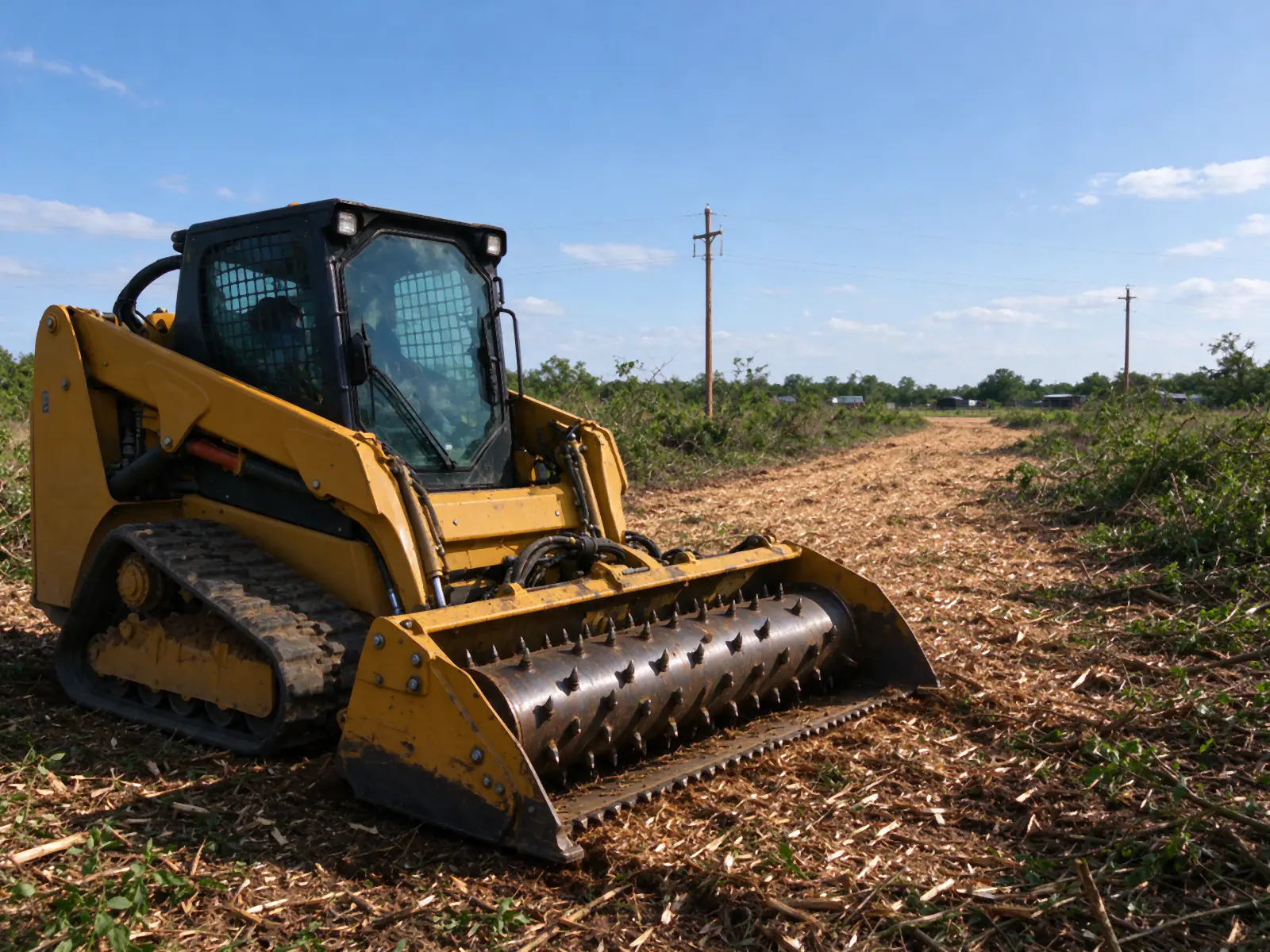
Clearing brush near power lines starts with one rule: no person, tool, machine or falling tree may come within 6 feet of a high-voltage overhead line unless the utility has been notified at least 48 hours ahead and a safety arrangement is in place. Trees growing into lines are the utility’s job. Post Oak Land Clearing Denton plans clearing around lines with that rule first.
Within that limit, a great deal of brush work can still go ahead: mulching and mowing well clear of the wire, cutting brush along a corridor, felling trees away from a line, and clearing the ground after the utility has trimmed what touches its conductors. This guide covers the law, the utilities around Denton, what each one handles, and how a clearing job is planned around overhead and underground lines.
What Texas law says about working near overhead lines
Texas Health and Safety Code Chapter 752 covers high-voltage overhead lines, meaning lines carrying more than 600 volts, which includes ordinary distribution lines on wooden poles along roads and across acreage. Unless a line is guarded, no person may do anything that could bring them, or any part of a tool, piece of equipment, machine or material, within 6 feet of it.
To work closer than that, the person responsible for the work has to notify the line operator at least 48 hours before starting and agree on a safety arrangement first: de-energizing the line, moving it temporarily, or installing barriers. The person doing the work pays the operator’s actual cost for that arrangement. A violator who causes contact with the line is liable to the operator for all damages that result. Utility employees and contractors working for the utility on its own system are exempt, which is why line-clearance tree crews can work in spaces a landowner or clearing crew cannot.
The law applies to everyone. It does not matter whether the work is done by a homeowner with a pole saw, a farmer with a shredder or a contractor with a mulcher.
Why 6 feet is a minimum, not a comfort zone
Electricity does not need a direct touch to hurt someone. High-voltage current can arc across a gap, travel through a branch that brushes a line and into the ground around a tree, and energize a machine whose arm or a lifted limb comes too close. Green wood and wet brush conduct.
Clearing work adds movement to that picture. A mulching head throws debris, a dozer lifts a tree as it pushes, a felled trunk can swing or kick back toward a line, and a tall cedar can fall farther than it looks. Lines also sag on hot afternoons and sway in wind, so the gap measured on a cool morning is not the gap all day. A plan that keeps machines, people and falling wood well beyond 6 feet is a plan that leaves room for those things.
Which utility owns the line over your land
Several electric utilities serve Denton County, and their territories overlap at the county scale. Inside most of the City of Denton the provider is Denton Municipal Electric. In towns such as Justin, Sanger and Roanoke, check the provider per address rather than assuming one. Across much of the rural county, including the ETJ and the north and west towns, it is often CoServ, the electric cooperative; elsewhere it may be Oncor or another cooperative or municipal system. The name on your electric bill is a start, but the line crossing a back pasture may belong to a different system than the one serving your house, so the tag or number on the pole is the surer guide.
| Utility | What it does about trees near its lines | How to reach it |
|---|---|---|
| Denton Municipal Electric (DME) | Contracts a professional arboricultural service to prune trees and vegetation within at least 10 feet of its lines, using directional pruning. Its guidance: do not trim trees around power lines yourself. | (940) 349-7000; tree-trimming requests also go through Denton 311 |
| CoServ | Maintains trees along its lines on a three-year cycle; takes online vegetation maintenance requests, answered in 5 to 7 business days; asks for 10 feet of clearance in front of padmount transformers and 3 feet at the sides and back | Hazards and emergencies 855-938-3496 |
| Oncor | Clearance practices confirmed per address | General inquiries 888-313-6862 |
What the utility handles and what you handle
The utility handles anything touching or growing into its conductors and anything within the clearance zone its crews maintain. That includes limbs over the wire, trees leaning into a span and storm damage tangled in lines. In Denton, DME’s standard of at least 10 feet around its lines is wider than the 6-foot legal minimum, which tells you how much room the utility wants.
The landowner and a clearing contractor handle the ground and the brush outside that zone. Typical work around a line includes:
- Mulching or mowing brush in a corridor where the machine and its reach stay well below and away from the wire.
- Cutting brush and saplings along a fence or easement so the utility’s crews can reach their poles.
- Felling trees outside the line’s reach in a direction away from it, with a plan for every tree that could fall toward it.
- Leaving any tree that could reach the line when felled for the utility, or scheduling the utility first.
- Mulching or hauling the brush and limbs left on the ground after a utility trim.
The usual order on a lot with lines over it is simple. Note the lines on the walk-through, call the utility for anything near its conductors, let its crews trim first, then clear the rest. Any part of the clearing that would come within 6 feet waits for the 48-hour notice and the agreed arrangement. A tree that has to come down near a line and is not the utility’s to remove goes to a qualified line-clearance tree service, not a mulcher.
Utility easements and corridors
Many rural lots carry a utility easement where the line crosses. The easement gives the utility the right to keep vegetation clear, while the land stays yours. The recorded easement document sets what the landowner may build or plant inside it, so read it before planning fences, sheds or tree rows under a line.
Clearing in an easement is often the easiest kind, because a mulcher can turn a brushy corridor into an open strip that is easy to mow. It is also the place to avoid planting anything that will grow tall. In Argyle, the town’s tree preservation rules reach utility easements too, so protected trees there need the town’s permit whoever removes them. Easement clearing covers corridor work in detail, and fence line clearing the strips along boundaries.
Underground lines and padmount transformers
Overhead lines are only half of it. Buried electric, gas, water and communication lines cross many lots, and old service lines to former houses or wells are not always where anyone expects. Texas law requires an 811 locate request before machine work that disturbs soil 16 inches deep or more, which covers grubbing, root raking, grading and deep stump grinding. The request goes in no earlier than 14 days and no later than 48 hours before digging, excluding weekends and legal holidays. Surface forestry mulching stays shallower, but a locate before any ground work is sensible, and stump grinding below grade always needs one.
Green padmount transformer boxes deserve their own space. CoServ asks for 10 feet of clearance in front and 3 feet at the sides and back, so its crews can open and work on them; brush and plantings cleared back to that line keep access open.
After a storm or a fall
When a tree comes down on a line, stay away from the tree, the line and anything touching either, keep people and animals back, and call the utility. Treat every downed or contacted line as energized, even if it is silent and the power seems out. Do not try to cut the tree free or pull it off with a machine. Once the utility has made the line safe and removed what it handles, the rest of the trunk, limbs and brush can be cleared like any other debris through land clearing debris removal.
Planning a clearing job around lines
Lines change the method, the schedule and sometimes the price. Machine size and reach are chosen to stay clear of the wire; trees near the line are felled by hand with a planned direction or left for the utility; and the job may wait on the utility’s trimming or its 48-hour arrangement. Those steps are listed among the price drivers as utility conflicts, and a good quote says how lines will be handled. The what a land clearing quote should include guide has the full checklist.
If you are thinking of clearing near a line yourself, the clearing land yourself vs hiring guide is blunt about it: a tree that could reach a line is not a do-it-yourself tree. For a build, plan where the new service line will run before clearing, since the clearing land to build a house guide sequence puts utilities before grading.
Post Oak Land Clearing Denton offers and manages brush clearing and corridor work across Denton and the west and north of Denton County, with the work done by licensed and insured contractors, and leaves conductors to the utility. Call (940) 204-6191 or request an estimate and mention any lines over the work area.
Clear the brush, leave the wire to the utility
Send photos that show the lines and the brush under them. The plan sets what the utility trims first and what gets cleared after.