
Last Updated:
Take ten or more protected trees off a Roanoke site without a permit, and the city will not accept a zoning change, plat, site plan or planned development application for that land for the next 36 months. That penalty sits in the city’s tree preservation checklist beside a one-line rule: “No clear-cutting of land is allowed.” Post Oak Land Clearing Denton offers and manages land clearing, underbrush clearing and forestry mulching in Roanoke, with the work done by licensed and insured contractors, and a Roanoke plan begins by sorting what the city lets go from what it protects.
Why a Roanoke tract can’t be cleared to bare ground
Roanoke’s code treats trees as part of the site plan, not as brush in the way. Clear-cutting is prohibited outright, and before construction or development on a site with one or more protected trees, the owner needs a tree preservation plan approved by City Council, or a letter from a qualified professional stating that no protected trees exist.
Removing any protected tree takes a tree removal permit. The Development Review Committee reviews it; appeals go to the Park Board and then to City Council. A permit expires 6 months after it is issued, so the clearing has to be scheduled inside that window, which on wet clay is not always easy. The checklist covers process and penalties; which species and sizes count as protected on a given site is confirmed with the city before trees are marked.
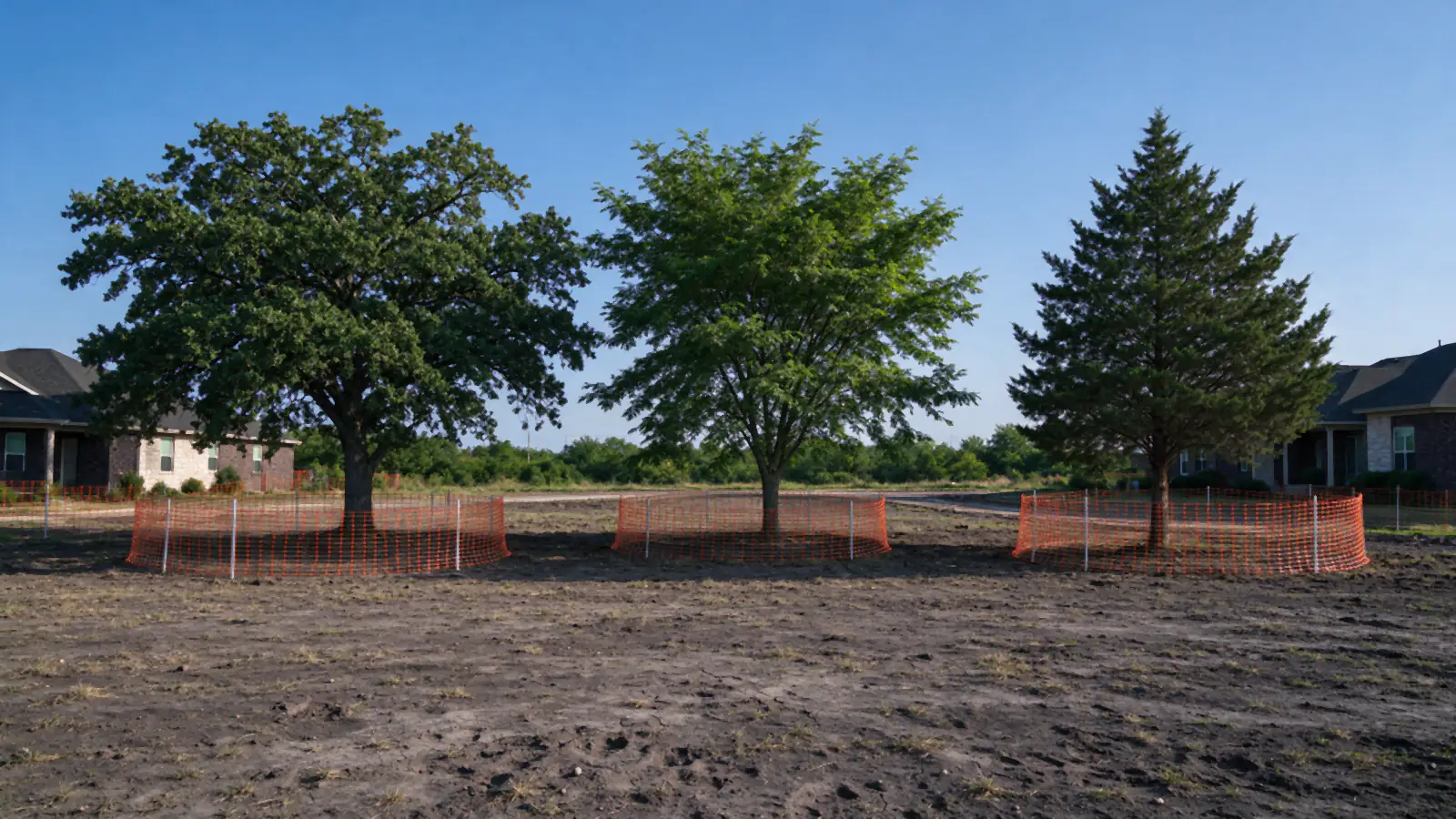
The practical effect is that a Roanoke clearing job is drawn on the approved plan. Selective clearing takes out what the plan releases, and the rest stays behind fencing. For a commercial or multi-lot site, that makes the tree plan the first line item in the schedule, ahead of mobilization, which is one reason commercial land clearing bids here should show the permit timing alongside the acreage.
Buildable areas, root zones and the brush underneath
Two allowances in the checklist make ordinary lot work possible. A tree removal permit is not required within a lot’s buildable area, the portion where building is allowed under its zoning. And crews may enter a protected tree’s critical root zone to clear underbrush and to grade a building pad.
Those allowances come with a condition. A protected tree within 50 feet of construction needs a 4-foot protective fence set outside its critical root zone. The fence keeps machines, fill and parked equipment off the roots, which matters on clay: tracks on wet clay compact the soil around roots, and compacted clay sheds water instead of letting it soak to the tree.
For a homeowner, the outcome is usually good news. Overgrowth under big trees can come out with brush clearing or a forestry mulching pass that grinds the material in place, leaving roots in the ground. Mulching does not take out every root, so cut brush can resprout; keeping brush from growing back covers the follow-up.
Burning brush under Roanoke’s own permit
Roanoke runs its own open burning permit through the Fire Department rather than leaving burning to the county alone. The application sets distances from structures, 15 feet for fires in approved containers, 25 feet for small 3-by-2 piles and 50 feet for every other fire, and limits burning to sunrise to sunset on permitted days, constantly attended, with water or another approved way to put it out on site. Non-residents of Roanoke pay a $100 inspection and permit fee, and the official-use block records the burn as logged with Denton County.
The form also makes the applicant liable for suppression costs and damage, with fines up to $2,000. State rules sit on top: Denton County is in the Dallas-Fort Worth ozone nonattainment area, so a land-clearing burn is allowed only when no practical alternative exists, and a county burn ban during drought stops burning entirely, sometimes for weeks. The form is an older one still listed on the city’s permit page, so current practice is confirmed with Roanoke Fire Prevention. For most lots, land clearing debris removal or mulching in place is the steadier plan.
How a Roanoke job usually runs
The tree paperwork sets the calendar here. An existing lot may need little more than fencing; a development site waits on a City Council vote before the first machine arrives.
The first conversation settles whether a tree plan or permit already exists, along with what the land is for and how much of it there is. The walk marks protected trees, maps the buildable area against the trees around it and shows where fencing has to go. Power lines over the work matter as well: state law requires a 6-foot clearance between energized high-voltage lines and any machine or falling tree unless the operator has arranged otherwise. The electric provider varies by address, so it is confirmed for the parcel.
Next comes the permit, then the fencing, plus a utility locate through Texas811 wherever digging will go below 16 inches. A site that opens an acre or more of soil also needs TCEQ construction stormwater coverage. The clearing then follows the approved plan, the brush is mulched, chipped or hauled, and bare soil is seeded or held with silt fence until it greens up.
Clay ground, creek bottoms and Oak Street
This is Grand Prairie country, and soil survey points around the city return Sanger clay, Leson clay and Navo clay loam, with frequently flooded Pulexas fine sandy loam along the creeks. Sanger clay is a hydrologic group D soil with high shrink-swell: it sheds rain, stays slick at the surface for days and ruts under tracks. That shapes Roanoke work in a particular way, because the 6-month permit clock keeps running through a wet May or October. Planning the start for a dry stretch protects both the schedule and the root zones the city wants left intact.
The city’s own landmarks show what kind of place it is. Roanoke’s historic Oak Street is on the National Register of Historic Places, with the 1886 Silver Spur Saloon building housing the visitor center and museum at 114 N. Oak St. The city sits at SH 114 and US 377, with Byron Nelson Boulevard carrying SH 114 Business through town, and Northwest Regional Airport lies about 2 miles north of the city center. A small part of Roanoke reaches into Tarrant County, so which county’s offices handle a given parcel is confirmed per address.
Growth figures point to a mostly settled city rather than open farm ground. Roanoke grew from 9,671 people at the 2020 base to an estimated 10,931 in mid-2025, and Census building-permit data show only 25 and then 12 new single-family homes over the two most recent years. Where land does change hands, the work is more likely to be a remaining tract, a commercial pad or an older lot with big trees than a new subdivision, and those are exactly the sites the tree rules were written for. A quote for that kind of site should spell out what stays, what goes and who files what, as what a land clearing quote should include explains. For a rough number before anyone walks the site, the land clearing cost calculator runs the same North Texas ranges used across the service area, and the Argyle page covers a stricter tree regime to the north.