Clearing land yourself makes sense for light brush, vines and saplings on a small area you can reach, when nothing is close to a house or a power line and the debris has somewhere to go. It stops making sense once trees get thicker than a few inches, stumps must come out, permits apply or the cut material outgrows a curbside pile. Post Oak Land Clearing Denton set out where that line usually falls.
Many owners land somewhere in between: they cut the small stuff and hire out the trees, stumps or haul-off. This guide covers what a homeowner can reasonably handle, where the risks rise, what renting a machine involves, and the rules that apply no matter who does the work.
What a homeowner can reasonably handle
Light work is light because the material is small and the fall is short. Briars, greenbrier, young privet, saplings and cedar seedlings can be cut with loppers, a hand saw or a walk-behind brush cutter, and stems an inch or two thick give way to a pruning saw. Cutting cedar below its lowest green branch ends that tree, which is why seedling cedar is a reasonable weekend job; the cedar guide explains why.
A chainsaw extends that reach to small trees, and that is where care starts to matter. The OSHA logging standard, written for professional crews, requires chainsaw operators to wear head, eye and face, hearing, leg and foot protection, which in practice means a helmet, face screen, ear protection, cut-resistant chaps and sturdy boots. Those are minimums for people who do this all day, not extras for occasional users. Keep other people well clear of the saw and of anything falling, and never work alone.
Homeowners report getting a small lot of light brush cleared over a few weekends with hand tools, a brush cutter and a saw. Expect the cut material to take longer to deal with than the cutting did. The brush clearing page describes the same work done by machine, for comparison.
Where doing it yourself turns risky
In clearing, the serious hazards sit with trees far more than with brush. A tree only falls where you intend when its weight, lean and wood behave the way you think they will, and on overgrown land they often do not.
- Lean and weight. A tree leaning toward a house, fence or road will go that way unless it is rigged or pulled. Heavy one-sided crowns do the same.
- Dead tops and limbs. Dead wood breaks unpredictably and falls on whoever is underneath, often while the cut is still being made.
- Interlocked crowns and hung trees. In thick woods a cut tree can lodge in its neighbor and hang, which is one of the most dangerous situations in tree work. Cutting the supporting tree to bring it down is how people get hurt.
- Spring poles. Saplings and limbs bent under a fallen trunk store energy and whip when cut.
- Machines and people together. A person on foot near a moving loader or a mulching head is in the danger zone; mulchers throw wood and rock well beyond the machine.
The rule of thumb is simple. A tree that could reach a house, an outbuilding, a road, a neighbor’s property or a power line is not a do-it-yourself tree. Those go to a tree service with climbing and rigging gear, and anything near a line goes to the utility. The clearing near power lines guide explains who to call.
Renting a machine: what to know
Equipment rental yards commonly rent skid steers, compact track loaders, mini excavators and attachments by the day or week. Whether that saves money depends on the job, your skill on the machine and what happens after the cutting.
Skid steer, track loader or excavator
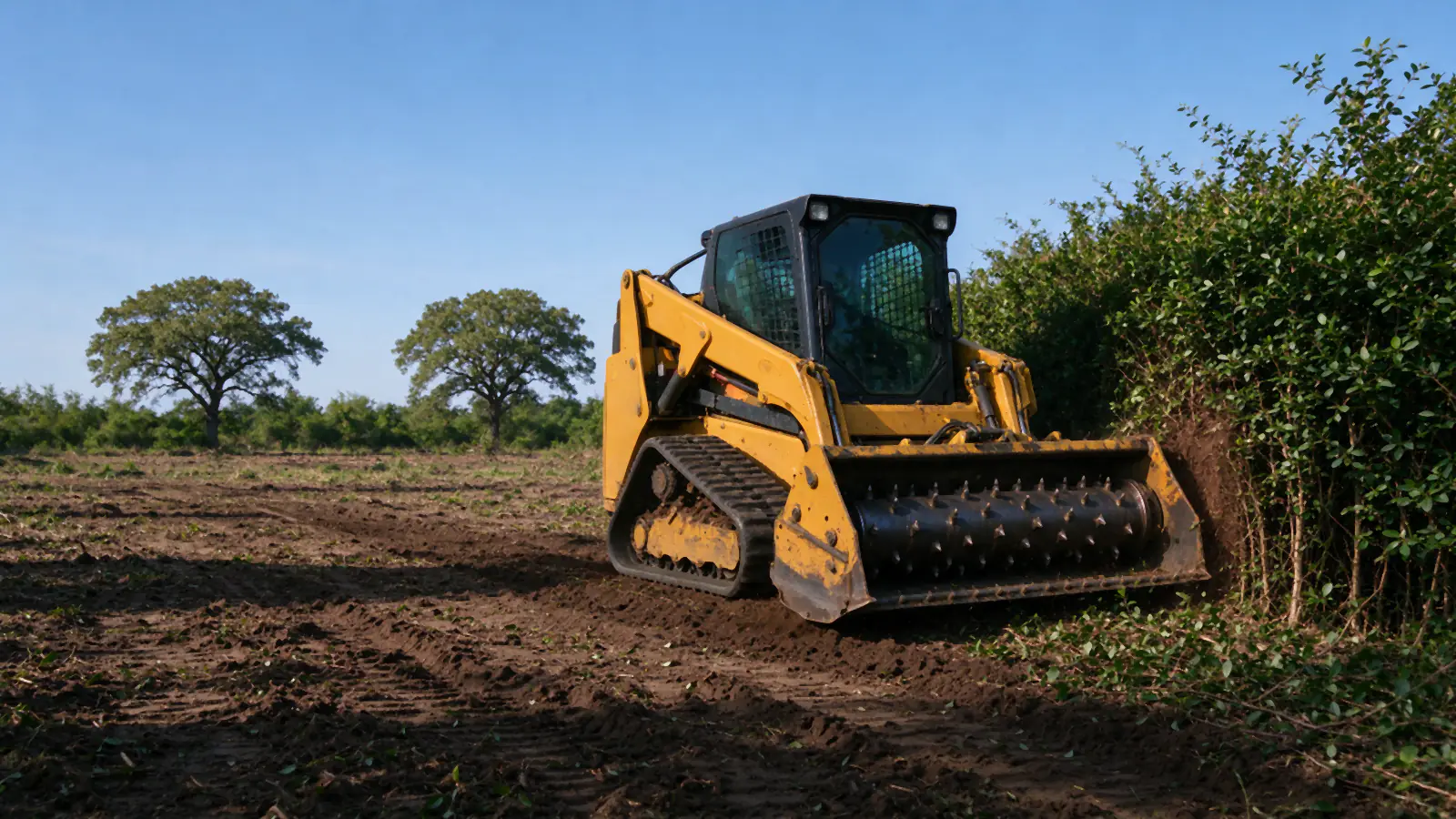
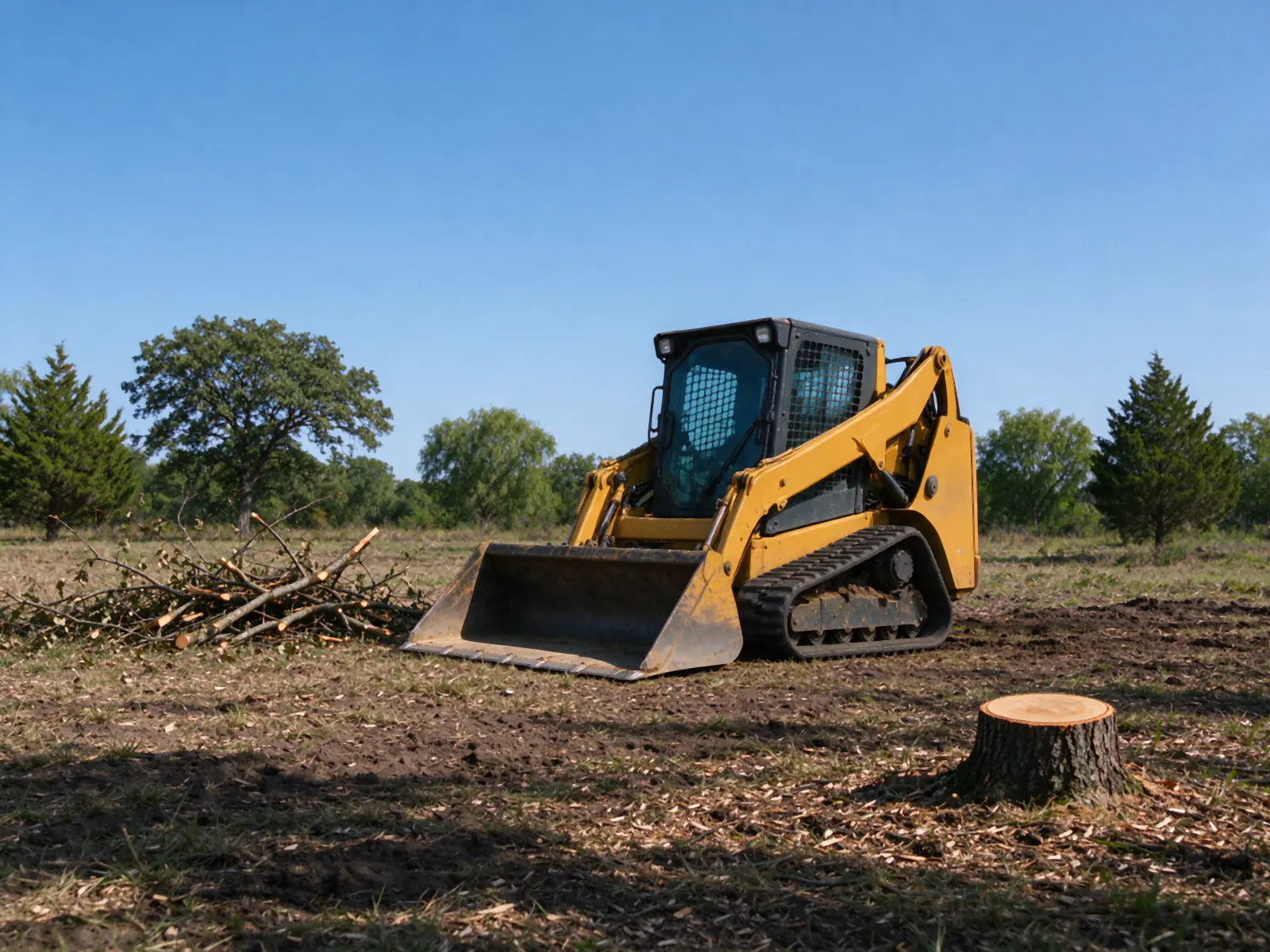
A compact track loader spreads its weight over rubber tracks, so it handles soft ground better than a wheeled skid steer and leaves less damage on Sanger and Slidell clay, the slow-draining soils west and north of Denton. With a grapple, it picks up and carries brush piles and logs, which is most of the labor on a cleared lot. A mini excavator with a thumb pulls individual stumps, sorts debris and reaches into tight spots without driving over everything. A forestry mulching head grinds brush in place, but most mulching heads need high-flow hydraulics, so they run only on larger high-flow machines, and an inexperienced operator can wear teeth fast on rock and wire.
The parts people underestimate
Transport comes first: a loader on a trailer needs a truck rated to tow it. Then there is learning time on unfamiliar controls, which on a day rental comes out of working hours. Hidden wire, T-posts and buried concrete stop a machine and damage attachments, and rental agreements typically charge for damage. Wet ground can stop a rental cold, and a rented machine bogged in clay still costs the day. The how long land clearing takes guide explains what slows machine time.
Rules that apply to you as much as to a contractor
Doing the work yourself does not change the law. These apply to any person running a saw or a machine.
| Rule | What it says | Where it applies |
|---|---|---|
| 811 locate | Machine work that disturbs soil 16 inches deep or more needs a locate request no earlier than 14 days and no later than 48 hours ahead, excluding weekends and legal holidays (Texas Utilities Code ch. 251). Dial 811. | Statewide: grubbing, root raking, grading, deep stump grinding |
| High-voltage lines | No person, tool, machine or material within 6 feet of a high-voltage overhead line unless the operator is notified at least 48 hours ahead and a safety arrangement is in place (Texas Health and Safety Code ch. 752) | Statewide |
| Clearing and grading permit | Any clearing, grading or grubbing beyond 2,000 square feet or 25 cubic yards needs a permit, $453 | City of Denton |
| Tree removal permit | Protected trees on regulated land need a permit, $425, plus mitigation where it applies; post oaks 6 inches across are heritage trees | City of Denton |
| Dirt work permit | No dirt work, grading or earth disturbance without a city permit | City of Justin |
| Stormwater | An acre or more of disturbed soil needs TCEQ permit coverage and a pollution prevention plan | Statewide |
Burning has its own layer. The Denton Fire Marshal’s Office does not allow open burning inside city limits. In unincorporated Denton County, land-clearing burns are allowed only when no practical alternative exists and only on a county burn day, decided each morning between 8 and 9 a.m.; check at 940-349-2840. Justin allows burning weeds or grass off a vacant lot only with a fire-chief permit and the fire department in attendance. The burning brush in Denton guide covers each step, and the Denton tree removal permit guide the city’s tree rules.
Debris: the half nobody plans for
Cutting is the visible part; moving what you cut is the slow part. For Denton residential customers, curbside brush pickup takes up to 4 cubic yards a week at no extra charge, about the size of four washing machines, cut to 4 to 8 foot lengths with the cut ends toward the street. Larger piles are billed to the utility account. That covers a weekend of trimming, not a cleared lot.
Past that, the options are haul-off, mulching or chipping. The City of Denton Landfill takes brush at $30 a ton for a Denton customer with pieces up to 12 feet, $35 for longer pieces and $40 for non-Denton customers, with a $26.50 minimum a load; bagged material is not accepted. A rented chipper handles limbs but not trunks or root balls. Ash wood has to stay inside the county under the emerald ash borer quarantine. Land clearing debris removal is often the piece owners hire out even when they did the cutting.
What about goats?
Goats are a real option for some brush. They browse leaves, vines and tender shoots, and a herd can open up a thicket of greenbrier and poison ivy that is miserable to cut by hand. They do not remove stems, stumps or roots, and woody brush they strip usually resprouts, so goats suit ongoing control more than clearing. The goats vs mulcher post compares the two.
Decision table: yourself, hire, or split it
| Situation | Doing it yourself | Hiring it out |
|---|---|---|
| Briars, vines and saplings on a small backyard | Reasonable with hand tools and a brush cutter | Worth it if the debris has nowhere to go |
| Cedar seedlings and small cedars in pasture | Reasonable: cut below the lowest green branch | Worth it once cedar is dense or tall |
| Trees over a few inches with clear room to fall | Only with training, protective gear and a helper | Usually faster and safer |
| Any tree that could reach a house, road or line | No | Tree service or utility |
| Stumps under a future pad, drive or pond | No: needs grubbing and an 811 locate | Clearing and grubbing or stump grinding |
| An acre or more of thick brush | Possible with a rented loader, slow | A mulcher usually finishes it in one pass and leaves no pile |
| Land inside Denton with protected trees | Permit and tree rules still apply | Permit list handled before work |
A split often works well. You clear the small brush near the house and mark what stays; a contractor handles the trees, stumps and the bulk of the debris. That keeps the dangerous and heavy parts with people and machines suited to them, and leaves the pleasant part to you. The land clearing assessment tool helps sort which method fits, and the cost calculator gives a range to compare against a rental week.
When hiring is cheaper than it looks
Compare like with like. A rental week covers the machine, but not the trailer, fuel, damage risk, your time, the debris or the stumps you could not move. A hired job is priced for the finished result: brush gone, debris mulched or hauled, stumps handled as agreed, ground left in the condition the quote describes. Typical North Texas ranges run about $1,500 to $3,500 an acre for light brush and $1,400 to $3,500 an acre for forestry mulching of light to moderate growth; the cost per acre guide breaks those down.
Post Oak Land Clearing Denton offers and manages overgrown lot clearing, brush clearing and full lot work across Denton and the west and north of Denton County, with the work done by licensed and insured contractors. If you want to do part yourself, say so. Call (940) 204-6191 or request an estimate with photos and the part you want handled.
Hire out the heavy part
Tell us what you will clear yourself and what you want handled. The quote covers the trees, stumps or debris you'd rather not take on.