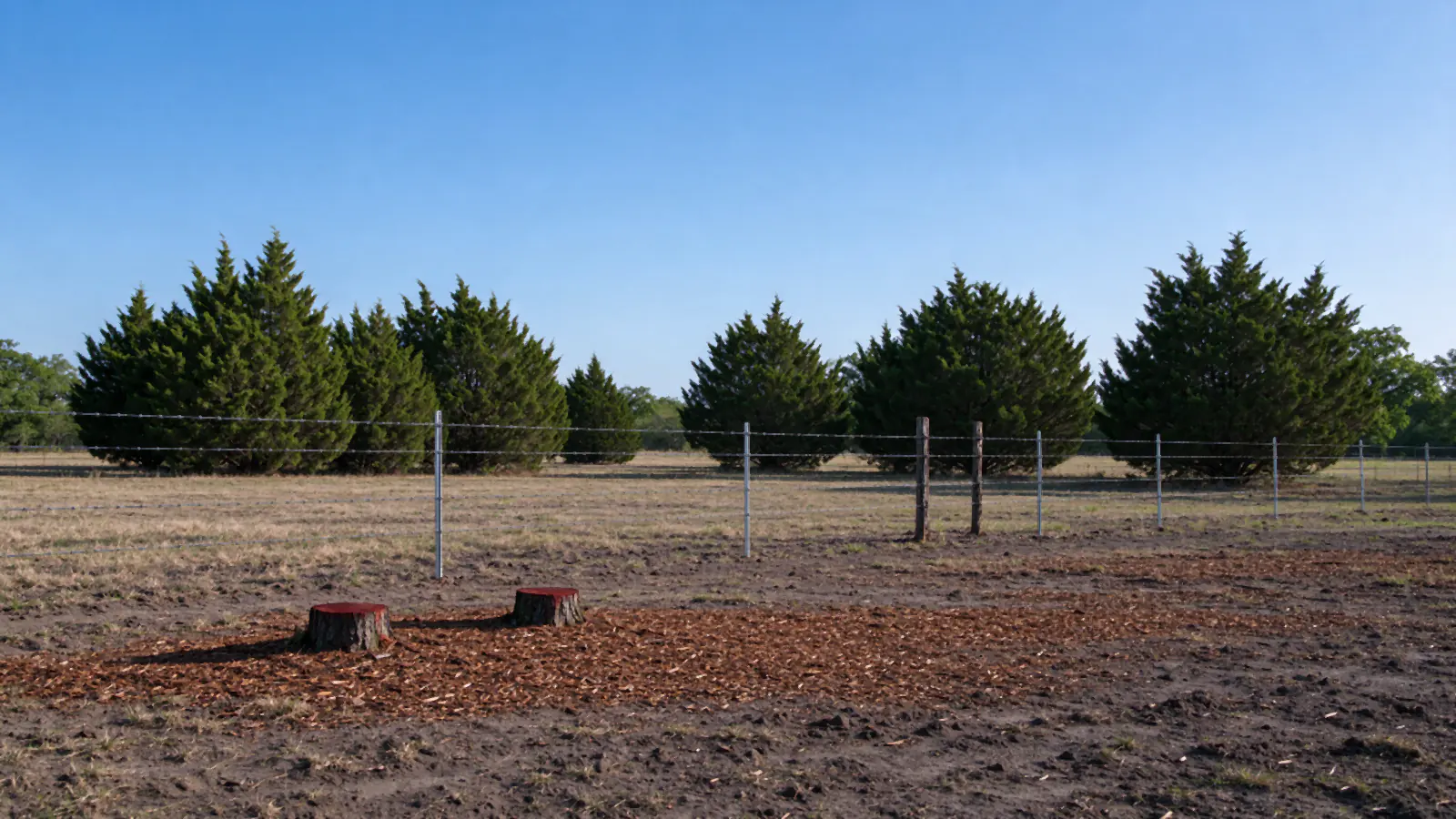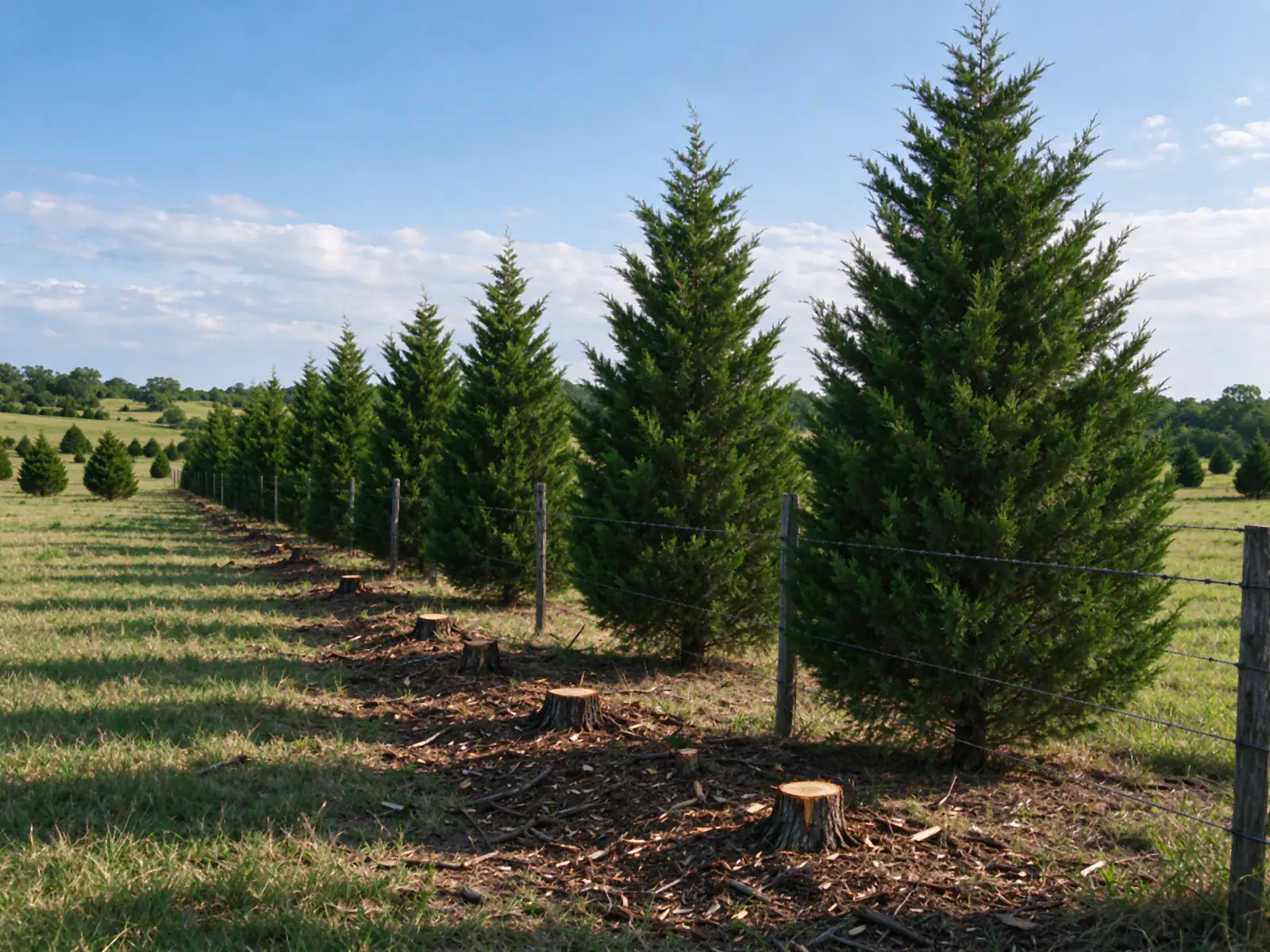
To get rid of cedar trees on your property, cut each one below its lowest green branch. Eastern redcedar, the cedar of North Texas, does not resprout from its roots, so a low cut ends that tree. The method depends on size and number: hand tools for seedlings, a saw for single trees, a mulcher for thickets. New cedars come from seed for years, so plan follow-up. Post Oak Land Clearing Denton explains each step here.
The cedar clearing service describes the machine work; this guide is the owner’s side of the decision. It covers why cedar behaves differently from other brush, which tool fits which tree, what to do with the wood, where Denton’s tree rules apply, and how to keep a cleared pasture from turning back into a cedar break.
Which cedar you have
What people call cedar in Texas is really juniper. Around Denton the common one is eastern redcedar (Juniperus virginiana), a native evergreen that spreads into pastures, fence rows and the edges of post oak woods. Ashe juniper is the cedar of the Hill Country, and redberry juniper grows farther west. The difference matters for one reason: eastern redcedar and Ashe juniper do not resprout once cut low, while redberry juniper does, and has to be cut below the soil surface to be controlled.
Cedar is dioecious, meaning each tree is male or female. Female trees carry the small blue, berry-like cones that birds eat; male trees shed pollen and bear no fruit. Both kinds are cleared the same way, but the females are the ones seeding the next crop.
Why a low cut ends a cedar
Many woody plants keep dormant buds on their root crown or roots, and when the top is cut, those buds push new shoots. That is why mesquite, honey locust and privet come back as a thicket after shredding. Eastern redcedar has no such buds below its foliage. Its living growing points are in its green branches, so if every green branch goes with the cut, nothing is left to regrow and the stump dies.
The catch is the lowest green branch. On a young tree it can sit right at the ground, under grass or leaf litter. Cut above it and that branch turns upward and becomes a new leader, which is how a “dead” cedar comes back as a bush. A cut at or just below ground line, below every green limb, avoids that. Mulching cedar down to the ground does the same thing mechanically, which is why mulched cedar stays gone. No herbicide is needed on the stump of a properly cut redcedar.
Methods by stem size
The right tool follows the size and number of trees. One acre with a dozen scattered cedars and one acre of solid cedar break are completely different jobs.
| Size and density | Method | What to watch |
|---|---|---|
| Seedlings under about 2 feet | Hand pull or grub with a mattock, including the root crown | Easy when the soil is moist; miss the lowest branch and it regrows |
| Small trees to a few inches | Loppers, a pruning saw or a chainsaw, cut at ground line | Cut below every green branch; protective gear for saw work |
| Scattered larger trees | Chainsaw felling with a planned direction, or a skid steer with a tree shear | Cedar is dense and can fall farther than it looks |
| Thickets and cedar breaks | Forestry mulching in place | Leaves a mulch layer; stumps at grade; deep mats under dense stands |
| Cedar on a future pad or drive | Clearing and grubbing to remove stumps and roots | Organic material under a slab settles; 811 locate for deep work |
Texas A&M AgriLife’s Brush Busters program describes hand grubbing as an easy way to kill seedlings under about 2 feet tall. Prescribed fire is also a range tool for cedar on large tracts, but inside Denton city limits there is no open burning, and in unincorporated Denton County a land-clearing burn is allowed only when no practical alternative exists and only on a county burn day, so it is not a homeowner method here.
Doing it yourself, or not
Seedlings and small cedars are a reasonable weekend job. Larger trees are where care matters: a dense cedar is heavier than it looks, and on a fence line or near a house, the fall has to be controlled. The clearing land yourself vs hiring guide sets out where that line falls. Anything near a power line is the utility’s, as the clearing near power lines guide explains.
What dense cedar does to the land
A cedar break shades out grass and forbs underneath it, and the ground beneath mature cedars is often bare except for needles. That is part of why owners clear it: grazing land disappears under it, and an open pasture can close up after years without mowing or grazing management. On Grand Prairie clays west and north of Denton, the bare ground under a thicket also sheds rain fast once the canopy is removed.
Clearing reverses that, but it needs a plan for the ground. Mulching leaves a layer of chips that protects the clay and lets light reach the soil; where the mulch is thin, grass returns through it, and where it is thick under the densest stands, spreading it out helps. On pasture, seeding bare spots and resting the land from grazing gives the grass a head start before seedlings do.
What to do with the wood
Cedar disposal depends on where the land is and how much wood there is.
Mulch it in place. For thickets and acreage, mulching is usually the cheapest route because nothing is loaded or hauled. Mulched cedar is wood, and spread at a normal depth it does not ruin soil.
Curbside or the landfill. For Denton residential customers, curbside brush pickup takes up to 4 cubic yards a week at no extra charge, cut to 4 to 8 foot lengths. A few small cedars fit; a cleared fence line does not. The City of Denton Landfill takes brush at $30 a ton for a Denton customer with pieces up to 12 feet, $35 for longer pieces and $40 for non-Denton customers, with a $26.50 minimum a load.
Burning, only where allowed. Cedar is oily and burns hot, which is another reason burn rules are strict. Inside Denton city limits it is not allowed. In the county, check the burn day at 940-349-2840 and the rules in the burning brush in Denton guide.
Posts and firewood. Straight cedar trunks have long been used for fence posts, and seasoned cedar makes aromatic kindling. That is value for your own use; cedar rarely has timber value, as the timber guide explains.
Denton’s tree rules and cedar
Cedar is not automatically fair game. The Denton Development Code’s non-protected list names mesquite, honey locust, crepe myrtle, ornamental pear and plants on the state noxious and invasive list, but not eastern redcedar. On land the tree rules regulate, a healthy redcedar 6 to 18 inches across counts as a quality tree, and removing protected trees needs a tree removal permit, currently $425, with mitigation where it applies.
The exemptions are what usually decide it. Property with an existing single-family or duplex home is exempt from tree preservation except for trees designated on an approved plan, and agricultural operations are exempt from the tree rules. Even so, the city states that any tree removal requires a permit submittal, with exemptions substantiated through Building Safety on eTRAKiT at no fee. Clearing beyond 2,000 square feet also needs the clearing and grading permit unless an exemption applies. Outside the city, Argyle, Roanoke and other towns have their own tree lists, confirmed per address. The Denton tree removal permit guide covers the details.
Keeping cedar from coming back
Cut cedars stay dead; new ones come from seed. Birds eat the cones of female cedars and drop the seed where they perch, so seedlings appear along fences, under power lines, beneath lone trees and at woods edges. Seed already in the soil keeps sprouting for a few years after clearing.
The fix is cheap if it is regular. Mowing or brush hogging every year or two keeps seedlings small enough that the mower takes them below their lowest branch. Pulling or grubbing the ones the mower misses, especially along fences, stops them before they become a saw job. Removing seed-bearing female cedars nearby reduces the seed rain. On pasture, healthy grass cover and sensible grazing leave fewer bare spots for seedlings to take. The keeping brush from growing back guide has a first-year plan, and brush hogging is the usual tool.
What it costs to clear cedar
There is no separate published price for cedar. Dense cedar is priced like heavy growth: typical North Texas ranges run $3,500 to $6,500 or more an acre for heavy woods, and $1,400 to $3,500 an acre for forestry mulching of light to moderate growth. Scattered cedar in pasture sits at the low end; a solid break with trunks past 8 inches sits at the high end, because there is far more wood per acre and the mulch layer gets deep. The cost per acre guide breaks down the drivers.
Keeping some cedar on purpose
Not every cedar has to go. A row along a north fence breaks winter wind, a few trees screen a neighbor, and cedar gives birds and wildlife year-round cover. Clearing the thicket while keeping a chosen few, often the male trees that do not seed, is a reasonable middle path, and selective clearing is built for it.
Post Oak Land Clearing Denton offers and manages cedar clearing across Denton and the west and north of Denton County, with the work done by licensed and insured contractors. Call (940) 204-6191 or request an estimate with photos of the cedar and the acreage.
Get the cedar off your land
Send the acreage and a few photos of the cedar. The walk-through sets the method, what stays and where the wood goes.