Inside Denton city limits there is no burn permit to get: the Fire Marshal’s Office does not allow open burning at all. In unincorporated Denton County, land-clearing brush can be burned only on a county burn day, only under TCEQ’s exceptions and only when no practical alternative exists. Nearby towns add their own permits on top.
Post Oak Land Clearing Denton offers and manages land clearing and debris removal across Denton and the west and north of Denton County, with the work done by licensed and insured contractors. Most jobs here end with debris mulched or hauled rather than burned, and this guide explains why, step by step; the clearing land in Denton guide covers the rest of the job.
Inside Denton city limits: no open burning
The Denton Fire Marshal’s Office puts it plainly: “We do not allow open burning within city limits.” The city points residents to curbside yard waste and brush collection instead. Its local amendments to the International Fire Code also push any permitted open burning location to at least 300 feet from structures and prohibit recreational fires inside the incorporated city.
That settles the question for any lot inside the city, from a backyard in town to undeveloped acreage on the city’s edge. Clearing debris there is mulched, chipped or hauled. The City of Denton Landfill at 1527 S. Mayhill Road takes brush at $30 a ton from Denton customers for pieces up to 12 feet, $35 for longer pieces and $40 from non-Denton customers, with a $26.50 minimum per load. Curbside pickup takes up to 4 cubic yards a week for residential customers, which suits trimming, not a cleared lot. The Fire Marshal’s Office is at 401 N. Elm Street, (940) 349-8118, for questions about a specific address.
In unincorporated Denton County: burn days and TCEQ rules
Outside city limits, the Denton County Fire Marshal allows burning only under the TCEQ exceptions in 30 TAC 111.209 and only on a declared burn day. Each morning between 8 and 9 a.m., the county decides whether the day is a burn day, using TCEQ’s recommendations and local fire conditions. The answer is on the burn line at 940-349-2840.
Unincorporated residents are told they must buy a Controlled Burn Permit before open burning, and anyone with a current Open Burning Registration logs each burn on the county’s Controlled Burn Log. Having a registration does not replace the morning check; the county still expects every burn to be reported. The county also asks that the burn site sit at least 300 feet from residential, recreational, commercial or industrial areas, and holds the person burning liable, civilly and criminally, if the fire damages someone else’s property.
Why “no practical alternative” matters here
Denton County is part of the Dallas-Fort Worth ozone nonattainment area. TCEQ’s rule treats nonattainment counties more strictly than others: on-site burning of trees, brush and plant growth from land clearing is allowed only when no practical alternative to burning exists. The brush must come from that property and be burned by the owner or someone the owner authorizes.
TCEQ defines a practical alternative as one that is economically, technologically, ecologically and logistically viable. On a tract a mulcher can reach, grinding brush in place usually meets that test, and so does hauling where a landfill is within reach. Burning is left for situations where neither works, such as a remote tract with heavy timber and no truck access. Even then, the decision rests on the person burning to defend.
The conditions on every land-clearing burn
TCEQ’s general conditions in 30 TAC 111.219 apply on top of the burn-day decision:
- Burn outside city limits unless the city’s own ordinance allows it.
- Start no earlier than one hour after sunrise and finish one hour before sunset.
- Keep the fire attended the whole time.
- Burn only with wind between 6 and 23 mph, so smoke disperses without the fire running.
- Stay downwind of, or 300 feet from, off-site structures with sensitive receptors such as homes, unless the owners give written approval.
- Post flag-persons if smoke drifts across a road.
Big green piles of cedar and oak do not burn down in a day. That is the practical reason many owners give up on burning: a pile still smoldering at sunset breaks the rules, and restarting it the next burn day is not the same as letting it smoke overnight.
What can never go on the pile
Acceptable material is brush, timber and yard trimmings from the property. Electrical insulation, treated lumber, plastics, non-wood construction and demolition waste, rubber and tires are prohibited under TCEQ’s rule, and the county lists lumber, construction materials, tires, plastics and rubber as unacceptable. Burning prohibited materials carries county fines of $250 to $2,000.
Old farmsteads are where this goes wrong. Brush along fence lines hides barbed wire, T-posts, creosote posts and scrap. Pull them out before the pile is built; treated posts in particular must never burn. Ash is a separate case: Denton County is inside the emerald ash borer quarantine, so ash wood is better chipped on the property rather than moved out of the quarantine area as firewood.
Burn bans and dry summers
Burn days stop entirely during a burn ban. The county has declared a mandatory ban under a local disaster declaration for wildland fire risk in a dry late summer, and while a ban is in force all outdoor burning in unincorporated areas is prohibited. NOAA’s normals for Denton show July as the driest month at about 1.77 inches of rain, and the hot, dry stretch of July and August is when fire risk runs highest. If your plan depends on burning, schedule the clearing for late fall or winter and keep a fallback ready. The when to clear land in North Texas guide covers timing.
Brush pile with nowhere to go?
Send photos and the address. The debris can be mulched on site or hauled, whichever the property and the rules allow.
Town by town around Denton
Each town decides whether burning is allowed inside its limits, and most lean on the county’s burn-day system.
| Place | Burning rule for land-clearing debris |
|---|---|
| City of Denton | No open burning within city limits |
| Unincorporated Denton County | TCEQ exceptions only, on county burn days; Controlled Burn Permit and burn logging |
| Sanger | City open burn permit, valid to a stated date and revocable; holders still call the county for burn days and logging; the fee schedule lists a fee for commercial burns over 25 acres |
| Justin | Burning weeds or grass off a lot only by the owner of a vacant lot, with a fire-chief permit, at a set time and with the fire department present |
| Roanoke | City burn permit with an inspection; fires at set distances from structures, attended, with water on site; applicant liable for suppression costs; fines up to $2,000 |
| Krum and Ponder | Fire departments route outdoor burning to Denton County burn regulations and burn-day status |
| Argyle and other towns | Confirmed per address |
Roanoke’s form spaces fires by type: 15 feet from structures for approved containers, 25 feet for small piles and 50 feet for all other fires, burned between sunrise and sunset on permitted days. Non-residents pay an inspection and permit fee, and the permit form records whether the burn was logged with Denton County. Justin’s rule is narrower than it sounds: it covers weeds and grass on a vacant lot, not a pile of cleared trees. Sanger’s permit form has a contractor section, so a contractor burning on your behalf is named on it. The Justin, Sanger and Roanoke pages cover each town’s other clearing rules.
Alternatives that usually cost less than a legal burn
TCEQ’s own guidance on outdoor burning lists the alternatives: recycling, composting, mulching and landfill disposal. On a clearing job those turn into three options.
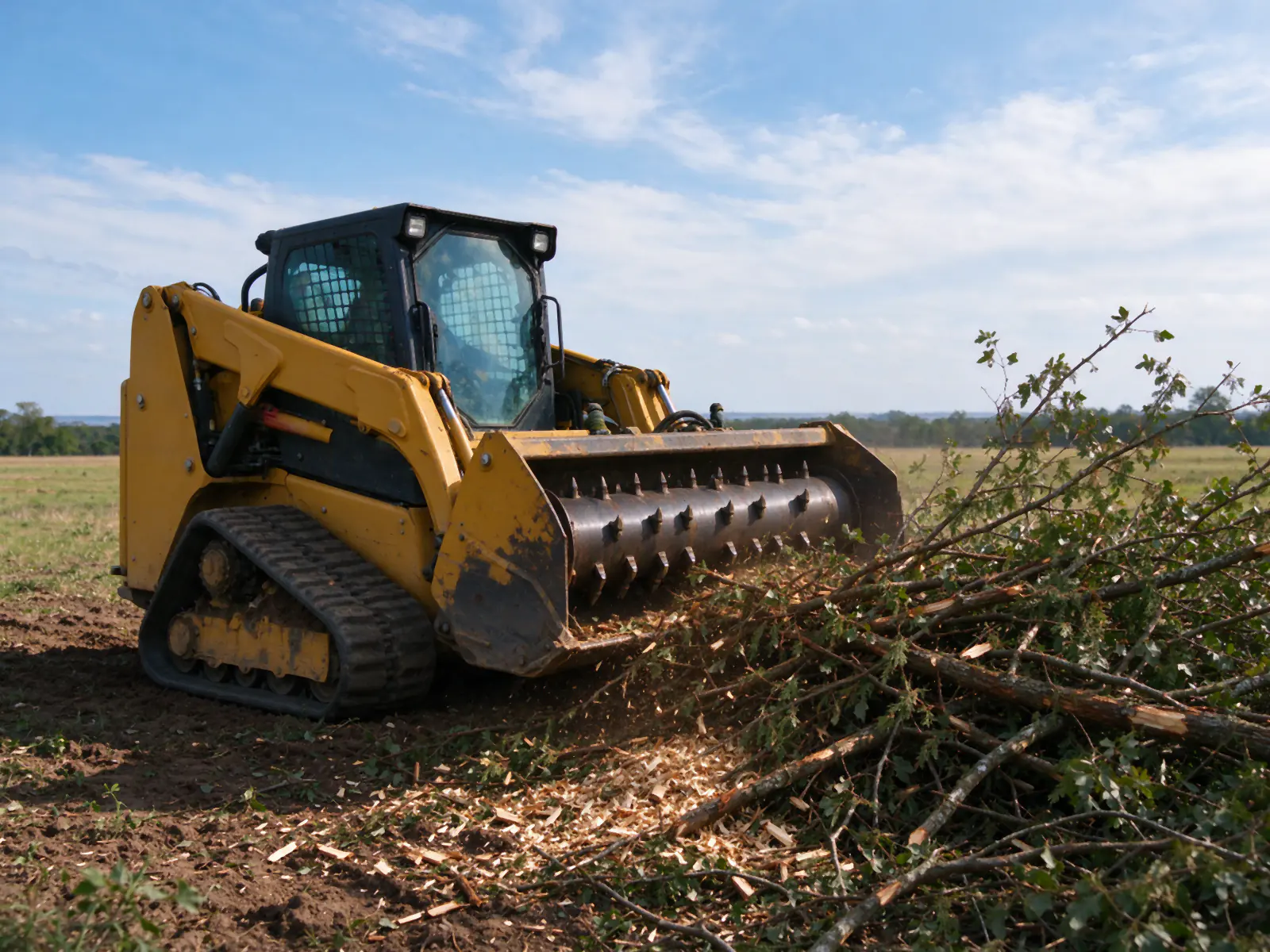
- Mulch in place. A forestry mulcher grinds standing brush where it grows and leaves the chips as ground cover. No pile is ever made. See forestry mulching, and the forestry mulching vs land clearing guide for when it fits.
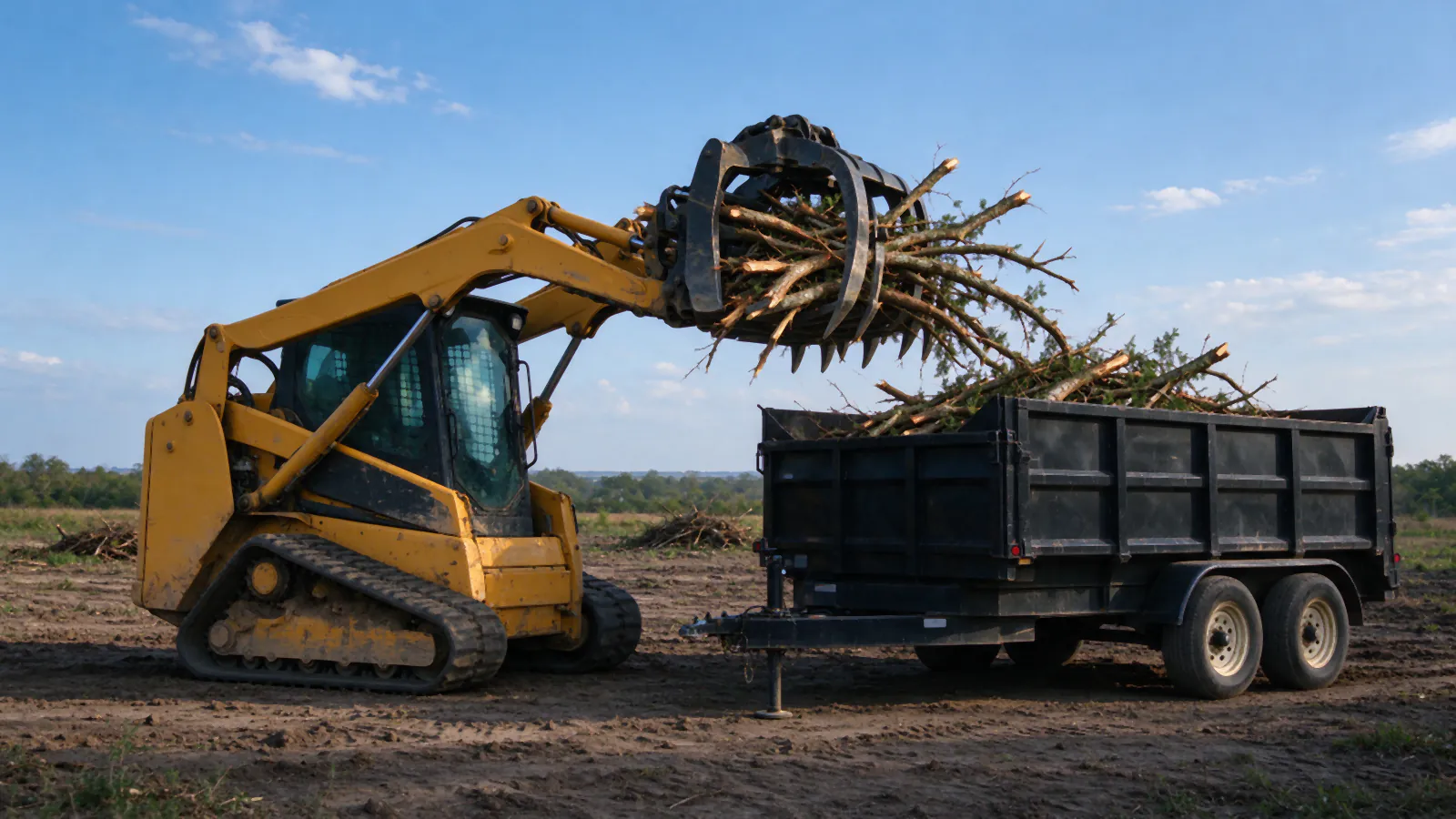
- Chip and spread or haul. Felled trees and limbs go through a chipper; the chips stay on paths and beds or leave in a truck.
- Haul whole. Logs, root balls and slash are loaded and tipped at a landfill or green waste site, priced by the ton.
Burning also rules out some funding. The Texas A&M Forest Service mechanical fuel reduction grant, which reimburses fuel-break mulching around homes in eligible areas, disqualifies any burning of the debris. NRCS cost-share for brush management on farm and ranch land has its own practice rules.
Practical checks before any burn
If burning is legal for your tract and you still want to do it, run through this first:
- Confirm the jurisdiction: city, town, ETJ or unincorporated county.
- Get the right registration or permit, and the town’s permit where one applies.
- Strip out wire, posts, lumber and anything else on the prohibited list.
- Build piles small enough to burn down well before sunset, away from overhead lines and at the required distance from neighbors. The power lines guide covers clearances.
- Call the burn line that morning and log the burn.
- Keep water and a way to cut a firebreak on site, and stay with the fire until it is out.
For most owners around Denton, the simpler path is a method that never makes a pile. Call (940) 204-6191 or request an estimate, and the cost per acre guide shows how debris handling sits inside a clearing price.