
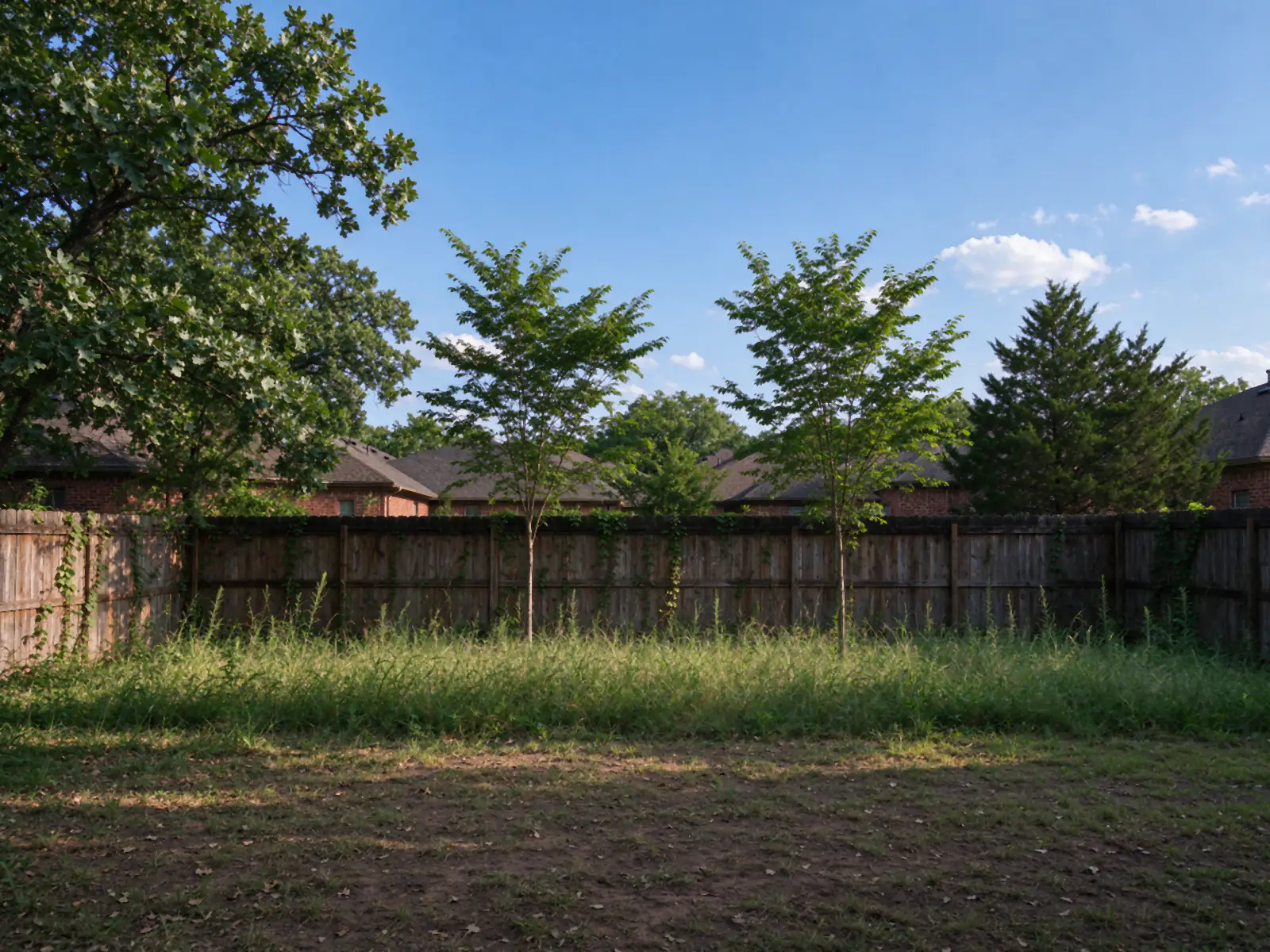
The questions behind this example come straight from Denton homeowners: weeds as tall as a person, a fence gate too narrow for a riding mower, a job that feels too big for a mowing service and too small for a land clearing outfit with skid-steer mulchers. Post Oak Land Clearing Denton offers and manages land clearing across Denton and the west and north of Denton County, with the work done by licensed and insured contractors, and small fenced lots are part of that work. Here is how a typical one runs, step by step, and why each step happens in the order it does.
The yard in this example
Picture a quarter-acre lot in Denton with a house on it and a backyard of roughly 7,000 square feet behind a wood privacy fence. Nobody has mowed it for two summers. Johnsongrass and ragweed stand at head height, greenbrier and trumpet vine have climbed the fence, and a row of hackberry and privet saplings, most 1 to 3 inches across, has filled in along the back line. Two small cedars sit in one corner. Near the house is a post oak about 14 inches across that the owner wants to keep, and a service drop runs from the alley pole to the house.
The owner’s goal is ordinary: a yard that can be mowed again, with the oak kept and nothing hauled into the street in a way that earns a code letter. Denton’s vegetation rules expect grass and weeds at 12 inches or less, so a yard like this one is already past the line.
Step 1: the call and the walk
The job starts with a call or the estimate form, then a walk of the yard. On a small lot the walk does most of the planning.
What gets marked and measured
The post oak gets flagged as a keeper first, along with anything else that stays: a shrub bed, a sprinkler line, a dog run. Then the gate gets measured. That single number decides more than anything else on a backyard job. A walk-behind brush cutter goes through nearly any gate. A compact tracked machine needs a wider opening, and if the gate is too narrow the options are to take a fence panel off for the day or to do the heavy part by hand. Homeowners report that this access question is exactly why mowing services turn these yards down.
The walk also checks the ground for buried hazards: old wire, a forgotten T-post, a clothesline footing, a sprinkler head. Teeth on a cutting head break on steel, so anything suspicious gets marked and pulled by hand before a machine goes near it.
Lines overhead and underground
Denton Municipal Electric has its contractors prune vegetation to at least 10 feet from its electric lines, and who handles a branch near the service drop is a question for DME, not a guess. DME’s own advice is plain: do not trim trees near power lines, and call DME at (940) 349-7000 first. No machine, tool or branch comes within 6 feet of a high-voltage line under Texas law without the line operator’s arrangement, so any sapling tangled near the alley pole is left for that conversation. If stumps will be ground deep, a Texas811 locate goes in at least 48 hours ahead, since mechanized digging 16 inches down or more requires one.
Step 2: sorting out the paperwork
In this example, very little paperwork applies, and it is worth knowing why. Cutting weeds, vines and brush on a lot with an existing house counts as ordinary maintenance under the Denton Development Code, not land-disturbing activity. Tree removal is different: the city’s position is that any tree to be removed requires a permit submittal, and an existing single-family or duplex lot is one of the listed exemptions. The owner claims that exemption through Building Safety on eTRAKiT with a site plan or aerial and photos, and a substantiated exemption carries no fee. The Denton tree removal permit guide covers the form.
The clearing and grading permit only enters the picture if the work starts moving soil, such as grubbing out roots across the yard or regrading it, beyond 2,000 square feet or 25 cubic yards. If the yard backed onto a creek or sat in a mapped floodplain, those thresholds would not apply at all, and the plan would change. More on that in clearing near creeks and floodplains.
Step 3: cutting it down around what stays
The work runs from the outside in. Vines come off the fence by hand first, because pulling greenbrier with a machine tears boards. The tall weeds go down next, the same first pass used in brush clearing, with a walk-behind brush cutter or a compact machine with a cutting head, which drops the yard to a height where the saplings and ground can be seen clearly.
The saplings along the back fence are the slow part. Hackberry and privet at 1 to 3 inches are cut low, and the cedars in the corner are cut below their lowest green branch, which matters because eastern redcedar does not resprout from a stump cut that way. Hackberry and privet do resprout from their roots, which is why the next steps exist.
Around the post oak, nothing heavy goes inside the drip line. Tracks and tires over a root zone compact the clay the roots breathe through, and a post oak is slow to forgive that. The ground under the oak gets hand work only. For yards where the trees that stay are the point, selective clearing explains the approach in more depth.
Backyard grown shut?
Send a few photos and the gate width. The walk-through sets the method, the access and where the brush goes.
Step 4: where the brush goes
Burning is not an option here; the Denton Fire Marshal’s Office does not allow open burning inside city limits, as burning brush in Denton explains. That leaves three routes, and on a small yard they are often mixed.
- Curbside. The City of Denton collects up to 4 cubic yards of brush a week at no extra charge, cut to 4 to 8 foot lengths, stacked in one pile with cut ends to the street, at the curb by 7 a.m. and 4 feet from the carts. Piles over 4 cubic yards are billed to the utility account at $75 per staff hour.
- Landfill. Clean brush can be hauled to the City of Denton Landfill at 1527 S. Mayhill Rd. at $30 a ton for City of Denton customers (brush 12 feet or shorter) and $40 a ton for non-city customers, with a minimum charge of $26.50 a load.
- Mulched in place. Ground or chipped material can stay as a layer on bare spots, where it holds the clay and slows the weeds.
A head-high quarter-acre yard usually produces more than one week’s curbside allowance, so the plan in this example sends the woody saplings to the landfill, chips the vines and small stems, and keeps the weekly curbside pile for the stragglers. Land clearing debris removal covers haul-off on bigger lots.
Step 5: the finish, and the first spring
At the end of the job the yard is open ground with low stubs, a mulched area under the oak, and stumps cut flush or ground just below the surface where the owner wants to mow. Stumps that are ground are covered with the grindings or soil so the low spots do not hold water. Bare patches of clay get a thin mulch cover or seed, because exposed clay seals and sheds the next rain instead of soaking it in. The stump grinding and removal page explains the difference between a stump ground below grade and one pulled out.
The first spring decides whether the yard stays open. Privet and hackberry roots push new shoots within weeks, and Johnsongrass comes back from its rhizomes. Regular mowing at the 12-inch line handles most of it; the privet shoots may need a follow-up cut or a targeted treatment. The keeping brush from growing back guide sets out that schedule.
What sets the price of a yard like this
There is no single price for backyard clearing, and a small job does not cost a small fraction of an acre price. The drivers in this example are access through the gate, how much of the work is hand work, the volume of brush and how far it travels, and whether stumps are ground. Mobilizing a machine costs the same for a quarter-acre yard as for a much bigger lot, which is why small jobs are priced around time on site rather than area. The cost per acre guide explains how that minimum works, the land clearing cost calculator gives a range without a phone call, and what a land clearing quote should include lists the lines worth comparing.
If your yard looks like this one, Call (940) 204-6191 or send photos and the gate width, and the walk-through will turn this illustration into a plan for your lot.