
The City of Denton raised its tree removal permit fee from $215 to $425 and its clearing and grading permit fee from $427 to $453, effective October 1, 2026, after City Council adopted the new fee ordinances on September 22, 2026. Tree mitigation paid as a fee stayed at $200 per caliper inch, and the landfill’s brush rates did not change. Post Oak Land Clearing Denton offers and manages land clearing in Denton and the west and north of Denton County, with the work done by licensed and insured contractors, and every clearing quote inside city limits now carries these numbers. This note explains what changed, who pays which fee, and how it moves a budget.
What changed on October 1
The two permits most clearing jobs inside Denton city limits need both cost more, and the tree removal permit roughly doubled. The city’s published permit and fee schedule cites Ordinance 26-1576 for the building safety fees; tree mitigation sits in the development fees under Ordinance 26-1490; landfill rates come from the solid waste ordinance, Ordinance 26-0572.
| City of Denton fee | Before October 1 | Current | Source |
|---|---|---|---|
| Tree removal permit | $215 | $425 | Ord. 26-1576 |
| Clearing and grading permit | $427 | $453 | Ord. 26-1576 |
| Working without a permit | not compared | $453 | Ord. 26-1576 |
| Tree mitigation, per caliper inch | $200 | $200 | Ord. 26-1490 |
| Tree preservation relief, single-family or MD zoning | no fee | $500 | Ord. 26-1490 |
| Landfill brush, per ton | $30 to $40 | $30 to $40 | Ord. 26-0572 |
The relief request is new as a charge for single-family and MD zoning. Larger plans carry their own fees, such as a Tree Preservation Plan starting at $5,857 for up to 50 trees and an ESA Assessment at $1,118, but those belong to development review rather than an ordinary clearing job.
Who pays the tree removal permit, and when
The tree removal permit applies where Denton’s tree preservation rules apply: undeveloped land, redevelopment of nonresidential or multifamily sites, and single-family or duplex lots applying to demolish the house. On that land, no protected tree comes down for development until the final plat is approved and the Building Official issues the permit.
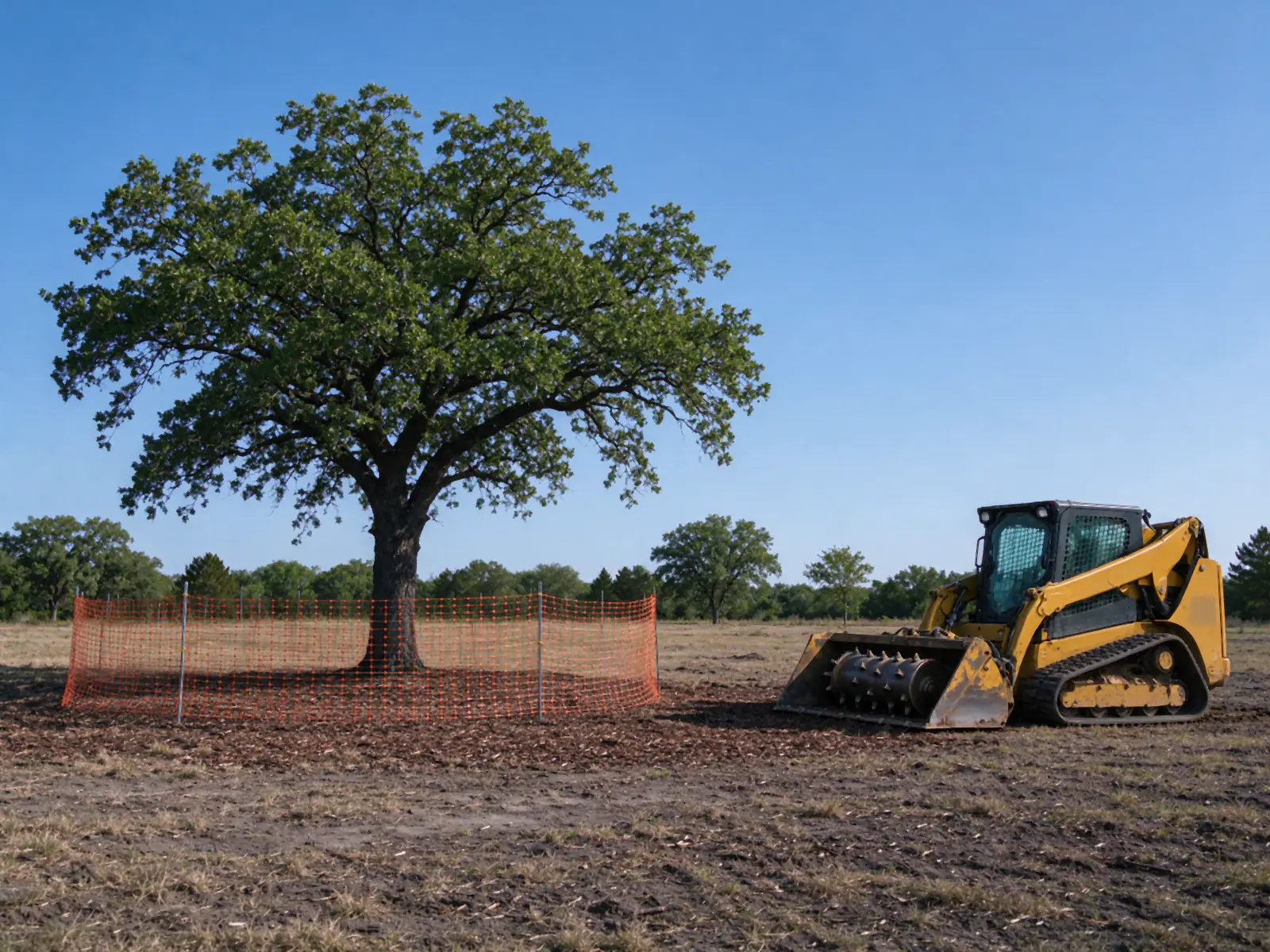
The order matters for scheduling. Orange protection fencing at least 4 feet tall goes up around the trees that stay, and the fencing inspection has to pass before the permit is issued. The permit then runs for 180 days or the life of the associated building or clearing permit. Which trees count, and how heritage, quality and secondary classes work, is laid out in the Denton tree removal permit guide.
Exemptions still go through the city
The city’s position is that any tree to be removed requires a permit submittal, and exemptions may apply. Property with an existing single-family or duplex home is exempt, as are dead or diseased trees documented by a qualified professional, storm hazards, trees on the state noxious and invasive list, narrow understory cuts for surveys and borings, and agricultural operations. The owner or contractor claims the exemption through Building Safety on eTRAKiT with a site plan or aerial, photos and the signed form. If the city accepts it, no fee is charged, so the higher fee only bites where the rules truly apply.
Who needs the clearing and grading permit
Almost any machine clearing inside city limits does. The Denton Development Code requires a permit for clearing, grading, grubbing, stockpiling or excavating unless the work disturbs no more than 25 cubic yards and no more than 2,000 square feet, stays out of watercourses, and sits outside floodplains and other environmentally sensitive areas.
That threshold is small. A quarter-acre lot is about 10,900 square feet, so clearing most of one goes over it. The permit lasts one year, and the city can refuse it when erosion and sediment controls are inadequate, which is why silt fence and ground cover belong in the plan from the start, as erosion control explains. Starting without the permit carries its own $453 fee, on top of the cure period, stop-work order and possible referral to TCEQ the code sets out. Lots near creeks need an ESA field assessment first; clearing near creeks and floodplains covers that step.
Why farm land can still owe the clearing fee
The two sets of rules treat agriculture differently. Agricultural operations are exempt from the tree preservation rules, so a working farm tract may owe no tree permit fee and no mitigation. The clearing and grading permit’s exemption covers only soil disturbance from normal crop operations, and it excludes tree removal in plain words.
A landowner pushing out a cedar or hackberry fence row on ag land inside the city can therefore be exempt on the tree side and still need the $453 clearing permit. The ag exemption and land clearing guide separates the property tax valuation from these permit questions, since one does not settle the other, and pasture clearing covers the work itself.
How the new fees move a clearing budget
On a large tract the permit increase is small next to the clearing itself; on a small lot it is a visible share of the bill. Clearing moderate brush with small trees runs a typical $2,500 to $4,500 an acre in North Texas, while the two permits are flat per-permit charges that cost the same on a half-acre lot as on twenty acres.
Mitigation is the line that moves most, and it scales with the trees rather than the acreage. Post oak counts as a heritage tree from 6 inches across, and each inch of heritage tree removed calls for 2.5 inches of replacement. Take a 10-inch post oak: removing it creates 25 inches of replacement, and paid as a fee each of those inches is $200, before the automatic state-law credit the code applies. Quality trees replace at 2 inches per inch, secondary trees at 4 inches per tree. Keeping trees changes that arithmetic, which is the case for selective clearing on wooded Denton lots, where the code already requires at least 30% of heritage and quality diameter to stay.
Debris costs did not change. Open burning is not allowed inside city limits, so brush is mulched in place, chipped or hauled; the City of Denton Landfill still takes brush at $30 a ton for city customers with pieces 12 feet or shorter, $35 for longer brush and $40 for non-city customers, with a $26.50 minimum per load. Land clearing debris removal explains how haul-off is priced.
For a full budget, the land clearing cost per acre guide shows where permits and mitigation sit next to the clearing price, and the land clearing cost calculator gives a starting range. A quote for lot clearing inside city limits should say who files each permit and whether fees and mitigation are inside the price; what a land clearing quote should include lists those lines.
Clearing inside Denton city limits?
The walk-through lists the permits, flags the trees that drive mitigation, and sets the clearing method around what stays.
The code keeps moving, so check before you file
Denton reviews its development code and its fee schedules from time to time, and either can change the numbers in this note. The fees above are the current City of Denton schedule. Before budgeting a permit, confirm the amount with Building Safety, and confirm the tree classes and replacement rates in the code that is in force when the application goes in. These fees apply inside Denton city limits only; land in the extraterritorial jurisdiction and in neighboring towns follows other rules, confirmed per address, and the clearing land in Denton guide maps those differences.
If a lot inside the city needs clearing, Call (940) 204-6191 or send the address and a few photos, and the walk-through will turn the fee schedule into a line-by-line plan for that property.